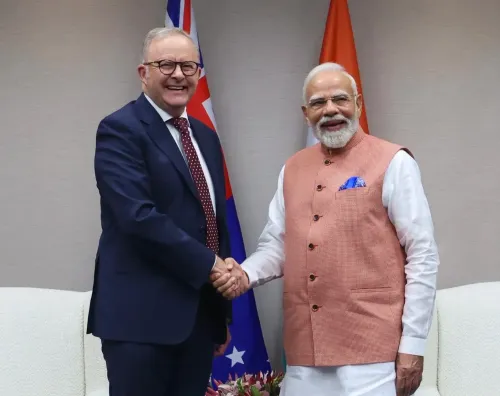
PM Modi at Australia CEO Forum: India, Australia natural partners for trade
Synopsis
Modi's Melbourne address was more than diplomatic courtesy — it was a structured investment pitch. From uranium-linked nuclear targets to $4 trillion Australian pension funds, he mapped Australia's resources and capital directly onto India's infrastructure and energy gaps, framing the bilateral relationship as a strategic economic hedge against global uncertainty.
Key Takeaways
PM Modi addressed the India-Australia CEO Forum in Melbourne on 9 July , calling both nations 'natural and trusted partners'.
India-Australia exports have doubled since the ECTA came into force in 2022 ; a Comprehensive Economic Cooperation Agreement is now under negotiation.
India targets 500 GW of renewable energy by 2030 and 100 GW of nuclear energy by 2047 , with Australia's uranium reserves cited as a direct link.
India is building highways at 34 km/day and laying 8+ km of railway track daily , with Australian pension funds — managing over $4 trillion — invited to invest.
The Indian government has committed more than $10 billion to its AI Mission , Quantum Mission , and Semiconductor Programme .
Modi proposed state-to-state and sector-to-sector partnerships to move the relationship beyond capital-level engagement.
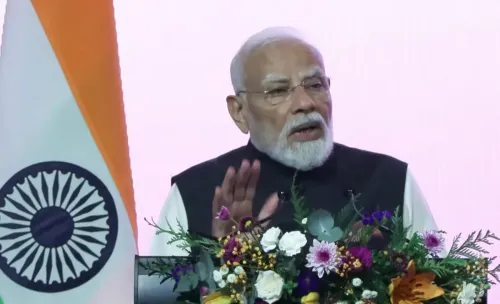
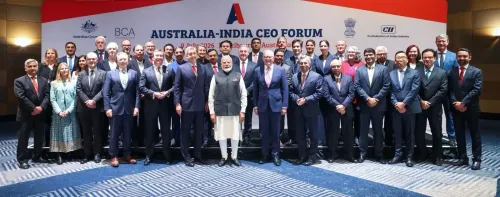
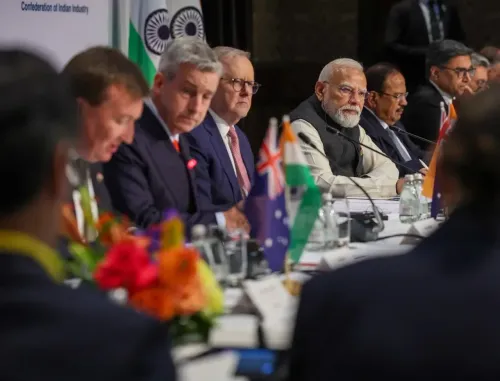
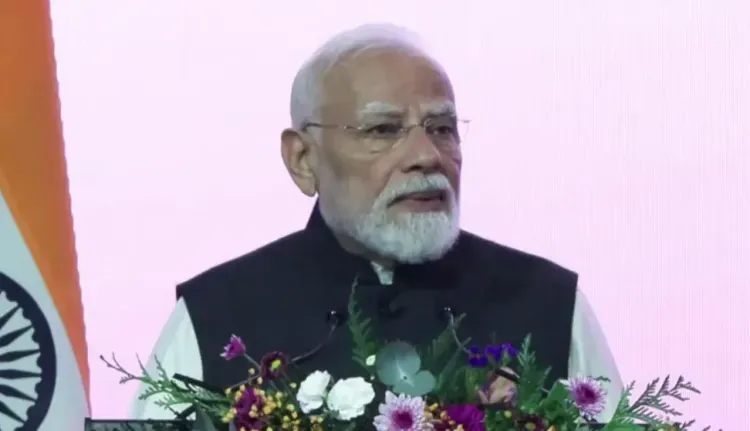
Prime Minister Narendra Modi on Thursday, 9 July called India and Australia 'natural and trusted partners' at the India-Australia CEO Forum in Melbourne, urging business leaders from both nations to deepen collaboration across clean energy, infrastructure, artificial intelligence, and education amid what he described as a period of global uncertainty and supply chain disruption.
Setting the Stage: A Partnership Built on ECTA
Addressing the Economic Roadmap Business Reception, Modi pointed to the India-Australia Economic Cooperation and Trade Agreement (ECTA), concluded in 2022, as a foundational milestone. 'Since its implementation, exports from India to Australia have doubled, and businesses in both countries have benefited from new market access,' he said. The two sides are now reportedly advancing negotiations toward a Comprehensive Economic Cooperation Agreement (CECA), signalling ambitions well beyond the initial trade pact.
Clean Energy and Nuclear: Where Resources Meet Ambition
Modi highlighted India's target of 500 gigawatts of renewable energy capacity by 2030 and Net Zero emissions by 2070, describing Australia's technological expertise, financial resources, and natural reserves as critical enablers. 'We are building a manufacturing ecosystem in India for hydro projects, green hydrogen, solar modules, and windmills,' he told clean energy executives at the forum.
In a notable policy reference, Modi said India had recently opened its nuclear sector to private companies and set a target of 100 gigawatts of nuclear energy by 2047. He directly linked Australia's uranium reserves to India's nuclear ambitions, framing the two countries' resource complementarity as a strategic advantage.
Infrastructure at Scale: The Investment Case
The Prime Minister invited Australian long-term investors — particularly large pension funds — to participate in India's infrastructure expansion. He cited specific metrics to underscore the pace: national highways are being built at roughly 34 kilometres per day, while more than 8 kilometres of railway track are being laid daily. 'This represents a convergence of scale, speed, and stability,' he said.
Addressing the managers of Australia's pension sector — which he noted oversees assets worth more than $4 trillion — Modi offered an assurance: 'India offers your funds opportunities for safe, stable, and sustainable growth. Our endeavour will be to ensure that both your trust and your capital grow.'
Technology, Education, and the Next Frontier
On emerging technologies, Modi said the Indian government has committed more than $10 billion toward its AI Mission, Quantum Mission, and Semiconductor Programme, and called for joint development of data centres, quantum technology, and digital public infrastructure. He also pointed to the presence of Deakin University and the University of Wollongong at GIFT City in Gujarat as evidence of growing educational ties, urging both sides to convert student mobility into structured talent partnerships.
What Comes Next
Concluding his address, Modi proposed moving beyond capital-to-capital engagement toward specific state-to-state and sector-to-sector partnerships, involving cities, universities, and industries across both countries. The push comes as India seeks to diversify its strategic economic relationships and as Australia recalibrates its own Indo-Pacific posture. Whether the ambitions outlined in Melbourne translate into binding agreements will depend on the pace of CECA negotiations and the appetite of Australian institutional investors for India's infrastructure pipeline.
Point of View
Not a diplomatic formality — matching Australia's specific assets (uranium, pension funds, university networks) to India's specific deficits (energy transition capital, infrastructure finance, talent pipelines). That precision is new. The open question is whether institutional follow-through matches the rhetorical architecture: ECTA took years to operationalise, and CECA negotiations have stalled before. Australian pension funds, meanwhile, have historically favoured more liquid markets. The nuclear framing is the most consequential signal — linking uranium supply to a 100 GW target by 2047 is a long-horizon commitment that will require treaty-level coordination, not just forum speeches.
NationPress
9 Jul 2026
Frequently Asked Questions
What did PM Modi say at the India-Australia CEO Forum in Melbourne?
Prime Minister Narendra Modi on 9 July described India and Australia as 'natural and trusted partners' and called on businesses from both nations to deepen ties across clean energy, infrastructure, AI, and education. He cited doubled exports under ECTA and outlined plans for a Comprehensive Economic Cooperation Agreement.
What is the India-Australia ECTA and why does it matter?
The India-Australia Economic Cooperation and Trade Agreement (ECTA), concluded in 2022, is a bilateral trade pact that has reportedly doubled India's exports to Australia since implementation. It is now being upgraded to a broader Comprehensive Economic Cooperation Agreement (CECA) covering more sectors and investment flows.
How is Australia linked to India's nuclear energy plans?
India has set a target of 100 gigawatts of nuclear energy by 2047 and recently opened the nuclear sector to private companies. Modi directly referenced Australia's vast uranium reserves as a key input into India's nuclear journey, framing it as a natural area of bilateral cooperation.
Why did Modi specifically address Australian pension funds?
Australian pension funds manage assets worth over $4 trillion, making them among the largest pools of long-term institutional capital globally. Modi invited them to invest in India's infrastructure sectors — ports, airports, highways, and railways — positioning India as a stable, high-growth destination for patient capital.
What technology investments has India committed to that were highlighted at the forum?
The Indian government has committed more than $10 billion toward its AI Mission, Quantum Mission, and Semiconductor Programme. Modi invited Australian partners to collaborate on data centres, quantum technology, semiconductors, and digital public infrastructure.