India's Resilience: Projected 6.4% Growth Amid Iran War Fallout, Reports ESCAP
Synopsis
India is projected to maintain its status as the fastest-growing large economy in the Asia-Pacific region, achieving a growth rate of 6.4% despite challenges posed by the Iran conflict, according to ESCAP. This growth is driven by robust consumption and a strong services sector.
Key Takeaways
India's GDP growth projected at 6.4% this fiscal year.
Fastest-growing large economy in the Asia-Pacific region.
Robust rural consumption and GST cuts fueled growth.
Services sector is crucial for economic resilience.
Targeted fiscal support for vulnerable populations enhances spending capacity.
United Nations, April 21 (NationPress) Amid the repercussions of the energy crisis caused by the Iran conflict, India is set to maintain its position as the fastest-growing large economy in the Asia-Pacific region, achieving a growth rate of 6.4 percent this fiscal year, as reported by ESCAP, the UN agency focused on the region's economic development.
The report, unveiled on Monday by the Economic and Social Commission for Asia and the Pacific (commonly referred to as ESCAP), indicates that India’s real Gross Domestic Product (GDP) growth has slowed from 7.4 percent last fiscal year, with expectations of a rise to 6.6 percent in the following fiscal year.
The forecasts for this fiscal year were based on conditions as of March 17, coinciding with the Iran conflict and the initial impacts of the Strait of Hormuz closures.
As the Asia-Pacific region serves as a significant growth engine for the world, India's leading position in this region also reflects its status as the top global growth economy.
The report estimates the GDP growth for the broader region, stretching from Japan to Turkey, at 4.1 percent last year, projecting a decline to 3.5 percent this year, with a slight recovery to 3.8 percent next year.
China’s growth was recorded at 5 percent last year, with projections of 4.3 percent this year and 4.5 percent next year.
Pakistan exhibited the weakest growth in South Asia, with a rate of 3 percent last year, expected to drop to 2.6 percent this year and rise to 3.1 percent next year.
India’s robust growth last year was primarily driven by strong consumption, especially from the rural sector, alongside reductions in the Goods and Services Tax rates, as highlighted in the report.
Additionally, U.S. importers increased their imports from India in anticipation of high tariffs, contributing to this growth.
However, economic activity showed a slowdown in the latter half of 2025, as exports to the United States fell by 25 percent due to the implementation of 50 percent tariffs in August 2025.
Throughout these fluctuations, the services sector has remained a crucial driver of growth.
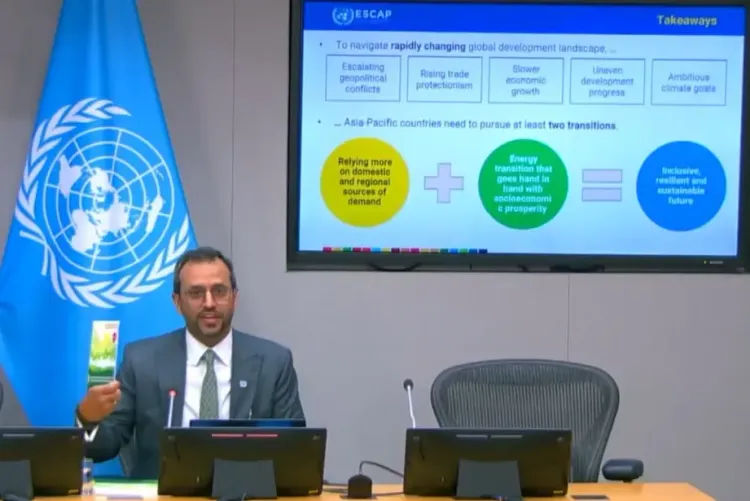
Hamza Malik, ESCAP’s Director of Macroeconomic Policy and Financing, emphasized that despite external challenges, India has managed to sustain growth due to productivity improvements.
In a press briefing accompanying the report release, he stated, “Ultimately, the sustainability of this growth rate hinges on the country’s productivity. If productivity is on the rise, maintaining high growth levels becomes feasible.”
Another key factor is India’s vast population, which enhances its capacity to absorb labor into productive sectors.
He noted, “There is a greater absorptive capacity for labor in productive areas.”
India’s targeted fiscal assistance for vulnerable populations will also bolster its resilience against global challenges.
Malik pointed out that India has a relatively higher capacity compared to many nations to provide fiscal support for at-risk populations, which would enhance their spending ability.
“Identifying vulnerable populations is not difficult; those heavily reliant on food, for example, will require more support as food prices rise,” he stated.
Point of View
India's sustained growth amidst external challenges reflects its robust economic framework and adaptability. The figures presented by ESCAP highlight a balanced approach to economic resilience, focusing on productivity and targeted support for vulnerable populations.
NationPress
16 Sept 2026
Frequently Asked Questions
What is India's projected GDP growth for this fiscal year?
India's GDP is projected to grow at 6.4% during the current fiscal year.
How does India's growth compare to other countries in the region?
India is the fastest-growing large economy in the Asia-Pacific region, while China's growth is projected at 4.3% this year.
What factors contributed to India's economic growth?
Robust consumption, especially from the rural economy, and reductions in GST rates have supported India's growth.
What impact did the Iran conflict have on India's economy?
The Iran conflict led to an energy crisis; however, India has managed to maintain a strong growth rate despite these challenges.
What role does the services sector play in India's economy?
The services sector remains a key driver of growth for India, contributing significantly to its GDP.