IMF Chief Highlights India’s Economic Resilience Amid Global Challenges
Synopsis
India's economy is set to remain strong despite global slowdowns, according to IMF Managing Director Kristalina Georgieva. With solid fundamentals and policy improvements, India is outperforming many other nations.
Key Takeaways
India's growth rate is over twice the global average.
Strong policy frameworks contribute to India’s economic resilience.
Emerging markets have improved their monetary policies significantly.
Rising energy prices pose a risk to energy-importing countries .
India's robust domestic demand aids its economic performance.
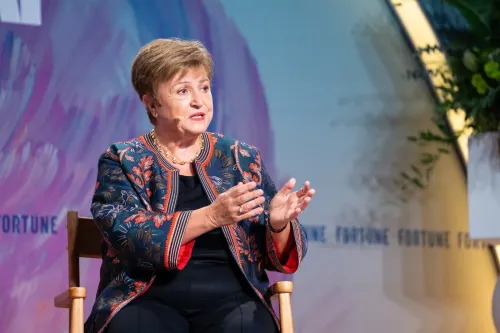
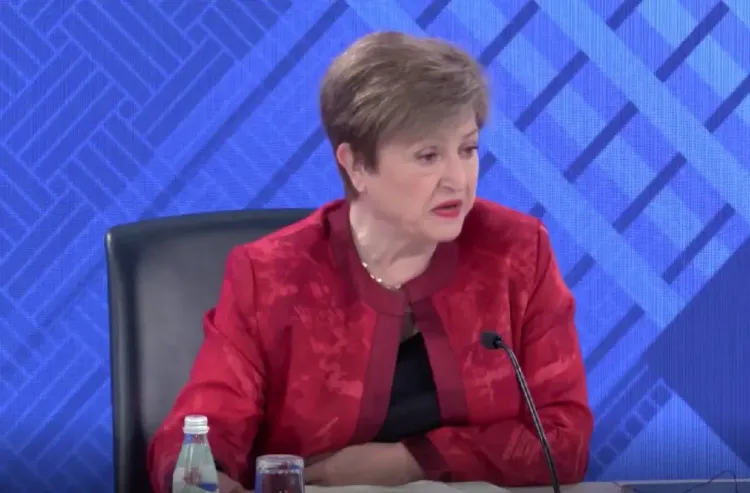
Washington, April 16 (NationPress) The International Monetary Fund's Managing Director, Kristalina Georgieva, has emphasized that India's economy is poised to remain steadfast, even as global growth experiences a downturn fueled by conflicts, thanks to its robust fundamentals that enable it to surpass many other economies.
“Examine India today. Its growth rate is over twice that of the global average,” Georgieva stated during a press conference at the IMF Spring Meetings on Wednesday (local time).
She credited India's comparative strength to ongoing policy enhancements and the institutional capabilities developed over the years. “This resilience stems from the strength of fundamentals,” she remarked, highlighting that nations with solid macroeconomic frameworks are more equipped to handle external challenges.
According to Georgieva, emerging market economies, including India, have made significant strides in refining their policy frameworks, especially in monetary policy. “In terms of monetary policy, they are performing at par with or even better than advanced economies,” she noted, while also pointing out that there is still a need for further advancements in fiscal policy.
She added that this development has played a vital role in creating a more resilient global economy. “Our world is more resilient due to the strength of several emerging market economies that have established independent central banks, fiscal councils, and accumulated substantial reserves,” she explained.
However, she warned that a prolonged conflict in the Middle East could adversely impact all economies, including India. “In a negative scenario, we can expect a slowdown in global growth,” she stated, adding that global expansion might fall to as low as 2 percent if hostilities continue.
The repercussions are anticipated to be particularly pronounced for energy-importing nations. Georgieva pointed out that rising oil and gas prices would influence all countries, but the effects would be disproportionate. “The negative repercussions are highly uneven, with the heaviest burdens on energy-importing nations,” she emphasized.
India, along with other Asian countries, faces additional challenges due to its reliance on energy imports from the Gulf region. “Asia is significantly affected by this dependence on imports,” Georgieva remarked, though she acknowledged that the region’s strong policy history is helping to mitigate the impact.
Despite these challenges, she asserted that nations like India, characterized by strong domestic demand, institutional resilience, and credible policies, are likely to outshine their counterparts. “We do not foresee a situation leading to a dramatic downturn,” she said, while cautioning that financial stability remains a crucial risk to keep an eye on.
India has emerged as one of the fastest-growing major economies in recent years, bolstered by robust domestic consumption, increased infrastructure investment, and reforms aimed at enhancing the ease of doing business. Its growth path has consistently surpassed global averages, positioning it as a key player in Asia's economic expansion.
Point of View
It is clear that India is navigating the current global economic landscape with resilience. The emphasis on strong fundamentals and policy frameworks highlights the nation's potential to emerge as a leader in economic growth, reinforcing its position amidst global uncertainties.
NationPress
16 Sept 2026
Frequently Asked Questions
What did IMF Chief Kristalina Georgieva say about India's economy?
She stated that India's economy is expected to remain resilient, with a growth rate over twice the global average, supported by strong fundamentals and policy improvements.
How have emerging market economies improved their policy frameworks?
According to Georgieva, emerging markets, including India, have made significant enhancements in their monetary policies, making them comparable to advanced economies.
What risks does India face amid global economic challenges?
India faces risks from rising energy prices and potential slowdowns in global growth, particularly due to conflicts in regions like the Middle East.
What factors are contributing to India's economic growth?
India's growth is driven by strong domestic demand, infrastructure investments, and reforms aimed at improving the business environment.
What is the outlook for global growth according to the IMF?
The IMF warns that global expansion could drop to as low as 2 percent if conflicts persist, impacting economies worldwide.