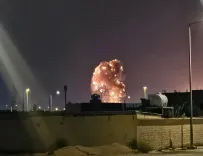
Iraq-Origin Drones Strike Kuwait Border Posts, No Casualties
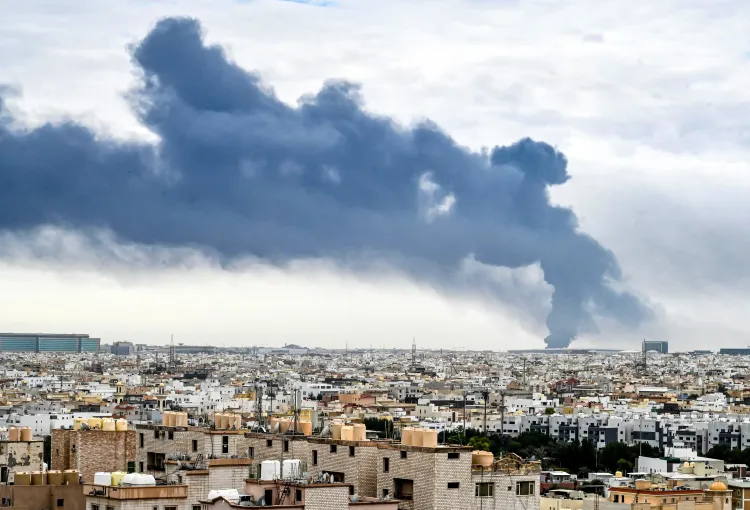
Synopsis
Iraq-origin fiber-optic guided drones struck two Kuwait northern border posts on April 24, causing material damage but no casualties. The attack is the latest in a series of Iran-linked assaults on Kuwait since February 2025, including a March 30 strike on a desalination plant that killed an Indian worker.
Key Takeaways
Two fiber-optic wire-guided explosive drones from Iraq struck Kuwait's northern border posts on Friday, April 24, 2025 , causing material damage but no casualties.
Kuwait's Ministry of Defence described the incident as a "sinful aggressive attack" and confirmed immediate emergency measures were activated.
On April 10 , Kuwait's armed forces intercepted seven hostile drones in Kuwaiti airspace within a single 24-hour period.
Iran attacked a Kuwaiti desalination facility on March 30 , killing one Indian worker and injuring members of the Kuwait National Guard .
Saraya Awliya al-Dam , an Iraq-based armed faction, claimed responsibility for shelling in Kuwait, Jordan, and Syria earlier in April 2025.
Kuwait International Airport is partially reopening with Terminals 4 and 5 resuming select operations from Sunday , following a suspension since February 28, 2025 .
Kuwait came under a drone attack on Friday, April 24, when two fiber-optic wire-guided explosive drones originating from Iraq struck military posts along the country's northern land border, Kuwait's Ministry of Defence confirmed. The ministry described the incident as a "sinful aggressive attack" that caused material damage but resulted in no human casualties. The attack marks a dangerous escalation in a pattern of cross-border hostilities that Kuwait has faced since early 2025.
Kuwait Defence Ministry's Official Statement
Kuwait's Ministry of Defence issued a formal statement confirming the assault, calling it a deliberate act of aggression. "This morning, two sites of the northern land border centers of the State of Kuwait were targeted in a sinful aggressive attack by two fiber-optic wire-guided explosive drones originating from the Republic of Iraq, resulting in material damage, with no human casualties recorded, praise be to God," the statement read.
The ministry affirmed that competent Kuwaiti authorities immediately activated emergency protocols and took all necessary measures to manage the aftermath of the incident. The use of fiber-optic guided drones — a technology that bypasses traditional radio-frequency jamming — signals a sophisticated and deliberate escalation by the attacking faction.
Pattern of Escalating Attacks Since February 2025
This latest drone strike is not an isolated incident. Kuwait has faced a sustained campaign of aerial aggression since early 2025, linked primarily to Iran-backed armed factions operating out of Iraq. On April 10, the Kuwait Army reported that seven hostile drones were monitored and neutralized within Kuwaiti airspace in a single 24-hour period.
Earlier in April, Saraya Awliya al-Dam, an armed faction based in Iraq, claimed responsibility for shelling incidents in Kuwait, Jordan, and Syria, according to Middle East Monitor. The group's simultaneous targeting of multiple countries suggests a coordinated regional destabilization effort, not opportunistic strikes.
On March 30, Iran carried out attacks on a power and water desalination facility in Kuwait, an assault that resulted in the death of an Indian worker — underlining the human cost of the ongoing regional conflict and its direct impact on South Asian expatriate communities in the Gulf.
Impact on Kuwait's National Guard and Civilian Infrastructure
The attacks have not been limited to military border posts. Kuwait's National Guard reported that Iranian aggression had previously targeted several of its vital facilities, leading to injuries among personnel who were subsequently treated and reported to be in stable condition. "The Iranian aggression resulted in targeting several vital facilities affiliated with the National Guard, leading to injuries among some of its members, who are currently receiving treatment with stable conditions, in addition to significant material damage," a military spokesperson stated.
The assault on a desalination facility on March 30 is particularly alarming. Kuwait relies almost entirely on desalinated water for its freshwater supply, making such infrastructure a critical national security asset. Attacking it constitutes not just a military provocation but a potential humanitarian threat to millions of residents.
Kuwait International Airport Reopening Amid Security Concerns
Amid the security turmoil, Kuwait has been cautiously restoring civilian aviation operations. On Thursday, April 23, Sheikh Humoud Mubarak Humoud Al-Sabah, Director General of Civil Aviation, announced the reopening of airspace at Kuwait International Airport, which had been under a precautionary suspension since February 28 due to regional security developments.
The Public Authority of Civil Aviation subsequently announced that Terminals 4 and 5 of Kuwait International Airport would reopen from Sunday for select destinations. Sheikh Humoud stated the decision was coordinated with local and international authorities to ensure operations resume under the highest safety standards, as part of a phased plan toward full airport restoration, according to Kuwait Times.
The aviation authority also confirmed it had completed assessments of damage sustained by airport facilities during previous Iranian-linked attacks, with maintenance and repairs actively underway. The phased reopening reflects Kuwait's attempt to project normalcy even as security threats persist.
Broader Regional Implications and What Comes Next
The repeated targeting of Kuwait — a GCC member state with historically neutral foreign policy postures — by Iran-backed militias signals a significant shift in the regional security calculus. Unlike more militarily assertive neighbors, Kuwait has traditionally relied on diplomacy and international alliances for security guarantees. These attacks test the limits of that strategy.
For the Indian community — one of the largest expatriate groups in Kuwait with over 1 million residents — the escalating violence poses direct personal risk, as evidenced by the Indian worker killed on March 30. New Delhi will likely face increasing pressure to issue updated travel advisories and engage diplomatically with Kuwait City and regional stakeholders.
As Kuwait pursues a phased restoration of civilian infrastructure and airport operations, the international community — including the United Nations and Arab League — faces pressure to hold accountable the factions and state actors behind these attacks. Further escalation in the coming weeks cannot be ruled out, particularly if diplomatic channels fail to produce a credible deterrent.
Point of View
With over a million nationals in Kuwait and one already killed in March, this is no longer a distant geopolitical story — it demands urgent diplomatic engagement. The pattern is clear: these are not random provocations but a calculated campaign to destabilize a strategically vital Gulf nation.
NationPress
19 Sept 2026
Frequently Asked Questions
What happened at Kuwait's northern border on April 24, 2025?
Two fiber-optic wire-guided explosive drones originating from Iraq struck two posts along Kuwait's northern land border on April 24, 2025. Kuwait's Ministry of Defence confirmed material damage occurred but no human casualties were recorded.
Who is responsible for the drone attack on Kuwait?
Kuwait's Ministry of Defence attributed the attack to drones originating from Iraq. Earlier in April, the Iraq-based armed faction Saraya Awliya al-Dam claimed responsibility for shelling in Kuwait, Jordan, and Syria, and Iran-backed groups have been linked to multiple attacks on Kuwait since early 2025.
Has Kuwait faced drone attacks before April 24, 2025?
Yes. On April 10, Kuwait's armed forces intercepted seven hostile drones in Kuwaiti airspace within 24 hours. On March 30, Iran attacked a Kuwaiti power and water desalination facility, killing an Indian worker and causing significant infrastructure damage.
Is Kuwait International Airport open after the attacks?
Kuwait International Airport partially reopened on April 24, 2025, after a precautionary suspension since February 28. Terminals 4 and 5 are set to reopen from Sunday for select destinations as part of a phased restoration plan.
How are Indians in Kuwait affected by these attacks?
An Indian worker was killed during Iran's March 30 attack on a Kuwaiti desalination facility, highlighting the direct risk to India's large expatriate community of over one million nationals in Kuwait. The escalating violence may prompt updated Indian government travel advisories for the region.