Why is the Radical Islamist Party Challenging Khaleda Zia's BNP Over the PR System?
Synopsis
In a heated political climate, the radical Islamist party Islami Andolan Bangladesh (IAB) has taken a strong stand against Khaleda Zia's BNP for opposing the Proportional Representation system. Their demands for reforms and a fair electoral process could reshape the upcoming February 2026 elections. Will the BNP reconsider its stance?
Key Takeaways
Islami Andolan Bangladesh criticizes the BNP's stance on the PR system.
Public support for electoral reforms is a contentious issue.
A referendum on PR has been proposed by the IAB.
Seven Islamic parties are advocating for changes to ensure fair elections.
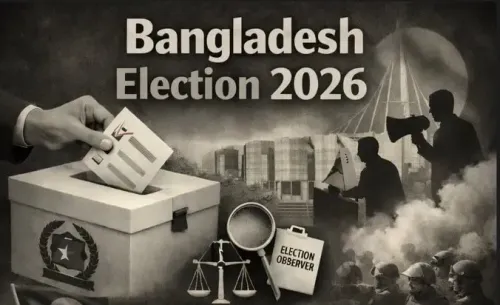
The February 2026 elections are pivotal for Bangladesh's democracy.
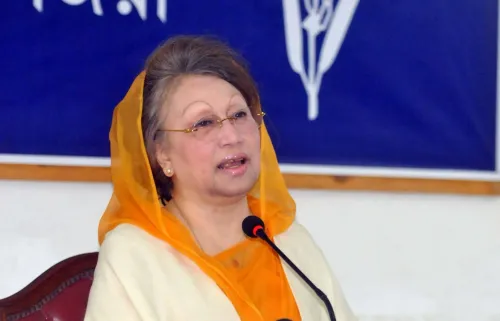
Dhaka, Sep 18 (NationPress) As the political tension intensifies ahead of the upcoming February 2026 elections, the radical Islamist party, Islami Andolan Bangladesh (IAB), has launched a strong attack on the Khaleda Zia-led Bangladesh Nationalist Party (BNP) for its opposition to the Proportional Representation (PR) system, despite claiming to have public backing, according to local media reports on Thursday.
"If the BNP genuinely believes in the people's will, why should they have an issue with PR? They could easily secure 90 percent of the votes and establish a single-party government with 270 seats; we wouldn't contest that. Why can't the BNP trust the public?" Mufti Syed Muhammad Faizul Karim, a leader of the IAB, was quoted in The Daily Star during a rally at Baitul Mukarram National Mosque in Dhaka.
"We should hold a referendum on PR. If the populace disapproves of it, we will retract our demands. Our demands are straightforward: reforms must be implemented, the July Charter must be legally recognized, trials must be visible, and elections must be conducted under the PR system. These are the people's demands," he asserted.
The IAB leader also expressed skepticism about the interim government led by Muhammad Yunus for not addressing their demands.
“If you move forward with elections before implementing reforms and trials, we will perceive the government as biased toward a particular party,” he warned.
Reports indicate that seven Islamic parties—including Jamaat-e-Islami, Islami Andolan, and Khilafat-e-Majlis—held separate rallies across Dhaka on Thursday, emphasizing common requests such as the implementation of the July Charter, the introduction of the PR system, and creating a fair environment for free, fair, and acceptable elections.
On Tuesday, Salahuddin Ahmed, a member of the BNP standing committee, reiterated that the party is completely against the PR system.
“We oppose PR in all contexts (both lower and upper houses). If any party desires it, they should include it in their manifesto and seek the people's mandate. Only if the public supports it can they legislate,” he stated.
The BNP leader criticized the three-day protest initiatives launched by the Islamist parties, labeling them as a deliberate attempt to disrupt the elections scheduled for next year.
The parties that previously allied with Yunus to oust the democratically elected Awami League government, led by Sheikh Hasina, are now embroiled in disputes over proposed reforms.
Point of View
It is crucial to recognize the ongoing political tension in Bangladesh. The clash between the IAB and BNP highlights the complexities of public opinion and electoral reforms. It is essential for all parties to engage constructively to ensure a democratic process that reflects the will of the people.
NationPress
19 Sept 2026
Frequently Asked Questions
What is the Proportional Representation system?
The Proportional Representation (PR) system is an electoral system where parties gain seats in the legislature in proportion to the number of votes they receive.
Why is the IAB opposing the BNP?
The IAB criticizes the BNP for opposing the PR system while claiming to have public support, questioning their trust in the electorate.
What are the main demands of the IAB?
The IAB demands electoral reforms, legal recognition of the July Charter, visible trials, and elections conducted under the PR system.
Who is Muhammad Yunus?
Muhammad Yunus is a prominent Bangladeshi social entrepreneur and politician who led the interim government.
What is the significance of the February 2026 elections?
The February 2026 elections will be crucial for determining the political landscape of Bangladesh amid ongoing tensions and reform demands.