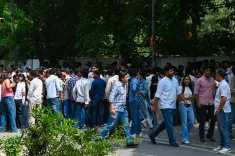
President Lee Jae Myung's Pledge to Uphold Democracy on 1960 Uprising Anniversary

Synopsis
On the anniversary of the 1960 pro-democracy uprising, President Lee Jae Myung reaffirmed South Korea's commitment to democracy, drawing lessons from history to combat contemporary threats against freedom.
Key Takeaways
President Lee Jae Myung emphasizes the need to protect democracy.
The April 19 uprising was a significant event leading to the removal of President Rhee Syng-man.
Public resistance is vital in combating anti-democratic actions.
Lee promises to honor the legacy of the uprising's victims.
The future of democracy hinges on the welfare of the people.
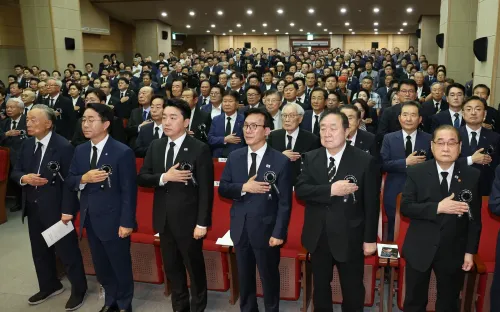
Seoul, April 19 (NationPress) On Sunday, South Korean President Lee Jae Myung underscored the critical need to protect democracy while commemorating the anniversary of the 1960 pro-democracy uprising that resulted in the removal of the nation’s first President, Rhee Syng-man.
In his address on the 66th anniversary of the "April 19 Revolution," Lee drew parallels between the people's resistance in 1960 and former President Yoon Suk Yeol's attempt at martial law in 2024, emphasizing that the "powerful voice" of the populace was instrumental in dismantling an "arrogant and unjust regime."
"The essence of the April 19 uprising, which put an end to the cruel dictatorship and was enshrined in the Constitution of the Republic of Korea, allowed South Korea to navigate through the dark times of insurrection in December 2024," Lee remarked at the April 19th National Cemetery in northern Seoul, where the remains of those who perished during the uprising are interred, as reported by the Yonhap news agency.
He emphasized the necessity of safeguarding democracy, stating, "Only by doing so can we thwart anti-democratic forces from seizing our freedoms once more and trampling on the invaluable daily lives of our citizens."
"The oppressive presence of dictatorship exacerbates the fissures of inequality and poverty, rationalizing the annihilation of democracy," Lee declared. "This is why I persistently assert that the core responsibility of governance is to ensure the well-being of the people, as their welfare is the fundamental reason for the existence of the state."
He pledged to carry forward a vision of a "democracy founded on freedom, equality, unity, and solidarity," which is "deeply ingrained in the DNA of the Korean populace."
Lee also extended his condolences to the families of the students and civilians who lost their lives during the uprising, committing to honor their sacrifice.
The civil revolt on April 19 was ignited by widespread public outrage over electoral fraud in the presidential elections orchestrated by the Rhee administration. A wave of nationwide student protests culminated on that day, resulting in numerous deaths and injuries among demonstrators during confrontations with armed police forces.
This uprising ultimately compelled Rhee to resign after a lengthy twelve-year tenure.
Point of View
It is imperative to recognize the significance of President Lee Jae Myung's remarks during the anniversary of the April 19 uprising. His commitment to democracy emphasizes the importance of historical lessons in protecting current freedoms and addressing societal inequalities. This reflection serves to unify citizens under the shared goal of safeguarding their democratic values.
NationPress
19 Sept 2026
Frequently Asked Questions
What is the significance of the April 19 uprising?
The April 19 uprising was a pivotal pro-democracy movement in 1960 that led to the ousting of South Korea's first president, Rhee Syng-man, in response to electoral fraud.
What did President Lee Jae Myung say about democracy?
President Lee emphasized the need to defend democracy and prevent anti-democratic forces from infringing on citizens' freedoms and livelihoods.
How did the uprising impact South Korea's political landscape?
The uprising marked a significant turning point that ended Rhee's twelve-year rule and laid the groundwork for South Korea's democratic development.
What was the public's reaction to the martial law efforts in 2024?
President Lee drew parallels between the past uprising and modern-day threats, indicating that public dissent is crucial in resisting oppressive governance.
What message did Lee convey to the families of the victims?
President Lee extended condolences to the families of those who lost their lives during the uprising, promising to honor their sacrifice.