South Korea's Lee Jae Myung vows zero compromise on workplace safety at Labour Day
Synopsis
In a historic first, South Korea's President Lee Jae Myung hosted Labour Day at Cheong Wa Dae, uniting two rival union federations and pledging zero compromise on workplace safety — while directly confronting AI-driven job anxiety with a firm 'people over productivity' stance.
Key Takeaways
President Lee Jae Myung pledged zero compromise on workplace safety at Labour Day on 1 May 2025 .
The event was held at Cheong Wa Dae for the first time , with 130 participants from labour, management, and government.
Both the Federation of Korean Trade Unions and the Korean Confederation of Trade Unions participated jointly — a historic first for the politically divided unions.
Lee addressed AI-driven job fears , saying it is "not right to ask workers to sacrifice themselves in the name of productivity." South Korea restored Labour Day to its original name and designated it a national public holiday earlier this year.
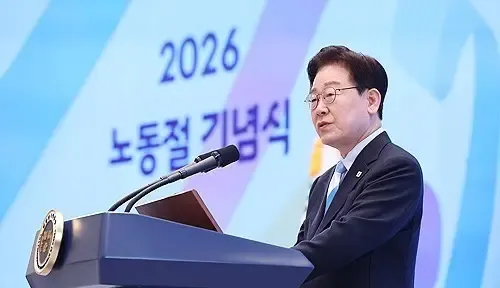
South Korean President Lee Jae Myung on 1 May 2025 pledged absolute commitment to workplace safety during his Labour Day address at Cheong Wa Dae (the Blue House), Seoul — marking the first time a Labour Day event has been held at the presidential complex. The address brought together 130 participants, including representatives from labour, management, and government, as well as workers from diverse occupations.
Key Commitments on Worker Safety
"I will neither compromise nor make concessions on workplace safety," President Lee said, vowing to build a "normal" country where no worker ever has to risk their life on the job. He described safeguarding workers as "the most basic responsibility of any nation and any business."
Lee also pushed back sharply against the long-held notion that worker welfare and business growth are mutually exclusive. "We can only move forward by breaking free from the outdated thinking that being pro-business means being anti-worker," he said. "Growth has a future only when labor stands behind it."
Addressing AI and Automation Fears
Amid growing public concern that artificial intelligence (AI) threatens jobs, President Lee sought to reassure workers that the government prioritises people over productivity metrics. "As technologies advance, the prevailing view is that machines powered by artificial intelligence will largely replace human labor," he acknowledged, before adding: "But it is not right to ask workers to sacrifice themselves in the name of productivity."
He called workers "the backbone of our economy," emphasising that growth which leaves workers behind is not growth at all — a pointed message at a time when AI adoption is accelerating across South Korean industries.
Historic Union Participation
The event also marked a significant political milestone: both major umbrella labour unions — the Federation of Korean Trade Unions and the Korean Confederation of Trade Unions, which are said to hold differing political views — participated together in such an event for the first time, according to Yonhap news agency.
This rare show of unity underscores the broad political significance Lee is attaching to labour rights at the outset of his presidency.
Labour Day Restored as National Holiday
South Korea had initially observed Labour Day on 1 May before the occasion was renamed "Workers' Day" in 1963. The government restored the original name last year and, earlier this year, designated it as a national public holiday — allowing all workers across the country to take the day off for the first time in decades.
Celebrations took place across the country, highlighting the value of work and its role in improving quality of life and driving economic growth. With Lee's presidency now firmly anchoring worker rights at the centre of national policy, the coming months will test whether legislative and enforcement action matches the rhetoric.
Point of View
Lee framed automation as a moral challenge, not merely an economic one. Whether his government's legislative record on workplace safety enforcement matches this rhetoric will be the real measure; South Korea has one of the higher industrial accident rates among OECD nations, and past administrations have made similar pledges without sustained follow-through.
NationPress
19 Sept 2026
Frequently Asked Questions
What did South Korean President Lee Jae Myung say on Labour Day 2025?
President Lee pledged zero compromise on workplace safety, calling it the most basic responsibility of any nation and business. He also addressed AI-driven job fears, arguing that growth which leaves workers behind is not growth at all.
Why was the Labour Day event at Cheong Wa Dae significant?
It was the first time a Labour Day event had been held at Cheong Wa Dae, South Korea's presidential complex. The event also saw both major rival union federations — the Federation of Korean Trade Unions and the Korean Confederation of Trade Unions — participate together for the first time.
How did Lee address concerns about AI replacing jobs?
Lee acknowledged that AI is widely expected to replace much of human labour but said it is not right to ask workers to sacrifice themselves in the name of productivity. He positioned people as a priority over automation-driven efficiency gains.
When did South Korea restore Labour Day as a national holiday?
South Korea restored the name 'Labour Day' last year after it had been called 'Workers' Day' since 1963, and designated it a national public holiday earlier in 2025, allowing all workers to take the day off.
Who attended the Labour Day event at Cheong Wa Dae?
Around 130 participants attended, including key figures from labour, management, and government, as well as workers from diverse occupations across South Korea.