How Did a Young Girl from Lucknow Reach NASA?
Synopsis
Discover the inspiring journey of Hashima Hasan, a girl from Lucknow who, after witnessing Sputnik in 1957, became a key figure in NASA's groundbreaking space missions, including Hubble and James Webb. This article chronicles her remarkable achievements and the challenges she overcame in her pursuit of a career in space science.
Key Takeaways
Hashima Hasan witnessed Sputnik as a child, igniting her dream of becoming a scientist.
She earned her doctorate in theoretical nuclear physics from Oxford University .
Hasan played a crucial role in the development of Hubble Space Telescope software.
She overcame societal challenges to become a leading figure at NASA .
Her journey exemplifies the importance of pursuing dreams in the STEM fields.
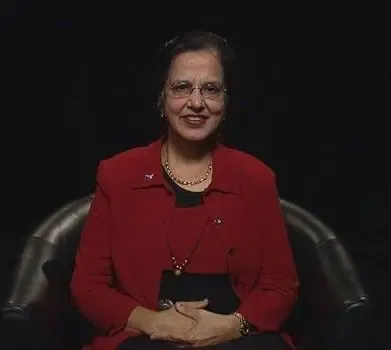
Washington, Feb 19 (NationPress) In October 1957, a young girl from Lucknow gazed up at the dawn sky, mesmerized by the sight of Sputnik soaring overhead. Fast forward nearly seventy years, and that same girl has played a pivotal role in guiding some of NASA's most intricate space telescopes, including Hubble and James Webb.
“The journey begins in October 1957, when I was just 7, and my grandmother gathered the entire family, including my 3-year-old sister and all the household staff, to witness the passing of Sputnik in the clear Lucknow skies,” wrote Hashima Hasan in a personal narrative shared by NASA on Wednesday.
“That morning, as I observed Sputnik against the dark, star-filled sky, I envisioned the impossible dream of becoming a space scientist one day.”
Hasan later secured a scholarship to Oxford University, earning her doctorate in theoretical nuclear physics in 1976. “The journey towards a conventional academic career for female scientists was laden with hurdles, amplified by societal expectations,” she recounted. After completing her post-doctoral work and holding faculty positions across three continents, she relocated to the United States in 1985 with her husband and two young sons.
At the Space Telescope Science Institute in Baltimore, she took on a research role to develop software for simulating the optics of NASA's latest telescope, the Hubble Space Telescope. Under the guidance of Dr. Christopher Burrows, she created the Telescope Image Modelling (TIM) software.
“Unbeknownst to us at the time, TIM would prove crucial in our analysis of the initial images post-launch, identifying and characterizing the spherical aberration, monitoring the telescope's focus, and conducting image simulations that allowed scientists to interpret their aberrated data,” she noted.
Hasan was designated as the Optical Telescope Assembly scientist, holding the unique position of being the first and only OTA scientist responsible for maintaining Hubble’s focus until a permanent solution was implemented. Every three months, focus adjustments were necessary to ensure optimal performance.
“I take pride in being part of the NASA team that transformed challenges into triumphs. The narrative of Hubble reflects NASA’s unwavering ‘can-do’ spirit,” she stated, commending the astronauts who serviced Hubble on five occasions.
In 1994, she joined NASA Headquarters as a visiting senior scientist under Dr. Edward Weiler. By 1999, she became a civil servant and took on the role of program scientist for Hubble, managing key instruments and contributing to servicing missions SM3A and SM3B.
Her journey with the James Webb Space Telescope began in 1995 when it was referred to as the Next Generation Space Telescope. She served as the NGST program scientist from 1999 to 2001 and as the JWST program scientist from 2011 to 2015, leading early technology development and complex negotiations with the European Space Agency and the Canadian Space Agency regarding the Mid-InfraRed Instrument.
“On the fateful day of September 11, 2001, we were reviewing proposals for MIRI management. Once again, we refused to let adversity deter us, and today MIRI along with all other scientific instruments are successfully integrated into JWST,” she expressed.
She referred to JWST as another embodiment of ‘Explore as One,’ where scientists, engineers, private sectors, and non-U.S. space agencies collaborated.
“I encourage all readers to pursue their dreams as I have and to remain undeterred as we continue to explore the Universe. The sky belongs to each of us,” concluded Hasan.
Hasan has held the position of NASA program scientist for numerous missions and acted as deputy program scientist for JWST.
Point of View
It’s crucial to highlight inspiring stories like that of Hashima Hasan, who not only broke barriers but also showcased the determination of women in science. Her journey from Lucknow to NASA epitomizes resilience and ambition, reminding us of the limitless potential within each individual. This narrative should resonate with readers and encourage a new generation to chase their dreams in STEM fields.
NationPress
24 Sept 2026
Frequently Asked Questions
What inspired Hashima Hasan to pursue a career in space science?
Hashima Hasan was inspired by witnessing Sputnik pass through the sky in 1957, which sparked her dream of becoming a space scientist.
What significant roles has Hasan held at NASA?
Hasan has served as a program scientist for multiple missions, including Hubble and James Webb, overseeing key instruments and contributing to servicing missions.
What challenges did Hasan face as a female scientist?
Hasan faced numerous societal pressures and obstacles as she pursued her academic career in a predominantly male field.
How did the TIM software contribute to the Hubble mission?
The TIM software played a vital role in analyzing initial Hubble images, identifying spherical aberrations, and aiding in image simulations.
What message does Hasan have for aspiring scientists?
Hasan encourages all aspiring scientists to pursue their dreams relentlessly and not be discouraged by challenges.