Punjab CMO: Jalandhar Police Narrows Space for Organised Crime
Synopsis
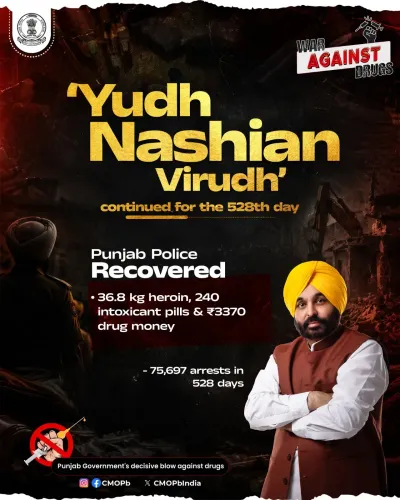
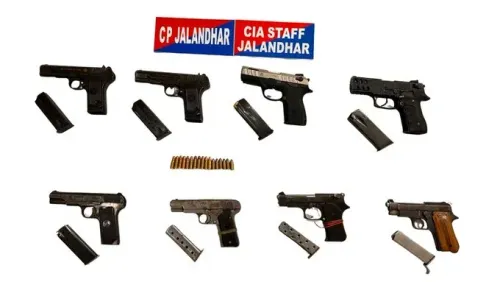
Commissionerate Police Jalandhar registered 1,201 NDPS cases and recovered 51 illegal pistols and 133 cartridges over seven months, the Chief Minister's Office of Punjab announced, citing parallel action under 'Gangstran Te Vaar' and the statewide 'Yudh Nashian Virudh' anti-drug drive.
Key Takeaways
1,201 cases registered under the NDPS Act by Commissionerate Police Jalandhar in the last seven months.
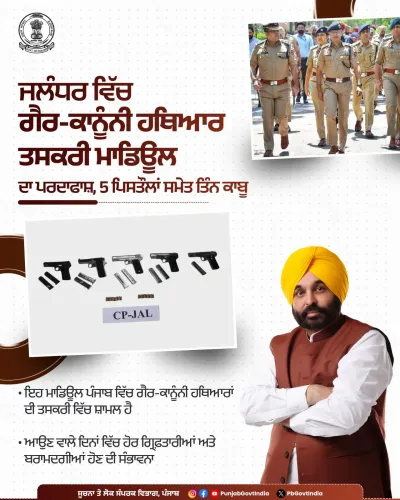
51 illegal pistols and 133 live cartridges recovered during the same period.
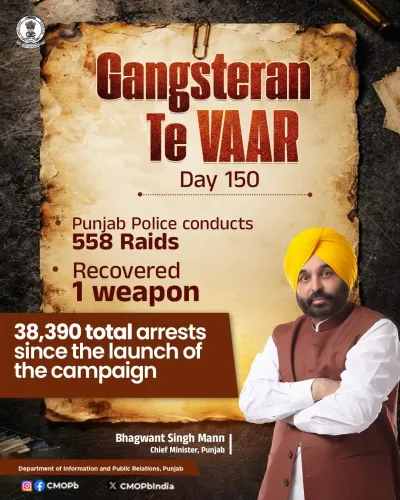
Campaign 'Gangstran Te Vaar' targets illegal arms suppliers, gang associates, and facilitators — not just end perpetrators.
Surveillance has been placed on individuals identified as supporting organised criminal groups as a pre-emptive measure.
The operation implements Punjab's statewide 'Yudh Nashian Virudh' anti-drug drive at the commissionerate level.
Jalandhar operates under the commissionerate police model introduced across Punjab's urban districts from 2022.
Over seven months, Commissionerate Police Jalandhar has registered 1,201 cases under the Narcotics Drugs and Psychotropic Substances (NDPS) Act, seized 51 illegal pistols and 133 live cartridges, and systematically dismantled the support networks that keep organised crime alive — a record the Chief Minister's Office of Punjab put on public record on Saturday, 8 August 2026.
What 'Gangstran Te Vaar' is targeting — and why it starts with arms
The parallel campaign Gangstran Te Vaar ('Strike Against Gangsters') is built on a deliberate logic: cut off the supply of weapons before violence occurs, rather than respond after the fact. Jalandhar Police has focused specifically on illegal arms suppliers, gang associates, and facilitators — the connective tissue that keeps criminal groups operational. Surveillance has been placed on individuals identified as supporting organised criminal networks, a pre-emptive posture that marks a shift from reactive policing.
The NDPS Act, 1985 — India's primary central legislation on narcotics — is the instrument of choice for the drug-trafficking prong of the operation. 1,201 cases in seven months translates to roughly 170 cases a month, a sustained enforcement tempo rather than a one-off sweep.
Jalandhar's commissionerate model and the statewide 'Yudh Nashian Virudh' drive
Jalandhar's enforcement push sits within two larger frameworks. The commissionerate police system — rolled out across Punjab's major urban districts from 2022 onwards — gave city police forces greater operational autonomy and direct accountability, replacing the older district-superintendent model. The results being reported now are, in part, a test of whether that structural change delivers on the ground.
Above that sits Yudh Nashian Virudh ('War Against Drugs'), the Punjab government's statewide anti-narcotics drive. Jalandhar's NDPS numbers are framed explicitly as an implementation of every project launched under Punjab Police's broader mandate — signalling that the commissionerate is not acting in isolation but feeding into a coordinated state strategy.
Punjab's long fight with cross-border narcotics and gangster networks
Punjab's proximity to the international border has made it a persistent transit and destination point for narcotics, with smuggling networks historically linked to cross-border flows and diaspora connections. Successive governments have launched anti-drug and anti-gangster drives; what distinguishes the current approach is the simultaneous targeting of both supply chains — drugs and illegal weapons — under named, branded campaigns that create public accountability benchmarks.
The stated objective, as the CMO post puts it, is to 'weaken criminal networks by restricting their access to weapons and dismantling their support systems before violence occurs.' Whether the numbers hold and whether the drive extends to remaining commissionerates will determine if this is a durable shift or a headline cycle.
Point of View
District-level metrics rather than broad claims. The dual-track approach of hitting drug networks under NDPS while simultaneously targeting arms supply under 'Gangstran Te Vaar' reflects a matured understanding that organised crime in Punjab is a supply-chain problem, not just a personnel one. If the commissionerate model continues to generate this kind of granular data, it could become the template for accountability-driven policing across other states. The real test, however, is sustainability: whether enforcement intensity holds beyond election cycles and whether prosecutions convert arrests into convictions.
NationPress
22 Sept 2026
Frequently Asked Questions
What is 'Gangstran Te Vaar' in Punjab?
'Gangstran Te Vaar' ('Strike Against Gangsters') is a Punjab Police campaign targeting illegal arms suppliers, gang associates, and facilitators linked to organised criminal groups, running parallel to the state's anti-drug drive.
How many NDPS cases did Jalandhar Police register in 2026?
Commissionerate Police Jalandhar registered 1,201 cases under the NDPS Act in the seven months leading up to August 2026, according to the Chief Minister's Office of Punjab.
What is the NDPS Act and how is it used in Punjab?
The Narcotic Drugs and Psychotropic Substances Act, 1985 is India's primary central law for prosecuting drug-related offences. Punjab Police uses it extensively in its 'Yudh Nashian Virudh' anti-drug drive across all districts.
What is the commissionerate police system in Punjab?
The commissionerate system, rolled out in Punjab's major urban districts from 2022, gives city police forces greater operational autonomy and direct accountability, replacing the older district-superintendent model.
What weapons did Jalandhar Police seize in the anti-gangster drive?
Commissionerate Police Jalandhar recovered 51 illegal pistols and 133 live cartridges during the seven-month period covered by the CMO's update.