CM Fadnavis: Homes for sanitation workers, water for Marathwada
Synopsis
Chief Minister Devendra Fadnavis on 6 November 2026 announced ownership-title housing for Maharashtra's sanitation workers, accelerated progress on the Marathwada Water Grid, and a pledge to house long-settled Mumbai residents within the city — three welfare commitments released in the CMO's Friday end-of-day summary.
Key Takeaways
Sanitation workers across Maharashtra are to receive homes with full ownership rights ( maalki hakkane ), upgrading from informal housing arrangements.
The Marathwada Water Grid , designed to address chronic water scarcity across eight eastern Maharashtra districts , has been given fresh momentum by CM Fadnavis.
Original Mumbai residents ( mool Mumbaikars ) will be guaranteed housing within Mumbai itself, countering displacement driven by redevelopment pressures.
All three announcements align with the central Pradhan Mantri Awas Yojana framework launched in 2015 , which provides federal housing assistance to states.
The CMO published the commitments as a structured Friday, 6 November 2026 daily summary on X, creating a timestamped accountability record.
Three announcements. Three distinct constituencies. And a single political message: Maharashtra's government is spending Friday, 6 November 2026 making concrete welfare commitments that go well beyond rhetoric. The Chief Minister's Office of Maharashtra released its end-of-day summary on X, flagging statements by Chief Minister Devendra Fadnavis on ownership housing for sanitation workers, acceleration of the Marathwada Water Grid project, and a housing guarantee for long-settled Mumbai residents.
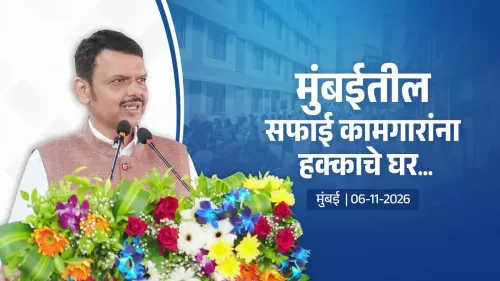
The post, in Marathi, opens with a declaration that lands squarely: 'स्वच्छता कर्मचाऱ्यांना मालकी हक्काने घरे देणार' — 'sanitation workers will be given homes with ownership rights.' That single line represents a meaningful shift from rental or transit accommodation models that have historically governed worker housing in Maharashtra's urban municipalities. Ownership rights mean legal title — a generational asset, not a temporary shelter.Sanitation workers and the ownership-title promise
Sanitation workers — the backbone of municipal waste management across Maharashtra's cities — have long lived in informal or semi-formal housing arrangements with no guaranteed tenure. By anchoring the announcement in 'ownership rights' (maalki hakkane), Fadnavis is signalling a policy upgrade that aligns with the central government's Pradhan Mantri Awas Yojana, launched in 2015, which provides federal funding to states for exactly this category of beneficiary. The state's challenge will be execution: beneficiary identification, land acquisition within city limits, and speed of construction.Marathwada Water Grid gets a push
The second announcement, on the Marathwada Water Grid, points to a region that needs little introduction to anyone who has tracked Maharashtra's annual drought bulletins. The Marathwada division — eight districts in eastern Maharashtra — faces chronic water scarcity driven by erratic rainfall and depleted reservoirs. The Water Grid concept, designed to inter-link water sources across the region and ensure equitable supply, has been discussed in state policy circles for years. CM Fadnavis signalling 'momentum' (gati) for the project suggests active movement on funding and implementation timelines, though specific figures were not disclosed in Friday's summary.Mumbai's 'original residents' and the housing squeeze
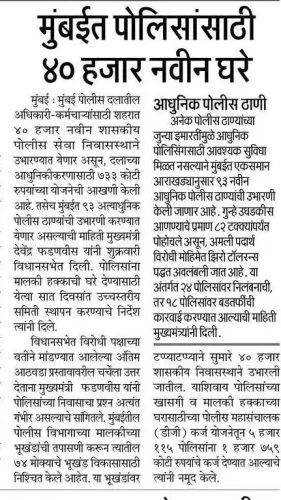
The third strand — housing for 'mool Mumbaikars', or original Mumbai residents — addresses one of India's most politically charged urban dilemmas. Mumbai, a city of roughly 20 million people, has seen long-term residents displaced by redevelopment cycles, sky-high real estate values, and slum rehabilitation schemes that do not always deliver promised units on time. The Chief Minister's assurance that original Mumbaikars 'will get homes in Mumbai itself' is a direct counter to the narrative that the city's poor and working class are being pushed to the periphery. It is also a politically resonant promise ahead of any municipal cycle — the Brihanmumbai Municipal Corporation being one of the most consequential civic bodies in India. Taken together, Friday's summary reads as a welfare trifecta: labour rights for the city's most invisible workers, water security for the state's most drought-stressed region, and housing dignity for Mumbai's oldest residents. The policy details — timelines, budgets, beneficiary counts — will be the real test of whether these commitments harden into delivery.The CMO's daily summary format itself is worth noting: by publishing structured end-of-day recaps, the government is building a public accountability trail. Every promise posted is now indexed, searchable, and timestamped.
Point of View
The sequencing matters: each announcement targets a distinct voter base — municipal workers, rural eastern Maharashtra, and the urban working class — without requiring a single unifying budget line to be disclosed. The CMO's daily-summary format is itself a governance-communication strategy, creating an indexed public record that is harder to walk back than a press conference. The real political test arrives when implementation timelines and beneficiary lists are published — that is when promises become policy, and policy becomes votes.
NationPress
7 Nov 2026
Frequently Asked Questions
What did CM Devendra Fadnavis announce for sanitation workers in Maharashtra?
CM Fadnavis announced that sanitation workers in Maharashtra will be given homes with full ownership rights, moving beyond rental or transit housing arrangements.
What is the Marathwada Water Grid project?
The Marathwada Water Grid is a regional infrastructure scheme designed to inter-link water sources across the eight drought-prone districts of the Marathwada division in eastern Maharashtra, ensuring more equitable and reliable water supply.
What does the Maharashtra government mean by housing for 'original Mumbaikars'?
The phrase refers to long-settled Mumbai residents who have faced displacement due to redevelopment cycles and high property values. CM Fadnavis pledged that these residents will receive housing within Mumbai itself, not on the city's outskirts.
How does Pradhan Mantri Awas Yojana connect to Maharashtra's sanitation worker housing scheme?
The Pradhan Mantri Awas Yojana, launched in 2015, provides central government funding to states including Maharashtra for urban and rural housing, and state-level schemes for occupational groups like sanitation workers can draw on this framework.
Where can I read the full details of Friday's Maharashtra government announcements?
The CMO of Maharashtra published links to full details on the official Mahasamvad portal in its 6 November 2026 end-of-day summary posted on X.