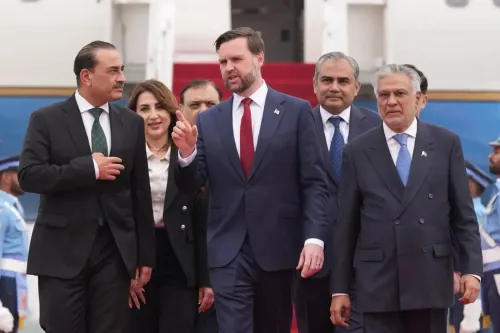
Pakistan branded 'active saboteur' in Iran-US talks, report finds
Synopsis
Despite Washington classifying Pakistan as a high-risk country and pausing its immigrant visas, the Trump administration has simultaneously handed Islamabad the role of mediating with Iran — a contradiction that a new report says has backfired spectacularly, with Iran branding Pakistan an 'active saboteur' of the very talks it was supposed to facilitate.
Key Takeaways
The US continues to use Pakistan as a mediator with Iran despite classifying it as a high-risk country alongside Afghanistan , Somalia , and Yemen .
Effective 21 January 2026 , the US Department of State paused all visa issuances to Pakistani immigrant visa applicants over public charge concerns.
Iranian MP Ebrahim Rezaei stated Pakistan "is not a suitable mediator" , accusing it of prioritising American interests.
Pakistani mediators allegedly failed to accurately convey Iranian positions and relayed unfulfilled US assurances, deepening the trust deficit .
Pakistan simultaneously issued a transit order allowing third-country goods to flow overland to Iran via six designated routes , reportedly undermining a US-backed naval blockade.
Independent reporting, per Greek City Times , describes Pakistan as an "overambitious but limited broker" that acted as an "active saboteur" .
The United States continues to rely on Islamabad for mediation in its standoff with Iran, even as Washington categorises Pakistan as a high-risk country alongside Afghanistan, Somalia, and Yemen, according to a detailed report published on Wednesday, 29 April 2025. The findings, cited by Greek City Times, paint a damaging picture of Pakistan's role as a broker — one that allegedly served American interests while undermining the very process it was meant to facilitate.
The Trust Deficit at the Core
Iran, according to the report, regards Pakistan's mediating role as fundamentally compromised by its perceived alignment with the US and Saudi Arabia. Iranian officials and state media have allegedly described Pakistan as a
Point of View
Freezes its immigrant visas, and entrusts it with one of the most sensitive diplomatic mandates in the region. That is less a coherent strategy than a symptom of limited options. For Iran, the damage is deeper — if a mediator is seen as a relay for the opposing side's terms rather than a neutral conduit, the process collapses before it begins. Pakistan's transit order allowing goods into Iran while ostensibly enforcing US pressure is the kind of double-dealing that destroys credibility in every direction at once. Islamabad may have overreached in seeking a strategic role it lacked the independence and leverage to fill.
NationPress
16 Sept 2026
Frequently Asked Questions
Why is Pakistan acting as a mediator between the US and Iran?
The Trump administration has reportedly entrusted Pakistan with conflict resolution efforts between the US and Iran, despite Washington's own classification of Pakistan as a high-risk country. The rationale has not been officially detailed, but analysts suggest limited alternatives and Pakistan's historic back-channel access to both sides.
What did Iranian MP Ebrahim Rezaei say about Pakistan's mediation?
Iranian MP Ebrahim Rezaei stated that Pakistan 'is not a suitable mediator', arguing it 'always takes [Trump's] interests into account and does not speak against the Americans' wishes.' He also accused Pakistan of failing to publicly criticise the US for backtracking on its commitments.
How did Pakistan undermine the US naval blockade of Iranian ports?
According to the Greek City Times report, Pakistan issued a transit order allowing third-country goods to flow overland into Iran via six designated routes, even while mediating a ceasefire that relied on US naval pressure. Critics described this as 'punching a legal hole' in the blockade.
What is the US visa policy on Pakistani applicants?
Effective 21 January 2026, the US Department of State paused all visa issuances to Pakistani immigrant visa applicants as part of a temporary review of screening procedures. The policy targets countries deemed high-risk for relying on US public benefits and affects consular processing, not visa petition approvals.
How has this affected Pakistan's credibility as a broker?
The report describes Pakistan as an 'overambitious but limited broker' whose efforts exposed its constrained influence. Iranian state media and television debates have openly questioned Pakistan's neutrality, with allegations of bias and procedural failures deepening what the report calls a 'trust deficit'.