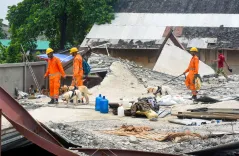
Pakistan hit by 5.4 magnitude quake hours after Friday tremor

Synopsis
Pakistan was jolted by two earthquakes within 24 hours — a 5.3 on Friday evening and a 5.4 on Saturday — with no casualties reported so far. The twin tremors are a reminder of Pakistan's acute seismic exposure where the Indian and Eurasian plates collide, even as Venezuela reels from a far deadlier sequence that has killed 920 and left 50,000 missing.
Key Takeaways
A 5.4 magnitude earthquake struck Pakistan on Saturday, 27 June , with no immediate deaths or structural damage reported.
The National Center for Seismology (NCS) confirmed the quake occurred at a depth of 75 kilometres ; the magnitude was revised between 5.3 and 5.5 before final confirmation.
A separate 5.3 magnitude tremor had struck Pakistan on Friday evening , less than 24 hours earlier.
Pakistan lies on the boundary of the Indian and Eurasian tectonic plates , making it one of the world's most earthquake-prone nations.
In Venezuela , twin quakes of 7.2 and 7.5 magnitude have killed 920 people, injured 3,360 , and left over 50,000 missing; 871 international rescue workers are on the ground.
A 5.4 magnitude earthquake struck Pakistan on Saturday, 27 June, according to the National Center for Seismology (NCS), with no immediate reports of casualties or structural damage. The tremor follows a 5.3 magnitude quake that rattled parts of the country just the previous evening, raising fresh concern over the region's seismic vulnerability.
What the NCS Said
In an official statement, the NCS confirmed the quake registered at a depth of 75 kilometres. Preliminary assessments had initially placed the magnitude at 5.4, later revised to 5.5, before the agency settled on a final reading of 5.3. Tremors were felt across several regions, though authorities reported no immediate casualties or property damage as of Saturday. Monitoring continues as further details are awaited.
Why Pakistan Remains Earthquake-Prone
Pakistan sits along the boundary where the Indian and Eurasian tectonic plates converge, making it one of the most seismically active zones on the planet. Saturday's event is the latest in a pattern of recurring tremors across the country and broader South Asian region. This sequence of back-to-back quakes — within roughly 24 hours — underscores the persistent geological risk faced by millions living in Pakistan's northern and western corridors.
Venezuela Earthquake: A Separate Catastrophe
Separately, a 4.9 magnitude aftershock struck off Venezuela's northern coast on Friday, two days after devastating twin earthquakes measuring 7.2 and 7.5 in magnitude caused widespread destruction across the country. Building collapses were reported in Caracas and surrounding areas. Venezuelan authorities confirmed the death toll has climbed to 920, with 3,360 people injured.
As of Friday afternoon, more than 50,000 people remain listed as missing, according to a dedicated government-run tracking portal. 871 international rescue workers were on the ground assisting relief operations, even as ongoing aftershocks complicated search and rehabilitation efforts.
Relief Efforts and What Comes Next
Emergency response teams in Venezuela remain engaged in large-scale operations, with disaster agencies on heightened alert. In Pakistan, authorities are continuing to monitor seismic activity following the two consecutive tremors. No evacuation orders or infrastructure damage alerts have been issued as of the latest available reports. The situation in both countries remains fluid, with agencies watching for further aftershocks.
Point of View
Not reassuring. Pakistan's seismic exposure is structural — the Indian-Eurasian plate boundary is one of the world's most active collision zones, and the country's building stock in vulnerable corridors remains largely unregulated. The absence of damage this time should not obscure the systemic risk. Meanwhile, the Venezuela disaster — 920 dead, 50,000 missing after 7.2 and 7.5 magnitude quakes — is a stark illustration of what happens when preparedness lags behind geological reality. India's own seismic monitoring infrastructure, including the NCS, deserves scrutiny over how quickly and accurately it communicates cross-border tremor data to the public.
NationPress
27 Jun 2026
Frequently Asked Questions
What magnitude was the earthquake that struck Pakistan on 27 June?
The earthquake that struck Pakistan on Saturday, 27 June was recorded at 5.4 magnitude by the National Center for Seismology (NCS), though readings were revised between 5.3 and 5.5 during preliminary assessments. No casualties or structural damage were reported immediately.
Was this Pakistan's first earthquake this week?
No. A 5.3 magnitude earthquake had struck parts of Pakistan on Friday evening, less than 24 hours before Saturday's tremor. The back-to-back quakes highlight the country's persistent seismic activity.
Why is Pakistan so vulnerable to earthquakes?
Pakistan sits along the convergence boundary of the Indian and Eurasian tectonic plates, one of the most seismically active collision zones on Earth. This makes the country especially prone to frequent and sometimes severe earthquakes.
What is the situation in Venezuela after the recent earthquakes?
Venezuela was struck by twin earthquakes of 7.2 and 7.5 magnitude, causing building collapses in Caracas and surrounding areas. The death toll has risen to 920, with 3,360 injured and over 50,000 people still missing as of Friday. A follow-up 4.9 magnitude aftershock struck off Venezuela's northern coast on Friday.
How many rescue workers are helping in Venezuela?
As of Friday afternoon, 871 international rescue workers were assisting relief operations in Venezuela. Emergency teams remain on the ground as aftershocks continue to complicate rescue and rehabilitation efforts.