Pakistan's Inaction on Trafficking Fuels Criminal Networks: Report
Synopsis
A report reveals that Pakistan's mishandling of trafficking cases contributes to the rise of organized crime. With thousands of disappearances recorded annually, the authorities' failure to treat these incidents as potential trafficking investigations undermines public trust and allows criminal networks to operate freely.
Key Takeaways
Pakistan's trafficking crisis is exacerbated by systemic failures.
Over 37,000 victims were identified last year.
Misclassification of cases allows criminal networks to thrive.
Efforts are needed to treat disappearances as serious crimes.
Addressing poverty and gender inequality is crucial in combating trafficking.
Islamabad, March 7 (NationPress) A recent report highlights that Pakistan is likely to witness ongoing disappearances concealed within administrative records instead of being treated as serious crimes, unless trafficking is acknowledged as both a humanitarian crisis and an institutional vulnerability. This oversight allows organized crime networks to thrive and diminishes the authorities' credibility.
As reported by 'The Friday Times', local police in the Sadiqabad area of Punjab province managed to reunite an elderly woman with her family on February 14 after her disappearance, an event that failed to capture national interest.
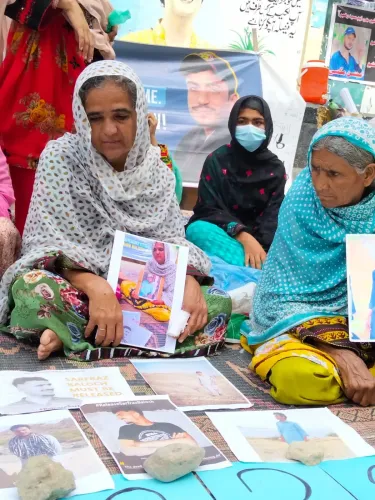
“In Pakistan, such successful outcomes are not commonplace. For every woman who is located, countless others vanish into situations later classified as abduction, migration, domestic conflicts, or voluntary exits. A crucial aspect often overlooked is the intersection of these disappearances with poverty, gender inequality, and organized trafficking networks,” the report noted.
Referencing the '2025 Trafficking in Persons Report' from the US Department of State, it stated that Pakistani authorities discovered 37,303 trafficking victims in the most recent reporting year, a rise from 29,113 the year before. Among the 26,613 identified victims of sex trafficking, over 21,000 were women, who also represented nearly half of the 9,917 forced labor victims.
“Many cases of trafficking initially emerge from missing persons reports: by the time exploitation is established, evidence has often vanished. For international observers, trafficking in Pakistan is frequently perceived primarily through the lens of cross-border migration routes, which is understandable,” it elaborated.
“Pakistan is significantly intertwined with regional and transnational trafficking networks. Routes lead westward through Balochistan into Iran, further to Turkey, and ultimately towards Mediterranean crossings in Europe. Others extend southward by sea to the Gulf states. Women are trafficked via both informal smuggling pathways and official visa processes, including work and pilgrimage visas that are subsequently misused. However, these cross-border pathways do not originate at the borders; they commence in local villages,” the report further explained.
Despite the annual registration of thousands of trafficking-related cases, the report indicated that conviction rates remain alarmingly low. Law enforcement agencies, such as Pakistan's Federal Investigation Agency (FIA), grapple with limitations in investigative capabilities, jurisdictional overlaps, and challenges with evidence.
“Many trafficking incidents do not start as trafficking inquiries. They begin as missing persons reports. By the time exploitation is confirmed, evidence has often dissipated, and victims face pressure from families or communities to avoid pursuing legal action,” a senior FIA official, speaking on condition of anonymity, shared with The Friday Times.
The report concluded, “Neglecting to view missing women cases as potential trafficking inquiries undermines institutional credibility. When disappearances are normalized as private family matters instead of being investigated as signs of organized crime, criminal networks can operate with relative freedom.”
Point of View
The findings of this report call for urgent attention. The systemic failures in addressing trafficking not only harm individuals but also reflect poorly on national governance. A robust response is essential to protect vulnerable populations and restore faith in law enforcement.
NationPress
30 Sept 2026
Frequently Asked Questions
What is the main issue highlighted in the report?
The report emphasizes Pakistan's failure to properly address trafficking cases, leading to the rise of organized crime and systemic neglect of disappearances.
How many trafficking victims were identified in Pakistan?
The report states that 37,303 trafficking victims were identified in the last reporting year, a significant increase from the previous year.
What factors contribute to trafficking in Pakistan?
Factors include poverty, gender inequality, and the connection between disappearances and organized trafficking networks.
What are the implications of misclassifying disappearances?
Misclassifying disappearances as private matters undermines institutional credibility and allows criminal networks to operate with little risk of repercussions.
What recommendations does the report suggest?
The report suggests treating missing persons cases as potential trafficking investigations to enhance accountability and protect victims.