Why is Public Support Vital for Balanced Regional Growth in South Korea?
Synopsis
South Korean President Lee Jae Myung highlights the critical role of public support in achieving balanced regional growth, aiming to decentralize resources from the Seoul metropolitan area while fostering new growth engines across the nation through strategic investments.
Key Takeaways
Public support is essential for balanced regional growth.
Focus on developing five major regional hubs.
Resistance from vested interests poses challenges.
Ulsan is a key player in the AI transformation .
Decentralization is a national survival strategy .
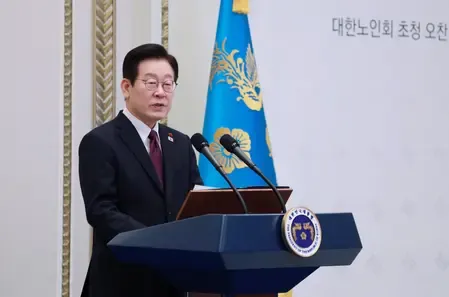
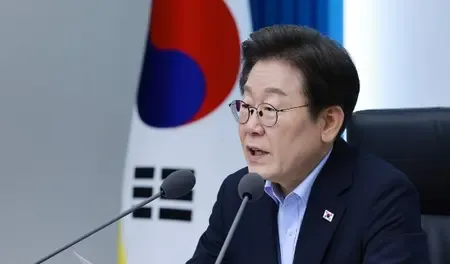
Seoul, Jan 23 (NationPress) South Korean President Lee Jae Myung emphasized on Friday that public backing is essential for the government's initiative to achieve balanced regional growth. This initiative aims to alleviate the overwhelming concentration in the Seoul metropolitan area and cultivate new growth engines throughout the nation.
During discussions, President Lee highlighted his administration's goal of establishing five significant regional hubs: the Seoul metropolitan area, the southeast, northeast, central, and western regions, in conjunction with three special self-governing provinces: Jeju, Gangwon, and North Jeolla.
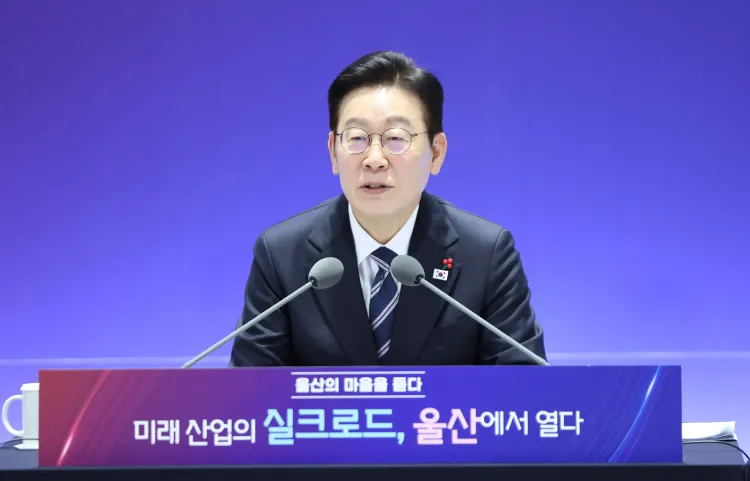
"Resistance is strong due to long-standing inertia and vested interests," Lee remarked at a town hall meeting in Ulsan. "During such challenging times, public awareness and support play a crucial role," as reported by Yonhap News Agency.
He pointed out that decades of resource concentration in the Seoul metropolitan area have reached a tipping point, citing skyrocketing housing costs and limitations on electricity and water supplies necessary for the establishment of new semiconductor facilities.
"Decentralization and balanced growth are not merely concessions but a strategy for national survival," he asserted.
Lee also underscored the importance of nurturing advanced industries like artificial intelligence (AI), urging Ulsan to embrace its strong manufacturing foundation and lead in the AI transformation.
As a significant industrial hub, Ulsan hosts large automotive, shipbuilding, and petrochemical complexes. Recently, SK Group announced plans to construct the nation’s largest AI data center in the city in collaboration with Amazon Web Services.
"Ulsan is a manufacturing titan with essential assets for future industries," he stated. "The AI transformation is an inevitable trend. If we cannot escape it, we must adapt rapidly and take the initiative."
Emphasizing the urgent need for an AI-centric industrial transition, Lee noted that South Korea must swiftly adapt, building upon its inherent competitive advantages, and pledged to bolster Ulsan as a key industrial center.
"Given Ulsan's strong fundamentals, we need to make concentrated investments here," he concluded.
Point of View
I believe that President Lee Jae Myung's call for public support in achieving balanced regional growth is a pivotal moment for South Korea. This initiative aims to redistribute resources and development opportunities beyond the Seoul metropolitan area, fostering a more equitable economic landscape. Public engagement will be crucial in overcoming resistance from entrenched interests, ensuring that the benefits of growth are shared nationwide.
NationPress
19 Sept 2026
Frequently Asked Questions
Why is public support important for regional growth?
Public support is vital as it helps overcome resistance from entrenched interests and ensures community engagement in government initiatives aimed at balanced regional growth.
What regions are targeted for development?
The government aims to develop five major regional hubs: the Seoul metropolitan area, southeast, northeast, central, and western regions, along with three special self-governing provinces: Jeju, Gangwon, and North Jeolla.
How does AI play a role in Ulsan's future?
Ulsan is set to become a leading hub for artificial intelligence, leveraging its strong manufacturing base to spearhead the AI transformation and drive industrial growth.