Should APEC Embrace AI-Driven Changes for Economic Growth?

Synopsis
In a pivotal address at the APEC summit, South Korean President Lee Jae Myung highlighted the imperative for member economies to leverage AI-driven changes for inclusive growth. His initiative, 'AI-Based Society for All,' aims to ensure equitable benefits from technological advancements, addressing demographic challenges and fostering a culture of innovation.
Key Takeaways
Embracing AI is crucial for economic growth.
South Korea's initiative aims for equitable technological benefits.
Demographic challenges require collaborative solutions.
A robust AI innovation ecosystem is being fostered.
The 'Gyeongju Declaration' will guide future APEC discussions.
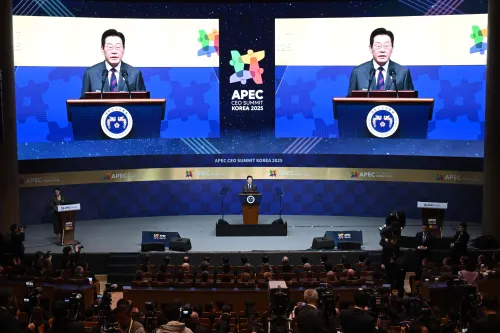
Gyeongju (South Korea), Nov 1 (NationPress) In a compelling address, South Korean President Lee Jae Myung urged the member economies of the Asia-Pacific Economic Cooperation (APEC) to recognize the transformative potential of artificial intelligence (AI) as a chance to foster inclusive economic growth. During the Retreat Session at the APEC summit held in the picturesque city of Gyeongju, Lee unveiled South Korea's initiative known as "AI-Based Society for All," aimed at leveraging AI for collective advancement.
"The Republic of Korea envisions a global AI society where individuals worldwide can equally reap the benefits of technological advancements and will consistently implement policies to bring this fundamental vision to fruition," Lee articulated, referencing South Korea's official designation.
"We must transform the significant changes brought about by AI into a valuable opportunity," he emphasized.
President Lee outlined South Korea's commitment to an "AI transformation" at the national level, fostering a robust ecosystem for AI innovation.
"We will enhance infrastructure, including expansive data centers, and implement regulatory reforms to cultivate an environment where global enterprises can innovate unimpeded," he stated.
Additionally, he called for unified efforts to tackle the challenges arising from low birth rates and an aging population, proposing a collaborative framework for APEC nations.
"Demographic shifts present substantial challenges impacting every facet of society, from economic growth and labor markets to education and welfare, and cannot be addressed through fragmented or isolated strategies," he noted.
In response to significant shifts driven by AI and demographic changes, South Korea is prioritizing the cultural and creative industries as a new engine for growth, as reported by Yonhap news agency.
During the session, APEC leaders are expected to endorse the "Gyeongju Declaration," summarizing this year’s discussions, alongside two documents addressing AI and demographic challenges.
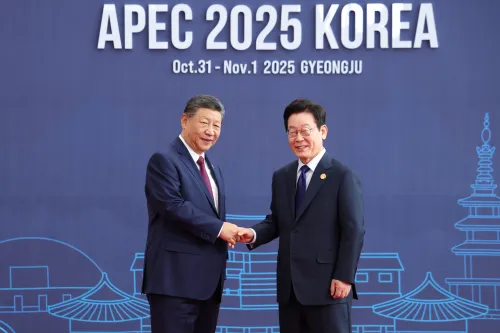
Following this, Lee will officially transfer the APEC chairmanship to Chinese President Xi Jinping, whose nation will host the upcoming summit.
After a group photo session, Lee is slated to conduct a press conference in his role as APEC chair to share insights on this year’s key outcomes.
Point of View
It is crucial to understand that President Lee's address at the APEC summit underscores a vital opportunity for collaboration among member nations. By advocating for an AI-driven approach to address demographic challenges and promote economic growth, South Korea positions itself as a leader in global innovation, fostering a future where technology benefits all.
NationPress
18 Sept 2026
Frequently Asked Questions
What is the main focus of President Lee's speech at APEC?
President Lee emphasized the need for APEC economies to embrace AI-driven changes as opportunities for inclusive economic growth.
What initiative did South Korea introduce at the summit?
South Korea introduced the 'AI-Based Society for All' initiative, aiming to ensure equitable access to the benefits of AI technology.
How is South Korea addressing demographic challenges?
President Lee proposed a collaborative framework for APEC nations to tackle issues related to low birth rates and aging populations.
What is the 'Gyeongju Declaration'?
The 'Gyeongju Declaration' is a document that encapsulates the outcomes of this year's APEC discussions, including strategies on AI and demographic challenges.
Who will take over the APEC chairmanship next?
Chinese President Xi Jinping will take over the APEC chairmanship, as China is set to host the next summit.