Is Trump Taking Control of Venezuelan Oil Reserves?
Synopsis
In a bold move, President Trump redefines US intervention in Venezuela as a long-term economic strategy. He emphasizes reclaiming oil resources, deterring rivals, and tackling drug trafficking, sending ripples far beyond Latin America. What does this mean for global dynamics?
Key Takeaways
US intervention in Venezuela is framed as a strategic economic move.
Control over oil resources is central to the US strategy.
The operation aims to deter rivals and curb drug trafficking.
Trump emphasizes a long-term commitment to stabilizing Venezuela.
Global oil prices may be affected by the restoration of Venezuela's production.
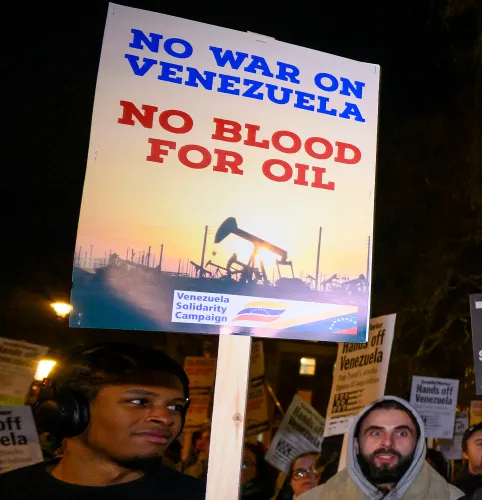
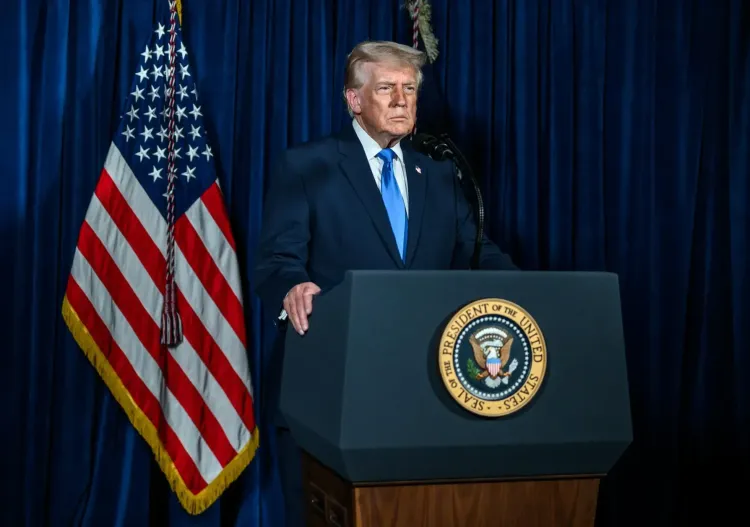
Washington, Jan 9 (NationPress) President Donald Trump is positioning the US involvement in Venezuela as a strategic economic and geopolitical shift rather than a mere temporary military intervention. He emphasizes that this move aims to reclaim control of oil resources, discourage competitors, combat drug trafficking, and send a resounding message beyond Latin America.
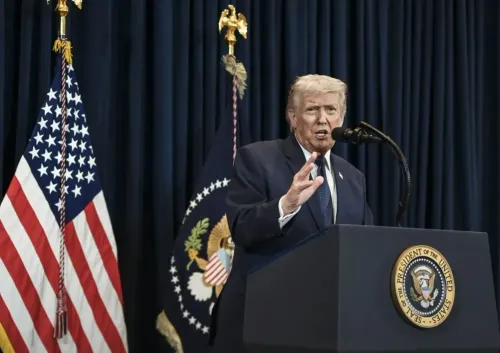
In an interview with Fox News’ Hannity, Trump provided an extensive justification for the actions that led to the ousting of Venezuelan leader Nicolás Maduro, consistently highlighting oil as the key instrument of US influence.
“They seized our oil years ago,” Trump remarked, referencing the nationalization of American energy properties in Venezuela. “We just reclaimed it.”
The president noted that the United States has already acquired significant amounts of Venezuelan crude through sanctions. “We’ve seized $4 billion worth of oil in just one day,” he stated, indicating that this figure would continue to increase.
Trump asserted that leading American firms would now work to restore Venezuela’s devastated energy sector. “The top 14 companies are on their way,” he declared. “They will revamp the entire oil infrastructure.”
He insisted that reviving production would have global ramifications. “This will lead to lower oil prices worldwide,” he claimed, highlighting the administration's close association of foreign policy with commodity markets.
While acknowledging that revitalizing Venezuela’s oil industry would require time—“The oil recovery will take a while,” he acknowledged—he made it clear that US engagement would not be short-lived. “We will remain until we stabilize the country,” Trump affirmed.
These remarks imply a prolonged US presence, with economic oversight preceding political changes. Trump stated that conditions for elections are not yet favorable. “They wouldn’t even know how to conduct an election at this point,” he noted. “The country has devolved into a third-world state.”
Beyond economic implications, Trump characterized the Venezuela operation as a show of deterrence. He contended that it sent a message throughout the region, especially to the governments in Cuba and Colombia.
“They witnessed the events,” he stated. “They are treating us with significant respect.”
Trump indicated that Maduro's ousting had led other leaders to comply, diminishing the potential for confrontation. The suggestion was that decisive action in one nation influences the behavior of others.
By presenting the operation as a law enforcement triumph with immediate security benefits, he accused the previous Venezuelan administration of exporting crime to the US. “He released criminals into the United States,” Trump claimed. “He discharged inmates from prisons and mental hospitals.”
He asserted a substantial decrease in maritime drug trafficking. “We’ve eliminated 97 percent of the drugs entering by sea,” he claimed. “Only a few vessels are currently operating.” While he did not provide independent verification for this statistic, he reiterated the notion that military action combined with law enforcement had yielded concrete results.
Trump described the Venezuela operation as risky yet successful. “We penetrated deep into a stronghold,” he recounted. “Thousands of soldiers were involved.” He noted that US forces reached Maduro swiftly and exited without any fatalities.
“We didn’t lose a soldier,” he emphasized, although he admitted there were injuries. “A couple of very courageous helicopter pilots sustained serious wounds,” Trump mentioned. “But they are fine.” He contrasted this success with past military failures. “You didn’t witness a Jimmy Carter disaster,” he remarked, referring to the unsuccessful Iran hostage rescue. “You didn’t see a Biden Afghanistan catastrophe.”
Trump repeatedly refrained from outlining specific conditions for further escalation. “I wouldn’t want to disclose that,” he responded when questioned about the requirements for deeper US involvement.
Point of View
This intervention reflects a significant shift in US foreign policy. While it aims to stabilize Venezuela economically and geopolitically, it raises questions about long-term implications for US engagement in Latin America and the global oil market.
NationPress
13 Oct 2026
Frequently Asked Questions
What is the main goal of US intervention in Venezuela?
The main goal is to reclaim control of oil resources, deter rivals, and combat drug trafficking.
How much oil has the US reportedly secured from Venezuela?
The US has claimed to secure $4 billion worth of Venezuelan oil in one day.
What impact does Trump claim this will have on global oil prices?
Trump claims that restoring Venezuela's oil production will lead to lower oil prices worldwide.
What does Trump say about the timeline for restoring Venezuela's oil industry?
Trump acknowledges that revitalizing the oil industry will take time but asserts that US involvement will be long-term.
What does Trump mean by the operation being a law enforcement success?
He views the intervention as a measure to eliminate crime and drug trafficking that has been exported from Venezuela to the US.