Did South Korean President Lee's Approval Rating Rise to 60 Percent?
Synopsis
In an exciting turn of events, South Korean President Lee Jae Myung has witnessed a significant rise in his approval rating to 60%. This increase is largely attributed to the public's positive sentiment over his recent diplomatic efforts, including pivotal discussions in China and upcoming talks in Japan aimed at strengthening bilateral relations.
Key Takeaways
President Lee's approval rating has reached 60% .
Public sentiment is largely positive due to his diplomatic efforts.
Lee's recent visit to China was a key factor in the approval rise.
Upcoming summit talks in Japan are anticipated to strengthen bilateral ties.
Approval ratings for political parties show a competitive landscape.
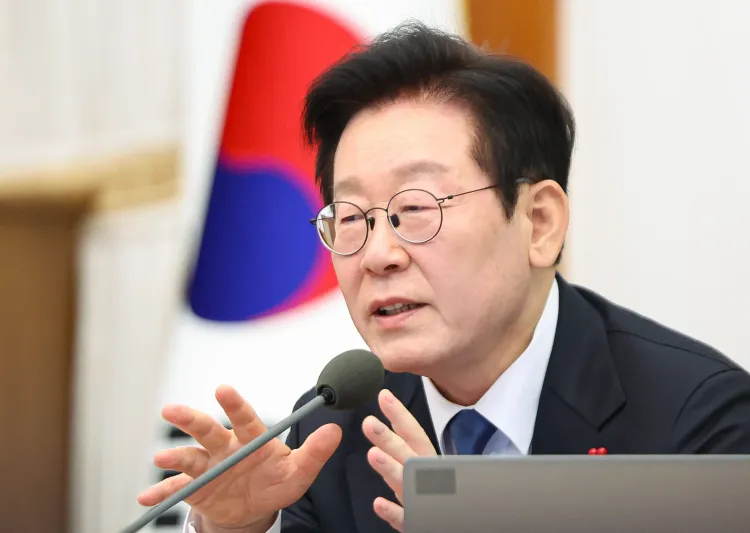
Seoul, Jan 9 (NationPress) The approval rating for South Korean President Lee Jae Myung has risen to 60 percent this week, reflecting a surge in public approval regarding his diplomatic efforts, according to a recent poll released on Friday.
The survey, conducted by Gallup Korea from Tuesday to Thursday with 1,000 participants aged 18 and older, indicated a 5 percentage point increase in the positive evaluation of Lee's overall performance compared to the prior poll in mid-December.
Negative views decreased to 33 percent, down from 36 percent in the previous survey, while 7 percent of respondents chose not to provide an evaluation, as reported by Yonhap News Agency.
Among the reasons for positive evaluations, diplomacy topped the list at 30 percent, followed by 14 percent citing his leadership in economic and livelihood issues.
On the other hand, negative assessments were primarily influenced by critiques of his handling of economic and livelihood challenges.
The pollster noted that Lee's recent state visit to China seemed to have revitalized interest in his diplomatic activities, leading to the rise in positive evaluations.
During his recent four-day state visit to China, Lee engaged in summit discussions with Chinese President Xi Jinping to bolster economic relations and coordinate peace efforts regarding North Korea.
The discussions also tackled sensitive matters, such as the presence of Chinese steel structures in disputed waters of the Yellow Sea, which Seoul perceives as potential grounds for territorial claims.
Furthermore, the approval rating for the ruling Democratic Party stood at 45 percent, while the main opposition People Power Party registered 26 percent.
The survey carries a margin of error of plus or minus 3.1 percentage points at a 95 percent confidence level.
In addition, President Lee Jae Myung is set to embark on a two-day visit to Nara prefecture in Japan early next week for summit talks with Japanese Prime Minister Sanae Takaichi to explore avenues for enhancing bilateral relations, as announced by Cheong Wa Dae.
Lee's departure for Japan is scheduled for next Tuesday, with the summit taking place in Nara, Takaichi's hometown, according to Cheong Wa Dae.
The two leaders are anticipated to discuss a broad spectrum of regional and global matters, including economic, social, and cultural issues, as stated by Cheong Wa Dae.
Previously, Lee and Takaichi convened for summit discussions on October 30 during the Asia-Pacific Economic Cooperation forum in Gyeongju and had a brief meeting on the sidelines of the Group of 20 leaders' gathering in South Africa in November.
Lee is also scheduled to participate in a friendship event with Takaichi next Wednesday and engage with ethnic Koreans residing in Japan before returning home that same day.
This upcoming visit marks Lee's second trip to Japan after his August visit to Tokyo, where he had summit talks with Takaichi's predecessor, Shigeru Ishiba.
Observers anticipate that this visit will reinforce the future-oriented progression of bilateral ties through "shuttle diplomacy", involving reciprocal visits, as highlighted by Cheong Wa Dae.
Point of View
It is evident that public sentiment plays a crucial role in shaping leadership effectiveness. President Lee's rising approval rating reflects the South Korean populace's appreciation for his diplomatic engagements and economic management. As a nation, we must continuously evaluate the impact of these political dynamics on our future.
NationPress
7 Oct 2026
Frequently Asked Questions
What factors contributed to President Lee's increased approval rating?
The rise in President Lee's approval rating is attributed to positive public sentiment regarding his diplomatic efforts, particularly his recent state visit to China and the focus on economic management.
How recent was the poll conducted?
The poll was conducted by Gallup Korea from Tuesday to Thursday of the previous week, involving 1,000 respondents.
What were the approval ratings of the ruling and opposition parties?
The approval rating for the ruling Democratic Party was 45 percent, while the main opposition People Power Party stood at 26 percent.
What is the significance of Lee's upcoming visit to Japan?
Lee's upcoming visit to Japan is aimed at strengthening bilateral ties and discussing various regional and global issues with Japanese Prime Minister Sanae Takaichi.
How does the poll's margin of error affect its reliability?
The survey has a margin of error of plus or minus 3.1 percentage points at a 95 percent confidence level, indicating a high level of reliability.