Did Putin Warn Bush About NATO Expansion in Ukraine Years Before the Conflict?
Click to start listening
Synopsis
Discover how President Vladimir Putin warned President George W. Bush about the potential consequences of NATO expansion into Ukraine and Georgia in previously classified discussions. These insights reveal the looming instability years before the conflict erupted, shedding light on Russia's strategic concerns and the U.S. response to these warnings.
Key Takeaways
- Putin's warnings about NATO expansion were made years before the conflict.
- NATO's eastward movement was viewed as a direct threat to Russia.
- The transcripts reveal the complexities of international relations.
- Bush recognized Putin's bluntness but refused to change U.S. policy.
- The documents illustrate Russia's defensive stance concerning NATO.
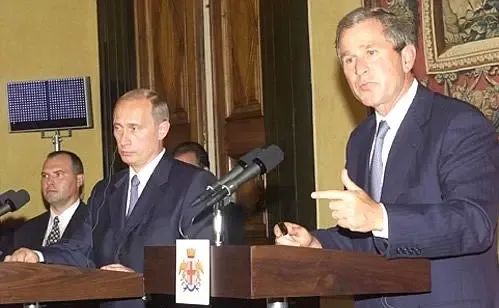
Washington, Dec 25 (NationPress) Long before the tensions between Russia and the West escalated into overt conflict, President Vladimir Putin privately cautioned U.S. President George W. Bush that NATO's expansion into Ukraine and Georgia would lead to enduring instability, as revealed in newly disclosed transcripts of their meetings from 2001 to 2008.
The records, published by the National Security Archive, illustrate Putin's consistent argument that NATO's move eastward was a direct threat to Russia's security, prompting Moscow to respond through political and strategic avenues.
In their final discussion in April 2008 in Sochi, following the NATO summit in Bucharest, Putin informed Bush that Ukrainian membership in NATO would instigate a “long-term confrontation” and cautioned that Russia would support anti-NATO factions within Ukraine to obstruct the alliance's progress.
“Russia would be creating problems there continuously,” Putin asserted, contending that NATO membership would fracture Ukraine internally and position military assets perilously close to Russia’s borders.
Putin characterized Ukraine as an “artificial country” established during the Soviet period, asserting that a significant segment of its populace viewed NATO as a threatening entity.
He warned that the placement of Western military infrastructure near Russia would necessitate countermeasures.
While Bush acknowledged Putin's perspective, he made it clear that U.S. policy would not be altered. Nevertheless, he praised Putin’s forthrightness, stating, “One of the things I admire about you is you weren’t afraid to say it to NATO… It was a commendable performance.”
According to the transcripts, Putin articulated his staunch opposition to NATO's expansion into Georgia, foreseeing that it could incite conflict in regions like Abkhazia and South Ossetia. He predicted guerrilla warfare and instability should Georgia attempt to resolve internal issues under NATO’s “military umbrella.”
For Indian readers, the documents provide unique insight into Russia’s perspective—a viewpoint that New Delhi must consider in its strategic relations with Moscow.
These documents underscore that Putin consistently portrayed the Western military presence near Russia's borders as an existential threat, while framing Russia itself as defensive rather than aggressive.
From the transcripts, it is evident that Putin clearly communicated his stance to Bush long before any military actions, contradicting U.S. assertions that Russian moves were sudden or unforeseen.
Despite their disagreements, Bush recognized Putin’s rationale and aimed to manage differences through transparency and dialogue, particularly concerning missile defense and strategic stability.
Point of View
It is crucial to present a balanced view on historical events. The revelations from the released transcripts illustrate the complexities of international relations and the foresight of leaders like Putin regarding NATO's expansion. While acknowledging the concerns raised, it is essential to understand the broader context of these discussions and their impact on current geopolitical dynamics.
NationPress
06/01/2026
Frequently Asked Questions
What did Putin warn Bush about regarding NATO?
Putin warned Bush that NATO's expansion into Ukraine and Georgia would lead to permanent instability and pose a direct threat to Russia's security.
When did Putin convey these warnings?
The warnings were conveyed during private meetings between 2001 and 2008.
How did Bush respond to Putin's concerns?
Bush acknowledged Putin's perspective but maintained that U.S. policy regarding NATO would not change.
What did Putin say about Ukraine's internal conflicts?
Putin claimed that NATO membership would create divisions within Ukraine and lead to ongoing problems.
Why are these documents significant for India?
They offer valuable insights into Russia's worldview, which is crucial for India's strategic engagement with Moscow.