Ramaswamy Asks Voters to Elect — Then Judge — Him
Synopsis
Vivek Ramaswamy, on election day in November 2026, posted a four-point voter appeal covering property taxes, electric bills, housing, and public safety — closing with a direct invitation for public accountability starting the day after the vote.
Key Takeaways
Ramaswamy posted his election-day appeal on November 4, 2026 , urging voters to back him on four specific issues.
The four pledges are: lower property taxes, lower electric bills, more affordable homes, and safer streets .
He explicitly invited voters to hold him accountable 'starting tomorrow' — a rare pre-emptive accountability commitment.
The messaging mirrors themes from his 2024 Republican presidential campaign , now applied to a state or local contest.
The specific office and jurisdiction were not named in the post.
Republican candidates across multiple states have similarly centred campaigns on property taxes, utility rates, and housing affordability in recent election cycles.
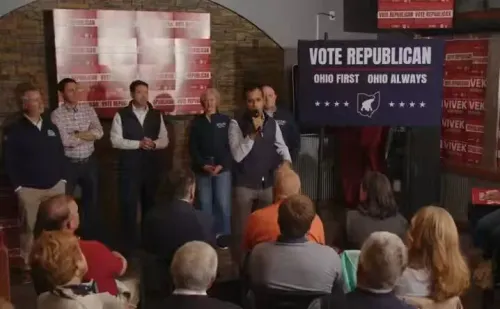
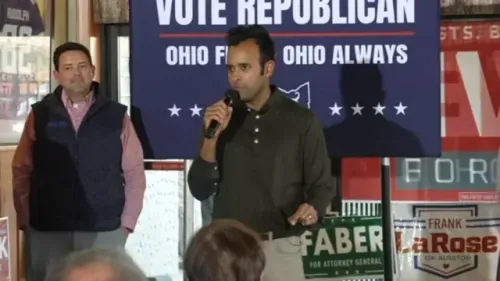
On the eve of what appears to be a competitive local or state race, entrepreneur Vivek Ramaswamy made a direct appeal to voters on Wednesday, November 4, 2026, staking his candidacy on four kitchen-table promises — and, in the same breath, daring the public to hold him to every one of them.
Ramaswamy's post is spare and deliberate: 'Today: vote for lower property taxes, lower electric bills, more affordable homes, and safer streets. Starting tomorrow: hold me accountable for it.' No caveats, no hedges. The accountability line is the story — a politician volunteering to be measured before the ballots are even counted.
Four Promises That Hit Where Families Feel It Most
The four planks are not accidental. Property taxes, utility bills, housing costs, and public safety consistently rank among the top concerns in voter surveys at both state and local levels. Each one is something a household confronts not in the abstract — but at the mailbox, on the monthly statement, at the front door. Ramaswamy is betting that specificity, over rhetoric, is what closes a race.
The framing echoes themes he hammered throughout his 2024 Republican presidential campaign, where cutting federal spending, slashing regulations, and driving down energy and housing costs formed the core of his platform. That national argument is now compressed into a single local ask — a deliberate translation of big-picture policy into neighbourhood consequences.
The Accountability Pivot — and Why It's a Calculated Risk
The second sentence is the sharper one. Republican candidates routinely promise affordability and safety; fewer publicly invite real-time scrutiny of their delivery. By framing the post as a before-and-after contract — 'today, vote; tomorrow, watch me' — Ramaswamy is making the promise the brand, not just the platform.
It is a calculated risk. Accountability messaging energises supporters who are tired of politicians who disappear after election night. But it also sets a measurable bar. If property tax rates do not fall or utility bills stay high, the post itself becomes the opposition's ready-made attack line. He appears to know that — and to be comfortable with it.
As voters head to their polling stations, the question Ramaswamy is posing is ultimately simple: do you trust this list enough to give him the power to act on it? The answer, he insists, can be graded starting the very next morning.
Point of View
Verifiable pledges to an immediate accountability dare, he attempts to inoculate against the voter fatigue that follows unfulfilled campaign promises. It also signals a strategic evolution: the candidate who built his 2024 identity on disruption is now pitching himself as a deliverable, measurable executive. Whether that pivot broadens his coalition or simply sharpens his base will be the first real test of his post-DOGE political identity.
NationPress
4 Nov 2026
Frequently Asked Questions
What did Vivek Ramaswamy post on election day 2026?
Ramaswamy posted a direct voter appeal on November 4, 2026, asking people to vote for lower property taxes, lower electric bills, more affordable homes, and safer streets — and inviting them to hold him accountable starting the next day.
What office is Vivek Ramaswamy running for in 2026?
The specific office and jurisdiction were not named in the post, and details of any 2026 candidacy beyond his prior national profile have not been independently confirmed.
What was Vivek Ramaswamy's role in DOGE?
Ramaswamy served as co-lead of the US Department of Government Efficiency (DOGE) advisory effort alongside Elon Musk, before returning to the private sector as executive chairman of Strive Asset Management.
What were Vivek Ramaswamy's main policy positions in 2024?
His 2024 Republican presidential platform centred on reducing federal spending, cutting regulations, and lowering energy and housing costs — themes he is now applying to a state or local race.
Why is Ramaswamy's accountability message significant?
By publicly inviting scrutiny 'starting tomorrow', Ramaswamy is setting a self-imposed, measurable standard for his own performance — a move that energises accountability-focused voters but also creates a ready benchmark for critics if promises go unmet.