Ramaswamy Eyes Ohio Governor Race, Vows High-Paying Jobs
Synopsis
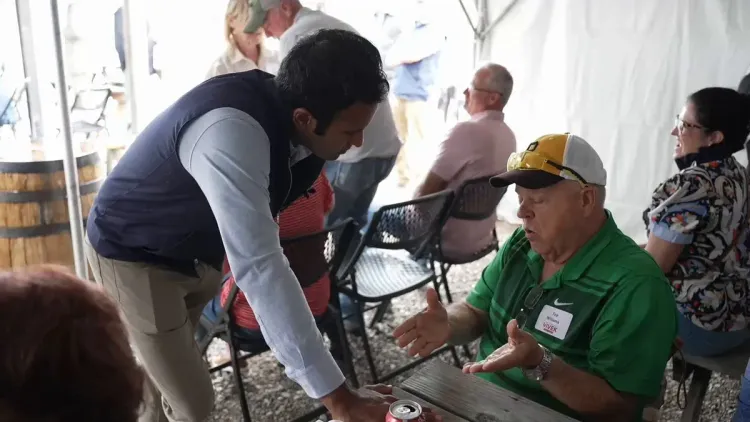
Entrepreneur Vivek Ramaswamy signalled his Ohio gubernatorial ambitions on 15 July 2026, pledging to make high-paying job creation his central mission and promising a 'positive surprise' in 2027, extending his national economic platform to a state-level race.
Key Takeaways
Vivek Ramaswamy posted on 15 July 2026 that bringing high-paying jobs back to Ohio would be the next governor's key task.
He expressed confidence in his ability to deliver, hinting at a 'positive surprise' in 2027 .
Ramaswamy is the founder of Strive Asset Management and a former co-lead of the DOGE advisory effort.
He ran for the 2024 Republican presidential nomination on a platform of deregulation, domestic energy, and tariffs to reshore manufacturing.
Ohio has experienced long-term manufacturing job losses from globalisation and automation, making economic revival a central voter concern.
The November 2026 Ohio gubernatorial election is the next formal milestone for the race.
Entrepreneur Vivek Ramaswamy signalled his ambitions for the Ohio governorship on Wednesday, 15 July 2026, declaring that bringing high-paying jobs back to the state would be the next governor's defining task and expressing confidence that he could deliver a 'positive surprise' in the year ahead.
Context
Posting on X, Ramaswamy wrote: 'Key job of Ohio's next Governor: bring high-paying jobs back to our state. I know how to get it done and think we'll deliver a positive surprise next year.' The statement is his most direct framing yet of a potential gubernatorial bid, positioning job creation as the central promise of his candidacy.
Ohio is a battleground Midwestern manufacturing state that has endured decades of employment losses tied to globalisation, automation, and offshoring. The state's industrial heartland — once anchored by steel, auto parts, and chemicals — has seen sustained wage pressure, making economic revival a perennial campaign theme.
Policy Backdrop
Ramaswamy, founder of Strive Asset Management and a former co-lead of the Department of Government Efficiency (DOGE) advisory effort under the second Trump administration, ran for the 2024 Republican presidential nomination on a platform of deregulation, expanded domestic energy production, and tariffs aimed at reshoring manufacturing.
Those federal-level ideas now appear to be translating into a state-level pitch. Republican governors across the Midwest have increasingly competed for high-wage industry investment — from semiconductor plants to electric-vehicle supply chains — using a mix of tax incentives, workforce training funds, and regulatory relief rather than relying solely on federal programmes.
Ramaswamy's framing mirrors a broader GOP pattern of former national candidates redirecting energy toward state executive roles, where economic policy levers are more direct and results more visible to voters.
Stakeholders and Impact
Ohio manufacturing workers and state employers stand as the primary audience for Ramaswamy's message. The state's unemployment picture and median wage levels have become flashpoints in debates over trade policy and industrial strategy at both the federal and state levels.
A gubernatorial run by a figure with Ramaswamy's national profile and fundraising network would reshape the 2026 Ohio Republican primary, drawing attention and resources into a race that will determine who succeeds the term-limited incumbent. His reference to a 'positive surprise next year' — pointing toward 2027 — suggests he is already thinking in terms of early-term deliverables should he win the November 2026 election.
What's Next
The November 2026 Ohio gubernatorial election is the next major milestone. Formal candidate announcements and primary developments will clarify the competitive field. Observers will watch whether Ramaswamy translates his national policy record into a concrete state economic agenda — particularly around reshoring supply chains, energy costs, and workforce development — that can withstand scrutiny in a general election.
If Ramaswamy does enter the race, Ohio could become a testing ground for whether the deregulation-and-domestic-industry thesis that animated national Republican politics in 2024 can be operationalised at the state level with measurable results.
Point of View
Energy expansion, and manufacturing reshoring — is being retooled for a state executive contest where results are harder to deflect. By anchoring his pitch to job quality rather than job quantity, he is targeting the wage-anxiety that has driven Ohio's swing-state volatility for two decades. A gubernatorial win would give him an executive record to counter the criticism that his 2024 presidential run was long on rhetoric and short on governance experience. The 'positive surprise' framing is politically shrewd: it sets a self-defined benchmark while creating anticipation without committing to a specific, verifiable metric.
NationPress
14 Oct 2026
Frequently Asked Questions
Is Vivek Ramaswamy running for Ohio governor in 2026?
Ramaswamy has strongly signalled his intent, stating on 15 July 2026 that he knows how to bring high-paying jobs back to Ohio and expects to deliver a 'positive surprise' next year, though a formal announcement has not yet been confirmed in public records.
What is Vivek Ramaswamy's background in economic policy?
Ramaswamy is the founder of Strive Asset Management and ran for the 2024 Republican presidential nomination on a platform of deregulation, domestic energy production, and tariffs to reshore U.S. manufacturing jobs.
What economic challenges does Ohio face?
Ohio is a Midwestern manufacturing state that has experienced decades of job losses tied to globalisation, automation, and offshoring, leaving wage growth and industrial employment as persistent voter concerns.
When is the Ohio governor election?
The Ohio gubernatorial election is scheduled for November 2026, with the primary expected to take shape in the months leading up to it.
What was DOGE and what was Ramaswamy's role?
The Department of Government Efficiency was an advisory effort launched under the second Trump administration; Ramaswamy served as its co-lead before departing to pursue other endeavours, including a potential Ohio gubernatorial run.