Groundbreaking Study by Australian Scientists Reveals Rare Exploding Star Type with No Black Holes
Synopsis
An Australian-led research team has made a significant discovery about a rare form of exploding star, revealing the existence of a 'forbidden gap' in black hole masses. This finding could reshape our understanding of stellar evolution and black hole formation.
Key Takeaways
Rare form of exploding star identified by Australian researchers.
Study reveals a forbidden gap in black hole masses.
Extreme stars may explode completely, leaving no black holes .
Research uses gravitational wave observations .
Findings could reshape understanding of stellar evolution .
Sydney, April 6 (NationPress) A research initiative spearheaded by Australian scientists has revealed crucial evidence of an unusual type of exploding star, offering insights into one of the universe's most dramatic phenomena.
Published in Nature, the study employs gravitational wave data to investigate the final stages of the most massive stars, bolstering the hypothesis of a long-suspected "forbidden gap" in the mass of black holes, as stated by Monash University in Australia.
Typically, at the end of their life cycle, the most massive stars implode to form black holes—regions of space with gravitational forces so intense that not even light can escape from them.
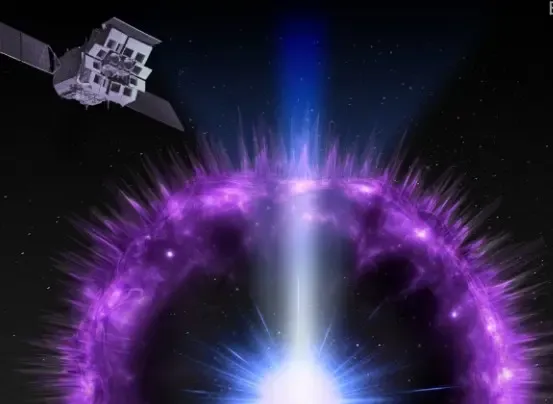
However, it is believed that exceptionally massive stars heat up to such extreme levels that they explode in a "pair-instability supernova." This cataclysmic event is so intense that it obliterates the star, leaving no black hole as a remnant, according to a report by Xinhua news agency, citing the Monash University statement.
The researchers have identified a "forbidden range" of black-hole masses exceeding 45 times that of the Sun, within which stellar-origin black holes are notably scarce. This gap aligns with theoretical models suggesting that these stars explode due to pair-instability, resulting in no remaining black holes.
Project leader Tong Hui, a PhD candidate at Monash University, commented that the research pinpointed a mass range where stars apparently do not yield black holes.
"The only black holes found in this mass range are formed from the merger of smaller black holes, rather than being directly derived from massive stars," said Tong Hui.
Confirming this gap would address a significant question regarding the life cycles of the most massive stars and the origins of black holes, the researchers concluded.
Point of View
I find this discovery by Australian researchers to be a pivotal moment in astrophysics. The identification of a 'forbidden gap' in black hole masses not only highlights the complexities of stellar evolution but also invites further investigation into the origins of black holes. Such findings emphasize the importance of ongoing research in our quest to understand the universe.
NationPress
16 Sept 2026
Frequently Asked Questions
What is a pair-instability supernova?
A pair-instability supernova is a type of stellar explosion that occurs in extremely massive stars, leading to their complete destruction without forming a black hole.
What does the 'forbidden gap' in black hole masses refer to?
The 'forbidden gap' refers to a range of black hole masses above 45 times that of the Sun, where stellar-origin black holes are rarely found, suggesting that these massive stars explode instead of collapsing into black holes.
How did researchers study these supernovae?
Researchers employed gravitational wave observations to analyze the final moments of massive stars, providing insights into their explosive deaths.
Why is this discovery significant?
This discovery is significant as it enhances our understanding of the life and death of massive stars and the processes leading to black hole formation.