Is Rising Violence Against Hindus in Bangladesh Indicating a Broader Regional Threat?
Click to start listening
Synopsis
The alarming rise in violence against Hindus in Bangladesh raises significant concerns regarding the stability of the region. A recent report delves into the historical context and current political dynamics, shedding light on the precarious situation of minority communities as elections approach.
Key Takeaways
- Hindu minorities in Bangladesh are facing heightened violence.
- The political landscape has shifted dramatically since 2024.
- NGOs report serious human rights violations against various communities.
- Future elections could further impact minority protections.
- Regional stability is at risk due to the ongoing crisis.
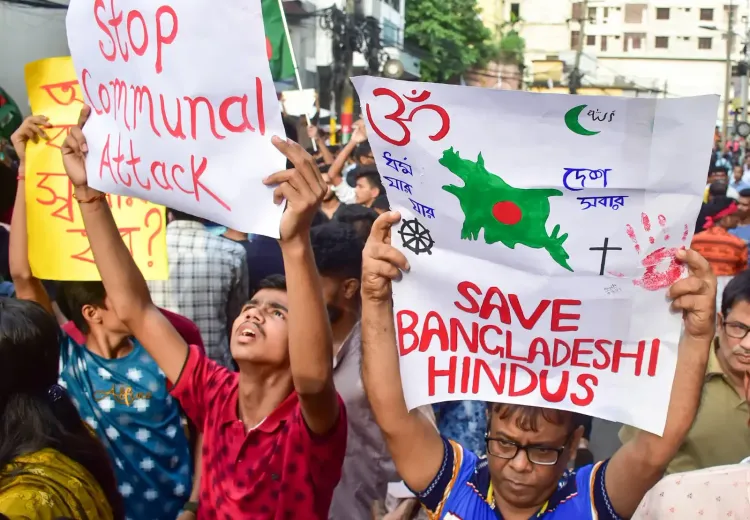
Dhaka/New Delhi, Jan 19 (NationPress) The ongoing violence against Hindu minorities in Bangladesh is not merely an isolated incident, but part of a long, sorrowful saga shaped by political turmoil, changing alliances, and the precarious assurance of minority protection, as detailed in a recent report. It emphasized that comprehending the current crisis requires an analysis of the history of displacement, the evolving geopolitical landscape, and lawful, non-violent measures to uphold human rights ahead of the upcoming elections in February.
“When 32-year-old factory worker Dipu Chandra Das left his home in Mymensingh on December 18, 2025, he had no way of knowing he would never return. Hours later, he was brutally killed by a mob, an incident that shocked his community yet was not unexpected for those aware of the deteriorating political climate in Bangladesh. In the following 18 days, five additional Hindu men were murdered across various districts, each incident heightening the atmosphere of fear,” according to an article in ‘Organiser Weekly’.
The report indicates that the removal of former Prime Minister Sheikh Hasina on August 5, 2024, following student-led demonstrations, created a significant political vacuum. This led to Muhammad Yunus assuming control of an interim government that promised reforms and elections, yet violence only intensified.
“Human rights organizations have recorded thousands of assaults on Hindu, Buddhist, Christian, Ahmadiyya, and other indigenous populations. The six recent murders of Hindus, spanning from Mymensingh to Narsingdi, illustrate a broader deterioration of law and order. Analysts attribute these attacks to political retribution, land disputes, and the empowerment of extremist factions,” the report highlighted.
It emphasized that as Bangladesh approaches the February 12 elections, the marginalization of the Awami League has enabled the Bangladesh Nationalist Party and radical Islamist entities to gain ground. Furthermore, Hindus, previously perceived as supporters of the Awami League, are now considered strategic targets.
“The assassination of candidate Sharif Osman Hadi in December 2025 sparked a wave of retaliatory mob violence, including the lynching of Dipu Chandra Das. The subsequent murders of businessmen Khokon Chandra Das and Rana Pratap further exemplify the escalating insecurity,” the report noted.
With Hindus constituting less than eight percent of Bangladesh's population, their vulnerability is particularly acute.
“NGOs continue to document land seizures, temple desecrations, and targeted assaults. Official narratives often downplay these occurrences as 'non-communal disputes,' yet community members recount a daily existence filled with fear and uncertainty,” it asserted.
Furthermore, the report stressed that the recent surge in violence across Bangladesh is more than merely a domestic issue—it poses implications for the entire region.
“Protecting Hindu communities has become a benchmark of Bangladesh’s democratic integrity, India’s strategic stability, and South Asia’s commitment to pluralism. If these moments are mishandled, the repercussions could resonate across borders and potentially reshape them,” it concluded.
Point of View
It is imperative to assert that the rising violence against Hindu minorities in Bangladesh is not only a national issue but a regional concern that merits urgent attention. It is crucial for the international community to recognize the implications of the ongoing crisis and support efforts to uphold human rights and pluralism.
NationPress
19/01/2026
Frequently Asked Questions
What is the current situation of Hindus in Bangladesh?
The situation of Hindus in Bangladesh is precarious, with increasing incidents of violence and targeted attacks against the community, exacerbated by political instability.
How has political unrest affected minority communities in Bangladesh?
Political unrest has led to a power vacuum and increased violence, making minority communities, particularly Hindus, vulnerable to attacks and discrimination.
What are the implications of this violence for the region?
The rise in violence against Hindus poses broader implications for regional stability, affecting diplomatic relations and the commitment to pluralism in South Asia.