South Korea, US hold first 2+2 finance meet at G20 Bangkok
Synopsis
For the first time, South Korea and the US brought together finance ministry and central bank chiefs in a single room — a '2+2' format borrowed from defence diplomacy and now applied to economic policymaking. The Bangkok meeting signals both sides are building institutional machinery to respond faster to global financial shocks, with the Fed chair and Seoul's BOK governor in the same conversation for the first time.
Key Takeaways
South Korea and the US held their first '2+2' finance and monetary policy meeting in Bangkok on 17 October 2026 .
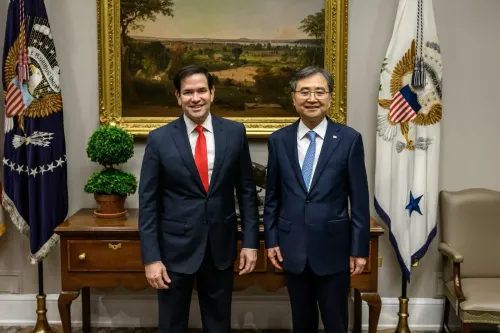
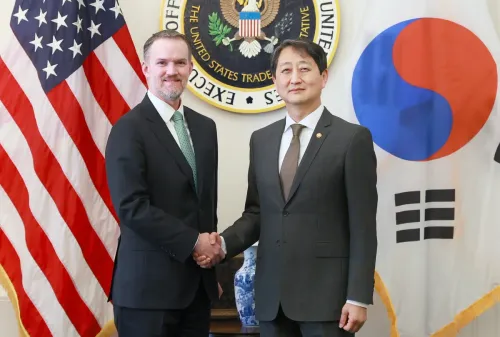
Finance Minister Lee Hyoung-il and BOK Governor Shin Hyun-song met Fed Chair Kevin Warsh and Deputy Treasury Secretary Francis Brooke .
The meeting took place on the sidelines of the G20 finance ministers' gathering and the 2026 IMF-World Bank Annual Meetings .
US Treasury Secretary Scott Bessent was absent from the Bangkok event.
Both sides agreed to establish a framework for closer coordination to address external financial uncertainties promptly.
The Bangkok trip was Minister Lee's first overseas visit since taking office last month.
South Korea and the United States convened their first-ever 'two-plus-two' meeting of senior finance and monetary policymakers in Bangkok on 17 October 2026, on the sidelines of the Group of 20 (G20) finance ministers' gathering, to strengthen bilateral coordination in the face of growing external financial uncertainties.
Who Attended and What Was Discussed
South Korean Finance Minister Lee Hyoung-il and Bank of Korea (BOK) Governor Shin Hyun-song sat down with US Federal Reserve Chair Kevin Warsh and US Deputy Treasury Secretary Francis Brooke for the landmark dialogue. According to the South Korean Ministry of Finance and Economy, participants exchanged views on recent economic developments and identified avenues to deepen bilateral economic and financial cooperation.
Notably, US Treasury Secretary Scott Bessent did not attend the Bangkok event. Also present was Erin Browne, Under Secretary for International Affairs at the US Treasury, who confirmed the discussions on her social media platform X account: 'Our four institutions exchanged views on economic and financial conditions in both countries and discussed opportunities to further strengthen US-Korea economic and financial cooperation,' Browne wrote.
Why This Format Is Significant
The '2+2' format — which brings together finance ministry and central bank officials from both sides simultaneously — is typically used in defence diplomacy but is unprecedented in economic policymaking between Seoul and Washington. Finance Minister Lee Hyoung-il described the meeting as meaningful, noting it was the first time the two nations had assembled senior representatives from both their finance and monetary authorities in a single forum.
A finance ministry official elaborated that the session 'aimed at enhancing the policy mix of the two countries' financial and monetary policies,' adding that the new framework would allow both sides to 'promptly and effectively address external financial uncertainties through close coordination.'
Context: G20 and IMF-World Bank Annual Meetings
Minister Lee was in Bangkok to attend both the G20 finance ministers' conclave and the 2026 Annual Meetings of the International Monetary Fund (IMF) and the World Bank Group. The Bangkok trip marked his first overseas engagement since assuming the finance portfolio last month. The meetings come at a time when global policymakers are navigating persistent inflation pressures, volatile capital flows, and slowing growth in major economies.
What Comes Next
The establishment of this bilateral coordination framework suggests that Seoul and Washington are preparing institutional scaffolding to manage future shocks — whether currency volatility, capital outflows, or supply-side disruptions — more nimbly than before. Analysts will watch whether this '2+2' format is formalised into a standing dialogue or remains an ad hoc arrangement tied to multilateral events like the G20.
Point of View
Seoul and Washington are acknowledging that monetary and fiscal policy are now inseparable levers in managing geopolitical risk — a lesson drawn from COVID-era dollar-swap line scrambles and post-Ukraine sanctions volatility. The absence of Treasury Secretary Bessent, however, raises a question about seniority parity: South Korea fielded its finance minister, while the US sent a deputy secretary. Whether this asymmetry reflects scheduling logistics or a deliberate calibration of Washington's commitment will matter as the framework matures. The real test comes when the next shock hits — and whether the new channel is robust enough to produce coordinated action, not just coordinated statements.
NationPress
17 Oct 2026
Frequently Asked Questions
What is the South Korea-US '2+2' finance meeting?
It is the first-ever joint meeting of senior finance ministry and central bank officials from both South Korea and the United States, held in Bangkok on 17 October 2026. The format, borrowed from defence diplomacy, brings together the two countries' fiscal and monetary policymakers simultaneously to coordinate responses to global financial risks.
Who represented South Korea and the US at the Bangkok meeting?
South Korea was represented by Finance Minister Lee Hyoung-il and Bank of Korea Governor Shin Hyun-song. The US side included Federal Reserve Chair Kevin Warsh, Deputy Treasury Secretary Francis Brooke, and Under Secretary for International Affairs Erin Browne. US Treasury Secretary Scott Bessent did not attend.
Why was the meeting held in Bangkok?
Bangkok was hosting the G20 finance ministers' meeting and the 2026 Annual Meetings of the IMF and the World Bank Group, providing a natural multilateral backdrop for the bilateral dialogue. Minister Lee was attending both events as part of his first overseas trip since taking office.
What did the two sides agree to at the meeting?
Both sides agreed to establish a bilateral framework for closer coordination between their finance and monetary authorities to address external financial uncertainties more promptly and effectively. No specific joint policy actions were announced, but the meeting was described as a foundation for future structured cooperation.
What is the significance of applying the '2+2' format to economic diplomacy?
Traditionally used in security diplomacy, the '2+2' format signals that Seoul and Washington now regard joint fiscal-monetary coordination as strategically important as defence ties. It allows real-time alignment between treasury officials and central bankers, reducing the risk of policy mismatches during financial crises.