Are Shehbaz's Concessions to the Pakistan Army Causing a Rift with Nawaz Sharif?
Click to start listening
Synopsis
The ongoing tension between Shehbaz and Nawaz Sharif highlights a significant political rift within the PML-N as Shehbaz faces pressure over military concessions. Will this conflict lead to a fracture in party unity and a shift in Pakistan's power dynamics?
Key Takeaways
- Shehbaz Sharif is under pressure from his brother Nawaz regarding military concessions.
- Nawaz believes the government should control military appointments.
- Experts caution about potential instability within the PML-N.
- Public perception of military influence is a significant concern.
- Nawaz wants safeguards against military overreach in governance.
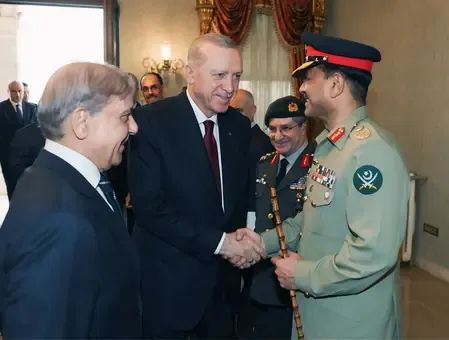
New Delhi, Dec 3 (NationPress) Shehbaz Sharif, the Prime Minister of Pakistan, often viewed as a puppet of the Army, is facing significant pressure from his brother Nawaz Sharif, the founder of the PML-N. Nawaz, a former Prime Minister, along with his daughter Maryam Sharif, is dissatisfied with the concessions that Shehbaz has been granting to the Army.
Indian officials report that Nawaz believes his brother is giving Field Marshal Asim Munir too much leeway and is advocating for a greater role in the appointments of key military positions.
The Prime Minister is set to arrive in Islamabad on Wednesday to finalize the notification regarding the Chief of Defence Forces (CDF).
Nawaz insists that the government should hold the authority to decide on sensitive military appointments, while Shehbaz prefers to avoid interference. The contentious issues between the two brothers center on the appointments of the Vice Chief of Army Staff and the Commander of the National Strategic Command.
Analysts observing Pakistan politics believe that Nawaz Sharif still exerts considerable influence over the party and that Shehbaz's position as Prime Minister hinges on his brother's support. An official stated that Shehbaz faces a tough decision: whether to heed his brother's concerns or to align with the Army, which played a crucial role in his rise to the premiership.
Nawaz and Maryam contend that the government should retain control and not concede excessively to the Army, warning that doing so could portray the government as merely a puppet regime. They argue that allowing too many Army loyalists in high positions could lead to a dangerous concentration of power.
Experts caution that this dilemma places Shehbaz in a precarious situation, compelling him to choose between his sibling and the military establishment. This conflict could escalate into a serious divide between the political leadership and the military, potentially fracturing the PML-N party. Many within the party share Nawaz's concerns that Shehbaz's concessions to Asim Munir could have long-term negative implications.
Despite being rivals, Nawaz recognizes that Imran Khan, the former Prime Minister, remains popular among the public. The treatment Khan received from the Army has not been well received by the populace, who feel he was unjustly deprived of power despite winning the elections fairly. Khan is also seen as a national figure who led Pakistan to its only Cricket World Cup victory.
The perception of both Imran Khan's treatment and Shehbaz's excessive concessions has cast a shadow over both the PML-N and the Army. Nawaz believes that giving too much freedom to the military poses two primary issues: public perception and the risk of the PML-N being perceived as a military puppet. He argues that placing too many Army loyalists in key roles would inhibit the government’s ability to act in the public's interest.
An official remarked that the military lacks accountability and is unlikely to prioritize the welfare of the citizens, unlike a political party that must answer to the electorate.
Nawaz is also concerned about the absence of institutional safeguards for his party and the government if military influence continues to grow unchecked. He advocates for government-selected individuals to occupy critical roles, preventing future political manipulation by the military—a situation he has experienced firsthand multiple times.
Moreover, he insists that the government should maintain oversight over the country's nuclear infrastructure, believing that such critical power should not rest solely with the military, which is under the control of a highly ambitious Munir.
Experts suggest that, while Nawaz raises valid points, Shehbaz may struggle to align with his brother's stance, leading to a deepening rift between the Sharifs.
Intelligence agencies warn that Pakistan is preparing for further unrest, as the Sharifs find themselves increasingly divided and tensions rise between political and military leaders.
Point of View
It's crucial to recognize the delicate balance of power between political leadership and military influence in Pakistan. The ongoing rift within the Sharif family underscores the challenges faced by the PML-N and the broader implications for governance in the country. Our commitment remains with providing unbiased coverage that serves the nation's interests.
NationPress
03/12/2025
Frequently Asked Questions
What is the main issue between Shehbaz and Nawaz Sharif?
The primary contention revolves around Shehbaz's concessions to the Pakistan Army, which Nawaz believes undermine the government's authority.
Why is Nawaz Sharif concerned about the Army's influence?
Nawaz is worried that excessive Army influence could portray the government as a puppet regime and inhibit its ability to make decisions in the public interest.
What potential impact could this rift have on the PML-N?
The growing divide between the Sharifs could lead to a split within the PML-N and weaken its political standing in Pakistan.
How does public perception play a role in this situation?
Public perception is critical, as many citizens view the PML-N as closely aligned with military interests, which could diminish their electoral support.
What do experts predict for the future of Pakistani politics amid this conflict?
Experts warn that the ongoing rift could lead to increased unrest and instability as political and military leaderships struggle for power.