Will South Korea's Liberal and Conservative Groups Commemorate the 1st Martial Law Anniversary in Yeouido?
Synopsis
In a significant political event, South Korea's liberal and conservative factions are poised to rally in Yeouido to commemorate the anniversary of President Yoon Suk Yeol's martial law declaration. With both sides showcasing their narratives, this gathering highlights the ongoing political divides in the nation. Stay tuned for an insightful exploration of this pivotal moment.
Key Takeaways
3,000 liberal activists will rally to oppose martial law.
President Lee Jae Myung is expected to participate.
Conservative activists demand Yoon's resignation .
The martial law declaration led to a political crisis in South Korea.
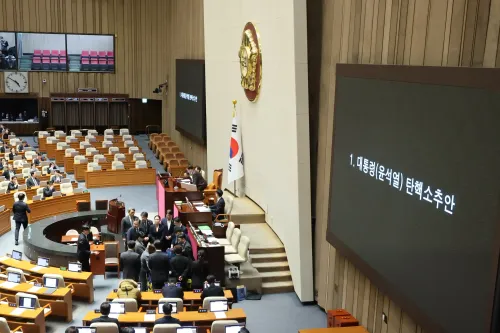
Impeachment proceedings were initiated against Yoon.
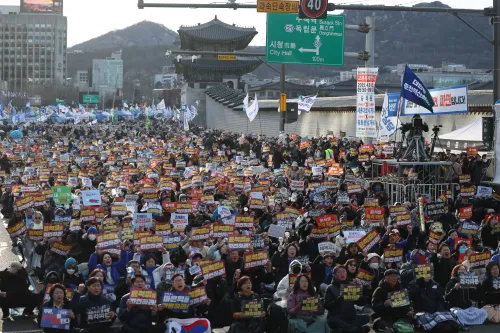
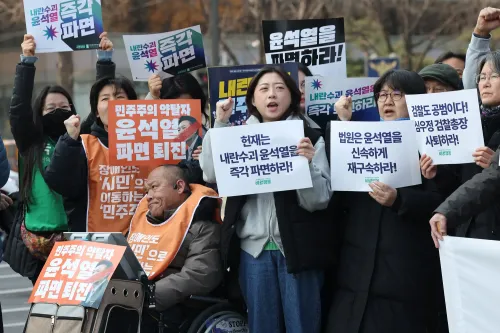
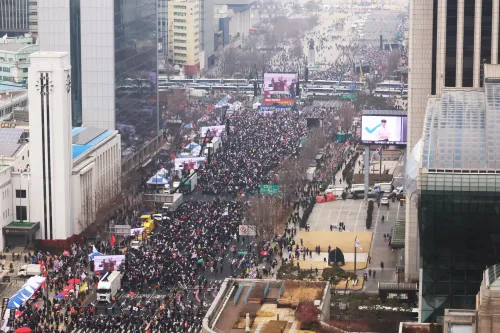
Seoul, Dec 2 (NationPress) Civic groups from both liberal and conservative spectrums in South Korea are set to hold distinct rallies in front of the National Assembly in Seoul on Wednesday to commemorate the first anniversary of former President Yoon Suk Yeol's declaration of martial law.
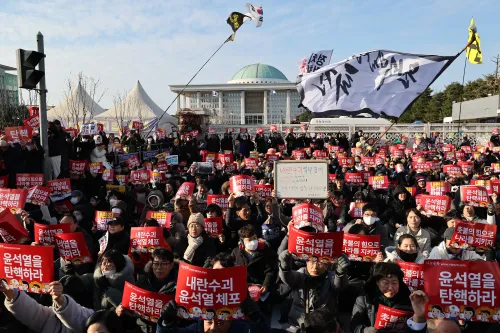
Approximately 3,000 individuals associated with various liberal civic organizations will convene at Exit 5 of National Assembly Station in Yeouido at 7 p.m. to reflect on their efforts to oppose the December 3 martial law and impeach Yoon.
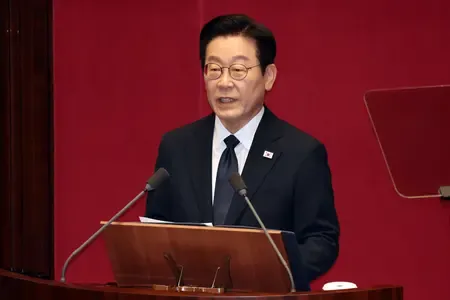
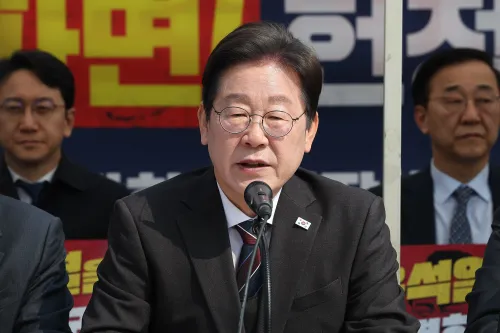
Importantly, South Korean President Lee Jae Myung is expected to attend the outdoor rally, as confirmed by the presidential office.
Following the rally, the liberal activists intend to march towards the headquarters of the main opposition People Power Party (PPP), located in Yeouido.
Prior to this event, members of the Solidarity Against Disability Discrimination and the Korean Confederation of Trade Unions, a militant labor organization, will hold separate rallies at the same venue.
In contrast, around 400 conservative activists supporting Yoon will gather at Exit 3 of National Assembly Station at 2 p.m. to demand Lee's resignation, after which they will march towards the headquarters of the ruling Democratic Party and the PPP.
Another faction of conservatives plans to rally in front of the PPP headquarters at 3 p.m. to affirm the legitimacy of the martial law imposition and contest the party's apology regarding the emergency measure.
Supporters of Yoon will also assemble at Hongik University Station in western Seoul on Wednesday morning before marching towards the presidential office in Yongsan, as reported by Yonhap news agency.
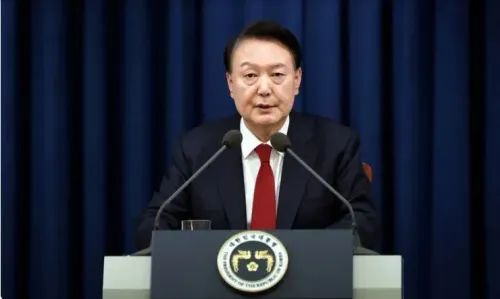
The 2024 South Korean martial law crisis was a significant political upheaval triggered by President Yoon Suk Yeol's martial law declaration. On December 3, 2024, at 22:27 Korea Standard Time (KST), Yoon announced the imposition of martial law during a televised address.
This declaration faced opposition from both parties and incited protests. On December 4, 190 legislators present at the National Assembly Proceeding Hall unanimously voted to revoke martial law, despite attempts by the Republic of Korea Army Special Warfare Command to obstruct the vote. Yoon and his cabinet subsequently rescinded the martial law and dissolved the Martial Law Command.
The opposition initiated impeachment proceedings against Yoon, vowing to persist if he did not resign. The uproar surrounding the declaration prompted resignations of several officials in Yoon's administration, including Defence Minister Kim Yong-hyun, who had urged Yoon to impose martial law during a last-minute cabinet meeting shortly before the declaration and played a central role in the martial law order.
Yoon, along with other officials from his administration and military personnel, faced investigations for their involvement in the decree's execution.
On December 7, Yoon issued an apology regarding the martial law declaration. The following day, former Defence Minister Kim Yong-hyun was arrested and transferred to a detention facility for his part in the martial law order, where he later attempted suicide shortly before a warrant could be filed against him. On December 12, Yoon proclaimed his intent to 'fight to the end' and asserted that the martial law declaration was an 'act of governance' to safeguard against anti-state forces.
It is widely believed that the declaration stemmed from political tensions with the DPK-controlled Assembly over repeated impeachment attempts against officials, opposition to his budget, and various scandals involving him and his wife, Kim Keon Hee.
Yoon was impeached on December 14 by the National Assembly and suspended from office pending a final ruling by the Constitutional Court on whether to affirm his removal from the presidency. Prime Minister Han Duck-soo served as acting president until he, too, was impeached on December 27, leading to Finance Minister and Deputy Prime Minister Choi Sang-mok taking over as acting president. However, Han's impeachment was overturned by the Constitutional Court on March 24, reinstating him as acting president.
Yoon was arrested on January 15. On January 26, he was indicted for leading an insurrection, marking the first instance of a sitting president being arrested and indicted in South Korean history. On April 4, the Constitutional Court unanimously upheld Yoon's impeachment and removal from office due to the martial law declaration.
Point of View
It is essential to approach this matter with impartiality. The upcoming rallies reflect the diverse political landscape in South Korea. While both sides have their arguments, it is crucial to foster dialogue and understand the implications of such significant historical events on the country's future.
NationPress
25 Sept 2026
Frequently Asked Questions
What is the significance of the martial law declaration?
The martial law declaration by President Yoon Suk Yeol marked a significant political crisis, sparking nationwide protests and leading to impeachment proceedings.
Who are the key figures involved in the rallies?
Key figures include President Lee Jae Myung attending the liberal rally and various conservative activists supporting former President Yoon.
What are the main goals of the rallies?
The liberal rally aims to reflect on the resistance against martial law, while the conservative rally seeks to assert support for Yoon and demand political accountability.
When and where will the rallies take place?
The rallies will take place on December 3 in front of the National Assembly in Yeouido, Seoul.
What was the outcome of the martial law declaration?
The martial law was lifted after legislative intervention, leading to significant political repercussions for President Yoon and his administration.