Aung San Suu Kyi moved to house arrest as Myanmar junta seeks legitimacy
Synopsis
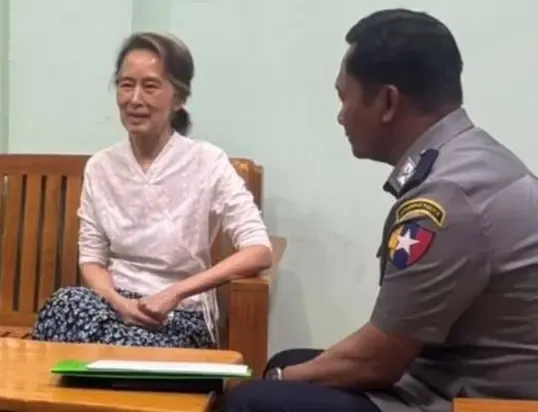
Myanmar's military junta has moved the ailing 80-year-old Aung San Suu Kyi from prison to house arrest — not as a genuine concession, but as part of a calculated charm offensive following Min Aung Hlaing's ascent to the presidency. With the economy shattered and international isolation deepening, the junta is betting that symbolic clemency can substitute for democratic legitimacy.
Key Takeaways
Aung San Suu Kyi , 80, was transferred from Nay Pyi Taw Prison to house detention on 1 May 2025 .
Her total sentence of 33 years had already been reduced to 22 years and six months ; a further one-sixth reduction was announced Thursday.
The move follows Min Aung Hlaing's election as president on 3 April by a parliament constituted without the banned NLD .
Former civilian president Win Myint and over 4,300 political prisoners were released on 17 April in a separate amnesty.
The National Unity Government in exile welcomed the prisoner releases but has not recognised the junta's political process.
Myanmar's economy remains severely weakened by the 2021 coup , a major earthquake, and ongoing ethnic insurgencies.
Myanmar's military junta has transferred Aung San Suu Kyi, the country's 80-year-old former de facto leader, from Nay Pyi Taw Prison to house detention, according to an official statement from Myanmar's Ministry of Information on 1 May 2025. The move follows the election of senior general Min Aung Hlaing as president on 3 April, and is widely seen as an attempt by the junta to project a veneer of democratic legitimacy amid deep international isolation.
What the Junta Announced
Myanmar's Ministry of Information said the president "has decided to commute the remaining sentences of Daw Aung San Suu Kyi, who is currently serving her sentence at Nay Pyi Taw Prison, to be served under house arrest." The ministry described the decision as taken "from a perspective of the state's benevolence and goodwill," citing the sacred Full Moon Day of Kasone — a day of deep significance for Myanmar Buddhists, commemorating the birth, enlightenment, and passing into nirvana of Buddha — as well as "recognition of her humanitarian compassion."
A Sentence That Has Shrunk, But Not Ended
Under junta rule, Aung San Suu Kyi was charged with offences ranging from allegedly owning walkie-talkies to sedition and corruption, accumulating a total sentence of 33 years. That was successively reduced to 22 years and six months. On Thursday, the junta announced a further reduction of one-sixth of the remaining term — though she will continue to be held under house detention rather than freed. She is reported to be in frail health.
Broader Amnesty Pattern
The transfer of Aung San Suu Kyi is part of a wider pattern of calculated clemency by the junta since Min Aung Hlaing assumed the presidency. On 17 April, former civilian president Win Myint was released from detention along with more than 4,300 political prisoners — a gesture the junta framed as observance of Myanmar's New Year. The National Unity Government in exile, which represents the overthrown civilian administration, said it "expresses its sincere satisfaction" with the release of "certain political prisoners — including our President, U Win Myint — who were unjustly arrested and detained by the military dictatorship."
Who Is Aung San Suu Kyi
Aung San Suu Kyi was the state counsellor and de facto leader of Myanmar's democratically elected civilian government, which was overthrown by the military in a February 2021 coup. She is the daughter of Aung San, the country's independence movement leader who was assassinated before Myanmar gained freedom from British rule in 1948. A graduate of Lady Shri Ram College in Delhi, she returned to Myanmar in 1988 and became a leader of the National League for Democracy (NLD). She has spent significant portions of her life in prison and house detention. Her marriage to a British citizen was used by the junta to bar her from the presidency, prompting the NLD to create the role of state counsellor specifically to give her executive authority.
Why the Junta Needs International Acceptance
Myanmar's economy has been severely battered — first by the fallout of the 2021 coup, then by a devastating earthquake last year, and compounded by multiple ongoing ethnic insurgencies across the country. The parliament that elected Min Aung Hlaing as president was itself constituted through polls held between December 2024 and January 2025, without the participation of the banned NLD. Critics and international observers have broadly dismissed the elections as a legitimising exercise for continued military rule. The junta's amnesty gestures, including the transfer of Aung San Suu Kyi, appear calibrated to soften that perception and attract foreign investment and diplomatic engagement the regime urgently needs.
Whether these moves will translate into meaningful international recognition remains uncertain, with rights groups and Western governments continuing to press for a full restoration of civilian rule and the unconditional release of all political prisoners.
Point of View
Not a democratic one. Myanmar's military has a long institutional history of deploying selective clemency — including previous periods of Suu Kyi's house detention — to manage international pressure without relinquishing power. The parliament that elected Min Aung Hlaing excluded the NLD entirely, making the 'democratic transition' framing hollow. What the junta actually needs is economic relief: foreign investment, sanctions rollback, and multilateral engagement. The amnesty gestures are the price it is willing to pay to get there. Whether that calculus succeeds depends largely on how firmly Western governments and ASEAN hold the line — and history suggests that line tends to blur under economic and geopolitical pressure.
NationPress
20 Sept 2026
Frequently Asked Questions
Why was Aung San Suu Kyi moved to house arrest?
Myanmar's military junta transferred Aung San Suu Kyi from Nay Pyi Taw Prison to house detention on 1 May 2025, citing 'state benevolence' and the sacred Full Moon Day of Kasone. The move is widely seen as part of the junta's effort to gain international legitimacy following Min Aung Hlaing's election as president.
What is Aung San Suu Kyi's current sentence?
Her original 33-year sentence had already been reduced to 22 years and six months. On 1 May 2025, the junta announced a further reduction of one-sixth of the remaining term, though she remains under house detention and has not been freed.
Who is Min Aung Hlaing and how did he become president?
Min Aung Hlaing is the senior general who led the February 2021 military coup that overthrew Myanmar's elected civilian government. He was elected president on 3 April 2025 by a parliament constituted through polls held between December 2024 and January 2025, from which the banned National League for Democracy was excluded.
Who else was released by the Myanmar junta recently?
Former civilian president Win Myint and more than 4,300 political prisoners were released on 17 April 2025, which the junta said was in observance of Myanmar's New Year. The National Unity Government in exile welcomed the releases but has not recognised the junta's political legitimacy.
What is the National Unity Government of Myanmar?
The National Unity Government is a government-in-exile formed by representatives of the civilian administration overthrown in the 2021 coup. It continues to oppose military rule and has expressed satisfaction at the release of political prisoners, including former president Win Myint, while condemning their original detention as unjust.