Trump: US Holds Strait of Hormuz Until Iran Signs Deal
Synopsis
President Trump has declared total US control of the Strait of Hormuz, blocking Iran from earning an estimated $500 million daily in oil revenue until Tehran agrees to a nuclear deal. With no fixed deadline and domestic US oil exports surging, Washington is betting economic strangulation will force Iran to the table.
Key Takeaways
President Donald Trump declared the US has "total control" of the Strait of Hormuz as of April 24, 2025 , using it as leverage against Iran .
Trump stated he does not want Iran earning an estimated $500 million per day in oil revenue until a deal is reached.
The Strait of Hormuz carries approximately 20% of the world's daily oil supply, making its closure a major global energy event.
US domestic oil and gas production is at a record high, with ships from around the world diverting to Texas, Louisiana, and Alaska for supply.
Trump confirmed consumers may face higher fuel costs "for a little while" but said stock markets remain at all-time highs .
No fixed timeline for a resolution has been set; Trump said "we have plenty of time," signalling a prolonged pressure campaign tied to Iran's nuclear programme .
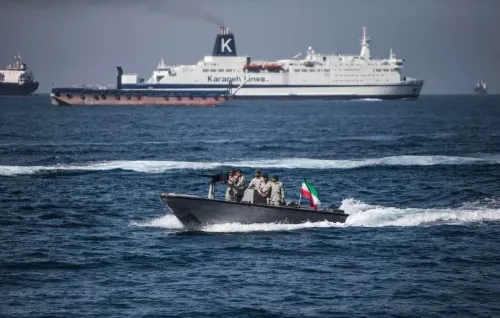
Washington, April 24 — US President Donald Trump declared that the United States has seized effective control of the Strait of Hormuz and will not relinquish it until Iran agrees to a deal, deploying the world's most critical oil shipping lane as a high-stakes economic weapon in the escalating standoff over Tehran's nuclear ambitions.
Trump's Strait of Hormuz Ultimatum
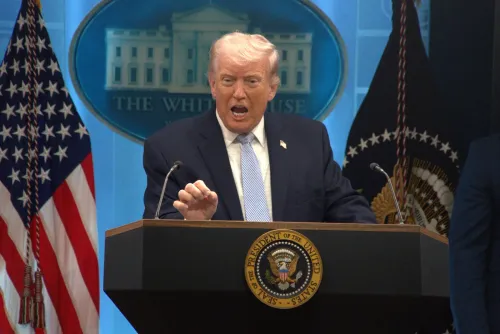
Trump was unambiguous about the US position. "We have total control of it," he stated, adding, "It'll open when they make a deal or something else happens that's very positive." The declaration marks one of the most aggressive uses of maritime leverage in recent American foreign policy history.
The core of Trump's strategy is economic strangulation. "If we open the strait, that means they're going to make $500 million a day. I don't want them to make $500 million a day until they settle this thing," he said, making clear that denying Iran oil revenue is the primary objective.
Why the Strait of Hormuz Matters Globally
The Strait of Hormuz is a narrow but supremely strategic waterway connecting Gulf oil producers — including Saudi Arabia, the UAE, Kuwait, and Iraq — to global energy markets. Roughly 20% of the world's oil supply transits through this chokepoint daily, making any disruption a potential trigger for global price shocks.
Historically, even threats to close the strait have sent crude prices surging. The current US control of the passage represents an unprecedented escalation, with ripple effects already being watched closely by energy traders, central banks, and governments worldwide.
Impact on Oil Prices and American Consumers
When asked directly about rising fuel costs for ordinary Americans, Trump acknowledged the pain but minimised its duration: "For a little while," he said. The response drew attention to the domestic trade-off embedded in his foreign policy gambit — squeezing Iran at the potential cost of higher pump prices for US consumers.
However, Trump pointed to resilient market conditions as justification. "The stock market is at an all-time high… I thought oil would go up to maybe $200 a barrel. And oil is at a very different number than anyone thought," he said, suggesting the economic fallout has so far been more contained than critics predicted.
The administration credited domestic energy output as a critical buffer. "We're putting out right now more oil and gas than we ever have in the history of our country," Trump said, framing US energy dominance as the safety net that makes the Hormuz strategy viable.
US Energy Exports Fill the Gap
Trump highlighted a notable shift in global energy trade flows. "Ships are coming from all over the world to Texas, Louisiana and Alaska… to get oil from the United States while this is closed," he said. This positions the US not merely as a geopolitical actor but as the direct commercial beneficiary of the strait's closure — a detail that critics argue reveals the dual economic-strategic motive behind the move.
This is a significant second-order consequence that most coverage has underplayed: as Iran loses oil revenue, American energy producers gain market share. The policy simultaneously punishes an adversary and enriches a domestic industry — a pattern consistent with Trump's transactional approach to foreign policy.
Nuclear Threat and No Fixed Timeline
Trump explicitly tied the economic pressure campaign to the overarching security objective of preventing Iran from acquiring nuclear weapons. "You can't let them have a nuclear weapon," he stated firmly, framing the Hormuz leverage as part of a broader non-proliferation strategy.
Notably, Trump signalled there is no deadline driving his hand. "I don't want to rush it… we have plenty of time," he said — a posture suggesting Washington believes Tehran's economic pain will intensify over time, eventually forcing concessions at the negotiating table. This mirrors the maximum pressure doctrine Trump applied during his first term, which saw Iran's currency collapse but did not produce a new nuclear agreement.
With nuclear talks at a critical juncture and Iran's economy already under severe strain from years of sanctions, the coming weeks will test whether Hormuz control translates into a diplomatic breakthrough or deepens a dangerous regional standoff with global energy consequences.
Point of View
American energy exporters are cashing in on redirected global demand. This is not merely a security strategy; it is a foreign policy that doubles as an industrial subsidy for US oil states. The irony is sharp — a president who campaigned on ending foreign entanglements is now wielding a global chokepoint as a permanent bargaining chip, with no stated timeline and American consumers quietly absorbing the fuel cost. Whether this produces a nuclear deal or a protracted standoff will define the energy and security architecture of the next decade.
NationPress
21 Sept 2026
Frequently Asked Questions
Why is the US controlling the Strait of Hormuz?
The US is controlling the Strait of Hormuz to pressure Iran economically and force it into a nuclear deal. President Trump stated he does not want Iran earning approximately $500 million per day in oil revenue until the dispute is resolved.
What is the Strait of Hormuz and why is it important?
The Strait of Hormuz is a narrow shipping lane between the Gulf and the Arabian Sea through which roughly 20% of the world's daily oil supply passes. Any disruption to this waterway directly impacts global oil prices and energy security.
How will the Strait of Hormuz closure affect oil prices?
Trump acknowledged that fuel prices could rise for consumers, though he described the impact as lasting only 'a little while.' He noted oil prices have remained lower than many analysts predicted, citing record US domestic production as a stabilising factor.
Has Trump set a deadline for Iran to reach a deal?
No, Trump explicitly stated he does not want to rush the process, saying 'we have plenty of time.' This suggests Washington is banking on Iran's escalating economic pain to eventually compel a negotiated agreement.
What is the US demanding from Iran in the current standoff?
The primary US demand is that Iran must not be allowed to develop a nuclear weapon, as Trump stated directly. The Hormuz leverage is being used to push Iran toward a broader deal addressing its nuclear programme.