Trump Urges Thune to Block Senate Recess, End Filibuster
Synopsis
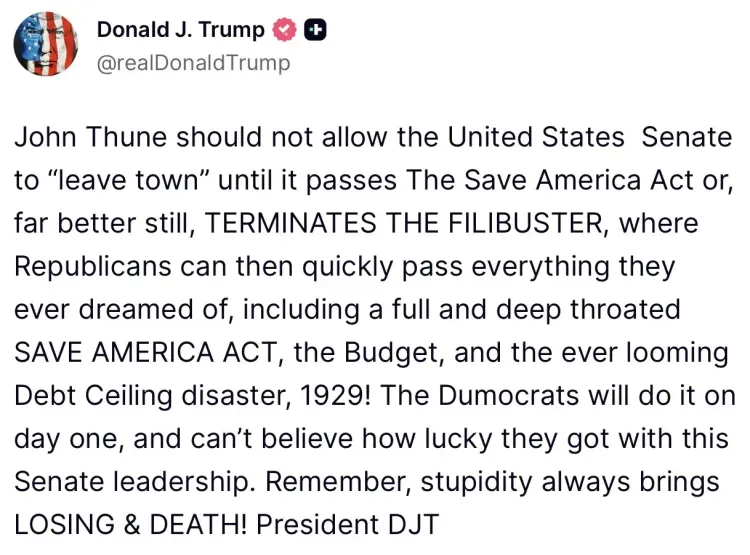
President Trump, via the official White House account, publicly demanded Senate Majority Leader John Thune keep the Senate in session until it passes the Save America Act — or eliminates the legislative filibuster entirely. The directive reignites a long-running battle over Senate procedure and executive legislative strategy.
Key Takeaways
President Trump issued a public directive on 27 July 2026 via the White House account targeting Senate Majority Leader John Thune .
Trump demanded the Senate not recess until it passes the Save America Act or eliminates the legislative filibuster .
The filibuster requires a 60-vote supermajority to advance most legislation, giving the minority party effective veto power.
In 2017 , Senate Republicans eliminated the filibuster for Supreme Court nominations but preserved it for legislation.
Thune controls the Senate floor schedule and is under direct presidential pressure to act before any recess.
Any rules change to end the filibuster would require near-unanimous Republican Senate support.
The White House, on behalf of President Donald J. Trump, issued a pointed public directive on Monday, 27 July 2026, demanding that Senate Majority Leader John Thune prevent the United States Senate from adjourning until it passes the Save America Act — or, in Trump's preferred outcome, permanently eliminates the legislative filibuster.
Context
The statement, posted on the official White House account, quotes President Trump directly: 'John Thune should not allow the United States Senate to leave town until it passes The Save America Act or, far better still, TERMINATES THE FILIBUSTER.' The all-caps emphasis on 'TERMINATES THE FILIBUSTER' signals the administration's frustration with the Senate's procedural rules, which require a 60-vote supermajority to advance most legislation past extended debate.
The filibuster has long been a flashpoint between executive ambition and legislative procedure. When the majority party holds fewer than 60 seats, the filibuster effectively gives the minority party veto power over most bills — a dynamic that has repeatedly stalled administration-priority legislation across both parties.
Policy Backdrop
Calls to curtail or eliminate the legislative filibuster are not new. In 2017, Senate Republicans invoked what is commonly called the 'nuclear option' to remove the filibuster for Supreme Court nominations, allowing Justice Neil Gorsuch's confirmation with a simple majority. During that same period, President Trump publicly urged Senate Republicans to go further and eliminate the filibuster for legislation as well — a step the Senate declined to take.
Both parties have historically adjusted Senate confirmation rules when in power while preserving the legislative filibuster, treating it as a guardrail against one-party dominance of the legislative calendar. Trump's renewed push in 2026 reflects a consistent position he has held across his political career: that the filibuster is an obstacle to decisive executive-backed governance.
Stakeholders and Impact
Senate Majority Leader John Thune, a senior Republican from South Dakota, is the direct target of the president's public pressure. As the leader who controls the Senate floor schedule, Thune holds the procedural authority to keep senators in session or allow a recess. The directive puts him in a politically delicate position — caught between loyalty to a sitting president and the institutional preferences of Senate Republicans who have historically resisted abolishing the filibuster.
Senate Republicans as a caucus represent the primary stakeholder group. Several Republican senators have in the past expressed reluctance to eliminate the filibuster, arguing it protects minority rights and would be used against them when out of power. Any move to end the filibuster would require near-unanimous Republican support in the Senate.
What's Next
The immediate question is whether Thune will heed the president's call and keep the Senate in session through what would otherwise be a scheduled recess period. Floor action on the Save America Act — the details of which remain unverified — and any Senate rules-change proceedings will be the key developments to watch in the coming days. If the filibuster debate intensifies, it could reshape the legislative calendar for the remainder of the 2026 session and define the contours of the Trump administration's second-term domestic agenda.
Point of View
Public accountability politics. The filibuster has survived repeated assaults from both parties precisely because sitting senators value its protection when they become the minority; Thune's response will reveal how much institutional loyalty remains in a Trump-era Republican Senate. This moment fits a broader pattern in which the executive branch uses social media to discipline legislative allies and set the terms of debate before formal negotiations begin. The outcome will be a significant indicator of whether the Trump administration's second term can translate political momentum into durable legislative wins.
NationPress
27 Jul 2026
Frequently Asked Questions
What is the Save America Act?
The Save America Act is a piece of legislation being pushed by the Trump administration in 2026. Specific details of the bill's provisions have not been independently verified, but President Trump has made its passage a stated Senate priority.
What is the filibuster and why does Trump want to end it?
The filibuster is a Senate procedural rule that allows the minority party to extend debate indefinitely on most legislation, effectively requiring a 60-vote supermajority to pass bills. Trump wants it eliminated so that a simple majority of 51 votes would be sufficient to pass administration-backed legislation without bipartisan support.
Who is John Thune and what power does he have here?
John Thune is the Republican Senate Majority Leader and senior senator from South Dakota. As majority leader, he controls the Senate floor schedule, including whether the chamber recesses or remains in session — making him the direct target of Trump's directive.
Has the filibuster ever been eliminated before?
The filibuster has been partially eliminated. In 2017, Senate Republicans removed it for Supreme Court nominations, allowing confirmations with a simple majority. However, the legislative filibuster — applying to regular bills — has never been fully abolished, though both parties have debated doing so when in power.
What happens if the Senate does not act on Trump's demand?
If the Senate recesses without passing the Save America Act or changing the filibuster rule, it would represent a public rebuke of the president's directive by his own party's leadership. This could escalate tensions between the White House and Senate Republicans and reshape legislative priorities for the remainder of the 2026 session.