Congress Faces Deepening Rift Over Iran Policy
Synopsis
The ongoing conflict over Iran policy intensifies in Congress as Senate Majority Leader John Thune supports President Trump, while House Democrats push for a resolution limiting military action. This political standoff highlights contrasting visions for U.S. foreign policy and national security.
Key Takeaways
Congress is divided on the approach to Iran, with Republicans supporting a strong military stance.
House Democrats are advocating for legislative limits on military action.
Senate Majority Leader John Thune backs President Trump's strategy.
Transparency in U.S. policy regarding Iran is being called for by Democratic leaders.
Bipartisan efforts are underway to support Iranian human rights and internet freedom.
Washington, Feb 26 (NationPress) The divide between Republicans and Democrats intensified over Iran on Thursday, as Senate Majority Leader John Thune expressed his support for President Donald Trump’s strategy, while House Democrats sought to initiate a vote on a resolution that would restrict any military engagement.
During an appearance on Fox News, Thune stated, “This president is dedicated to ensuring safer streets, providing greater financial resources for the American populace, and creating new opportunities for citizens to thrive.”
On matters of foreign policy, he remarked, “I believe the president is preparing us to safeguard America’s critical national security interests, both regionally and domestically. We cannot allow, we cannot tolerate a nuclear Iran… [President Trump] emphasized that in his speech last night, and I think that’s a sentiment that resonates with a substantial majority of Americans.”
Thune further noted that the United States has “crucial interests in that region” and asserted that the President is aiming for “peace through strength by ensuring that America has the right resources positioned properly, if necessary. Hopefully, it won’t come to that. If the Iranians are willing to negotiate, I believe there may be an opportunity for an agreement.”
Simultaneously, Democratic leaders in the House declared their intent to force a vote on the bipartisan Khanna-Massie Iran War Powers Resolution when Congress reconvenes next week.
“Upon Congress’s return, we will demand a vote from the full House of Representatives on the bipartisan Khanna-Massie War Powers resolution,” Democratic leaders announced in a joint statement.
“This legislation mandates that the President must seek Congressional approval before deploying military force against Iran,” they explained.
“We firmly believe that any such action would violate the Constitution without consultation and authorization from Congress. Next week, every Member will have the chance to publicly state their position on military action against Iran without Congressional consent.”
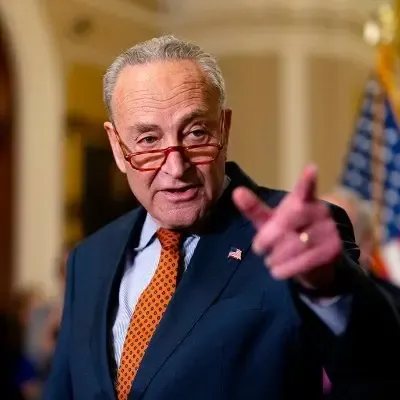
In the Senate, Democratic Leader Chuck Schumer urged the administration to provide clearer objectives as U.S. and Iranian officials engaged in discussions in Geneva.
“The administration must be transparent and inform the American people about its goals regarding Iran,” Schumer stated on the Senate floor.
“I have consistently maintained that addressing Iran and curbing its nuclear ambitions necessitates a comprehensive strategy, transparency, and clarity. However, so far, we have received none of that from the administration. The American public deserves clarity.”
Meanwhile, Senators Jacky Rosen and Dave McCormick introduced the bipartisan Iran Human Rights, Internet Freedom, and Accountability Act aimed at increasing pressure on Tehran following internet blackouts and a crackdown on protests.
“The citizens of Iran are forced to endure a repressive regime that employs censorship and internet blackouts to undermine their resistance,” Rosen stated.
“The future of Iran should be determined by its people, who are entitled to have their rights safeguarded and access to information unhindered.”
McCormick added that the legislation “reinforces America’s commitment to support the Iranian populace against a regime that is economically, militarily, and morally bankrupt.”
Point of View
It is essential to recognize the widening gap between political parties regarding foreign policy. The contrasting approaches to Iran highlight the complexities and challenges involved in addressing national security, international relations, and the constitutional prerogatives of Congress.
NationPress
26 Sept 2026
Frequently Asked Questions
What is the Khanna-Massie War Powers Resolution?
The Khanna-Massie War Powers Resolution is a bipartisan proposal aiming to require the President to seek Congressional approval for any military action against Iran.
Why are Democrats pushing for a vote on military action?
Democrats argue that any military action against Iran would be unconstitutional without consultation and authorization from Congress.
What did Senate Majority Leader John Thune say about President Trump's approach?
Thune endorsed Trump's strategy, emphasizing the need to protect vital national security interests and the importance of preventing a nuclear Iran.
What does the bipartisan Iran Human Rights Act aim to achieve?
The Iran Human Rights, Internet Freedom, and Accountability Act seeks to increase pressure on the Iranian government, promoting human rights and internet freedom.
What are the implications of the divide in Congress over Iran?
The divide signifies a broader conflict over U.S. foreign policy and highlights the differing priorities of Republicans and Democrats regarding national security.