Trump Warns of Military Strike on Iran, Signals No Rush for Deal
Synopsis
President Trump has warned he will strike the remaining 25% of Iran's military targets if Tehran refuses a deal, while revealing the US controls the Strait of Hormuz — blocking $500 million in daily Iranian oil revenue. The high-stakes standoff centres entirely on preventing Iran from acquiring nuclear weapons.
Key Takeaways
President Donald Trump warned on April 24 that the US will strike the remaining 25 per cent of Iranian military targets if Tehran refuses to negotiate a deal.
The US military claims to have already destroyed 75 per cent of its designated targets, including damage to Iran's naval, air, and missile capabilities.
Trump confirmed America holds "total control" over the Strait of Hormuz , blocking an estimated $500 million per day in Iranian oil revenue.
The central US objective is preventing Iran from acquiring a nuclear weapon — Trump ruled out any American use of nuclear arms in the conflict.
Trump described Iran's leadership as fractured and unstable, saying factions are "fighting like cats and dogs" over control of the country.
A humanitarian development: eight Iranian women facing execution are set to be released following a direct appeal from the United States .
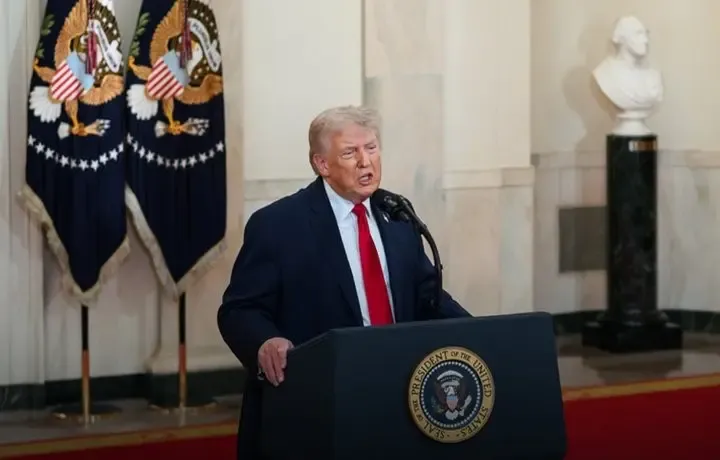
Washington, April 24 — US President Donald Trump has issued a stark warning that the United States could escalate military operations against Iran if diplomatic negotiations collapse, while simultaneously stating he is in "no rush" to finalise any agreement. The remarks, made on April 24, signal a calculated dual-track strategy combining sustained military pressure with conditional diplomacy aimed at permanently dismantling Iran's nuclear ambitions.
Trump's Military Warning and Strike Claims
Speaking publicly, Trump declared that the US military had already struck approximately 75 per cent of its designated targets inside Iran, inflicting severe damage on the country's naval, air, and missile infrastructure. He warned that if Tehran refuses to negotiate a lasting settlement, Washington would "finish it up militarily with the other 25 per cent of the targets."
Trump asserted that the recent US-led military campaign had "totally defeated" Iran's armed forces within weeks, describing the pace of destruction as unprecedented. The remarks came during what officials characterised as a fragile pause in active hostilities.
Despite earlier suggesting the conflict could be resolved within four to six weeks, Trump declined to set a firm timeline. "I don't want to rush it… we have plenty of time," he said, underscoring that Iran is under mounting pressure from economic strain and severely disrupted oil exports.
Strait of Hormuz: America's Economic Chokehold on Iran
One of the most significant strategic revelations in Trump's remarks was the confirmation that the United States now holds "total control" over the Strait of Hormuz — one of the world's most critical oil transit chokepoints, through which roughly 20 per cent of global oil supplies pass daily.
Trump stated that Washington has effectively kept the strait closed as an economic weapon against Tehran. "If we open the strait, that means they're going to make $500 million a day. I don't want them to make $500 million a day until they settle this thing," he said.
This blockade has far-reaching consequences — not just for Iran, but for global energy markets. Analysts note that prolonged closure of the Strait of Hormuz could spike international crude prices, affecting fuel costs across Asia, Europe, and beyond. Trump acknowledged short-term fuel price increases for Americans but framed the economic pain as a necessary trade-off to prevent Iran from acquiring nuclear weapons.
Nuclear Weapons: The Core of the Conflict
Trump was unequivocal on the central objective of US policy toward Iran: "This is all about a nuclear weapon. They cannot have the nuclear bomb, and they're not going to have the nuclear bomb."
He simultaneously ruled out any American use of nuclear weapons, stating: "No, I wouldn't use it. A nuclear weapon should never be allowed to be used by anybody." This positions Washington as seeking to enforce nuclear non-proliferation through conventional military superiority rather than nuclear deterrence.
Notably, Iran has long maintained that its nuclear programme is civilian in nature, a claim that the US, Israel, and Western allies have consistently disputed. The 2015 JCPOA (Joint Comprehensive Plan of Action) — the landmark nuclear deal abandoned by Trump during his first term in 2018 — was designed to cap Iran's enrichment capacity in exchange for sanctions relief. Its collapse set the stage for the current escalation.
Iran's Internal Instability and Leadership Vacuum
Trump painted a picture of a fractured Iranian leadership struggling to maintain coherence under the weight of sustained military strikes and economic pressure. "They don't even know who is leading the country… they're fighting like cats and dogs for who's going to control," he said.
This claim, if accurate, represents a significant shift in Iran's internal political dynamics. The Islamic Revolutionary Guard Corps (IRGC) and civilian government factions have historically maintained a tense but functional power-sharing arrangement. A genuine leadership vacuum could either accelerate a negotiated settlement — or, conversely, make it harder to find a credible counterpart for diplomacy.
On a humanitarian note, Trump revealed that eight women who were facing execution in Iran would be released following a direct US appeal — a rare instance of humanitarian diplomacy amid the broader conflict.
Strategic Implications and What Comes Next
The broader geopolitical stakes of the US-Iran standoff extend well beyond the two nations. A prolonged closure of the Strait of Hormuz threatens energy security across South Asia, including India, which sources a significant share of its crude oil from the Persian Gulf. Indian policymakers will be watching developments closely, given New Delhi's traditionally balanced ties with both Washington and Tehran.
Critics argue that Trump's approach — military dominance combined with economic strangulation — mirrors the maximum pressure campaign of his first term, which failed to bring Iran to the negotiating table and instead accelerated its uranium enrichment. Whether this second iteration produces a different outcome remains the defining question.
As diplomatic channels remain open but fragile, the world watches whether Tehran will blink under pressure or whether the absence of a clear Iranian leadership structure will complicate any path to a lasting agreement. The coming weeks will be critical in determining whether this conflict moves toward resolution — or a dangerous new phase of escalation.
Point of View
Directly enabling the enrichment levels that now justify military action. Control of the Strait of Hormuz is a double-edged sword — it squeezes Tehran, but it also holds global energy markets hostage, with countries like India caught in the crossfire. The real question mainstream coverage misses is this: without a coherent Iranian leadership to negotiate with, who exactly does Washington sign a deal with — and will it hold?
NationPress
19 Sept 2026
Frequently Asked Questions
Why is Trump threatening military action against Iran?
Trump is threatening further military strikes against Iran to pressure Tehran into agreeing to a deal that permanently blocks its nuclear weapons programme. He has stated the US has already hit 75 per cent of its targets and will strike the remaining 25 per cent if Iran refuses to negotiate.
What is the Strait of Hormuz and why is Trump controlling it?
The Strait of Hormuz is a critical global oil transit route through which roughly 20 per cent of the world's oil supply passes daily. Trump has confirmed the US now controls it and is keeping it effectively closed to cut off approximately $500 million in daily Iranian oil revenue as economic leverage.
Is Trump open to a nuclear deal with Iran?
Trump says he is open to a deal but is in 'no rush,' insisting any agreement must permanently prevent Iran from acquiring nuclear weapons. He declined to set a timeline for negotiations, arguing that Iran is under greater pressure due to economic strain and disrupted oil exports.
What has the US military campaign done to Iran's armed forces?
According to Trump, the US-led military campaign has 'totally defeated' Iran's military, causing significant damage to its naval, air, and missile capabilities. He claims approximately 75 per cent of designated US military targets inside Iran have already been struck.
How does the US-Iran conflict affect India and global oil prices?
The closure of the Strait of Hormuz by the US directly threatens global energy supplies, including oil flows to India, which sources a large share of its crude from the Persian Gulf. Prolonged disruption could spike international crude prices, raising fuel costs across Asia and beyond.