Is Trump Renewing His Push for Greenland Control?
Synopsis
In a bold move, President Donald Trump has reignited the debate over Greenland's status as a crucial asset for American national security. As Denmark and Greenland officials meet at the White House, tensions rise over the potential for US control of the Arctic island amidst fears of Russian and Chinese expansion.
Key Takeaways
Trump reaffirms US interest in Greenland National security concerns highlighted Congress divided on Greenland's future Proposed legislation aims to protect Greenland's sovereignty Geopolitical tensions in the Arctic intensifying
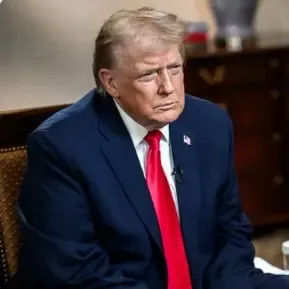
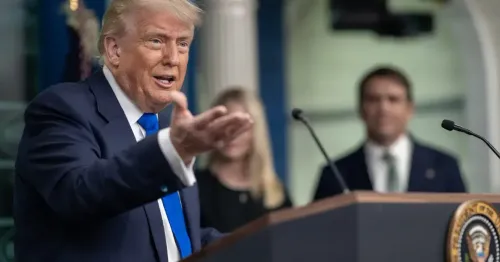
Washington, Jan 14 (NationPress) President Donald Trump on Wednesday reiterated his appeal for US dominance over Greenland, asserting on social media that the Arctic territory is crucial for American national security, as high-ranking officials from Denmark and Greenland initiated discussions at the White House.
“The United States requires Greenland for National Security purposes,” Trump stated on Truth Social. “It is essential for the Golden Dome we are constructing. NATO should spearhead our efforts to secure it. IF WE DON’T, RUSSIA OR CHINA WILL, AND THAT IS NOT GOING TO HAPPEN!”
In another message, Trump demanded action from the alliance, asserting: “NATO: Instruct Denmark to remove them immediately! Two dogsleds won’t suffice! Only the USA can!!!”
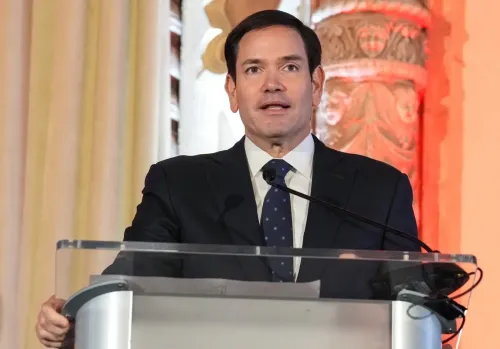
These statements were made as Danish Foreign Minister Lars Løkke Rasmussen and Greenlandic Foreign Minister Vivian Motzfeldt met with US Vice President JD Vance and Secretary of State Marco Rubio at the White House earlier that day. The discussions are anticipated to concentrate on Greenland’s security and the escalating rivalry in the Arctic.
Trump has persistently contended that possessing Greenland is vital for defense. In previous remarks, he indicated that the United States would act on Greenland “whether they approve or not,” cautioning that otherwise, Russia or China would expand their footprint near the island.
The renewed assertions have intensified divisions in Washington and elicited contrasting reactions in Congress.
On Tuesday, Democratic Congressman Jimmy Gomez of California introduced the Greenland Sovereignty Protection Act. This legislation would prevent the use of federal funds to facilitate the invasion, annexation, purchase, or any form of acquisition of Greenland by the United States.
“Greenland is not for sale, not for conquest, and not a bargaining chip,” Gomez declared. He cautioned that threatening an ally undermines international law and weakens NATO. The bill is designed to prevent Congress from financing what he termed Trump’s “imperial fantasies.”
The legislation would restrict funding for any actions related to acquiring Greenland. It would also prohibit increases in US military presence or financial investments there without explicit congressional consent. US-funded influence campaigns aimed at affecting Greenland’s political self-determination would also be banned. Any waiver would necessitate new legislation that specifically references the Act.
Gomez’s office clarified that the measure is not aimed at altering existing US defense cooperation with Denmark and Greenland under NATO and other agreements. Instead, it aims to avert unilateral actions outside established international frameworks.
The day prior, Republican Congressman Randy Fine from Florida proposed the Greenland Annexation and Statehood Act, advocating a contrasting approach.
“Greenland is not a remote outpost we can afford to overlook—it is a crucial national security asset,” Fine stated. He argued that control of Greenland is essential for Arctic shipping routes and US security, warning against permitting China and Russia to expand their influence in the area.
Fine asserted that years of ineffective US policy had weakened America’s strategic position. His bill would empower the president to take “whatever steps necessary” to annex or acquire Greenland as a US territory and would require a report to Congress detailing legal changes needed to admit Greenland as a US state.
In a separate initiative, Senator Chris Coons is leading a bipartisan congressional delegation to Copenhagen this week to reaffirm US support for Denmark and NATO. He remarked that the visit would demonstrate Congress’ commitment to alliances and sovereignty.
Greenland’s strategic importance has grown as Arctic ice diminishes and new shipping routes emerge. Both Denmark and Greenland have consistently stated that the island is not for sale, while opponents of annexation caution that any attempt to acquire it through force or pressure would undermine NATO unity and international law.
Point of View
I believe this ongoing discussion surrounding Greenland's status raises significant questions about national security and international diplomacy. While opinions are sharply divided, it's crucial to approach this matter with a focus on established frameworks and alliances, ensuring that actions taken are in line with international law and cooperation.
NationPress
2 Oct 2026
Frequently Asked Questions
What is the Greenland Sovereignty Protection Act?
The Greenland Sovereignty Protection Act is a bill introduced by Congressman Jimmy Gomez that aims to prohibit the use of federal funds for the invasion, annexation, or purchase of Greenland, emphasizing that the island is not for sale.
Why does Trump believe Greenland is important?
Trump argues that Greenland's control is essential for US national security, particularly in light of potential Russian and Chinese expansion in the Arctic region.
What are the implications of annexing Greenland?
Annexing Greenland could have significant geopolitical implications, potentially straining relations with Denmark and undermining NATO's unity and international law.
How has Congress reacted to Trump's proposals?
Congress has exhibited divided opinions, with some lawmakers supporting Trump's push for control while others, like Congressman Gomez, are fiercely opposed and advocating for legislation to prevent such actions.
What is the significance of Greenland's strategic value?
Greenland's strategic value has increased as Arctic ice melts, opening up new shipping routes and attracting attention from global powers like Russia and China.