Could Resuming Nuclear Testing Decrease the Likelihood of Nuclear Conflict?

Synopsis
In a bold statement, US Defence Secretary Pete Hegseth supports President Trump's directive to restart nuclear weapons testing, claiming it will reduce the chances of nuclear conflict. This unexpected move has raised eyebrows globally, with implications that could reshape international relations. Read on to discover the potential impact of this decision and the reactions it has sparked.
Key Takeaways
US Defence Secretary supports nuclear testing resumption.
Claims it could reduce nuclear conflict likelihood.
Testing ensures a credible nuclear deterrent.
Concerns over a potential arms race.
Historic context of nuclear tests in various countries.
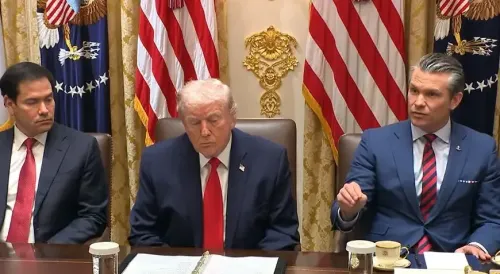
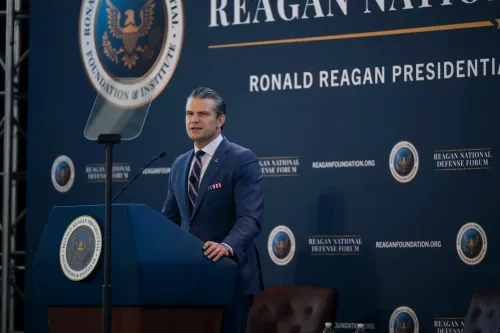
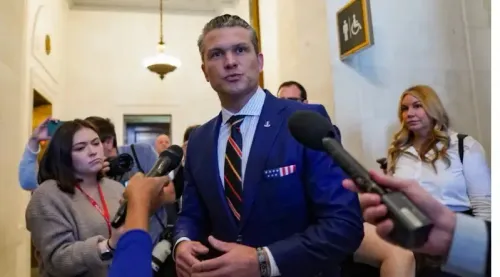
Kuala Lumpur, Oct 31 (NationPress) - US Defence Secretary Pete Hegseth, on Friday, supported President Donald Trump's unexpected order to recommence nuclear weapons testing, asserting that such a move would render nuclear conflict "less likely."
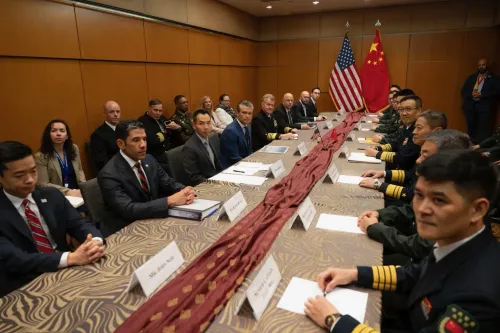
During a press briefing at the Association of Southeast Asian Nations (ASEAN) Defence Ministers' Meeting-Plus in Kuala Lumpur, Hegseth addressed the directive revealed by Trump for the resumption of US nuclear weapons testing.
He stated, "We would collaborate with the Department of Energy, but the President was explicit that we need a credible nuclear deterrent. This is the foundation of our deterrence strategy, and thus, understanding and restarting testing is a very responsible approach to achieve that."
Hegseth emphasized that knowing the capabilities of the arsenal and ensuring its operational effectiveness would make nuclear conflict "less likely." He asserted, "It’s the right directive."
Through testing, he noted, America will guarantee it possesses the "strongest, most capable nuclear arsenal" to uphold "peace through strength."
He added, "We do not seek conflict with China or any other nation. However, the more robust we are, and the stronger our alliances become through collaboration with allies in this region and globally, the lesser the chances of conflict."
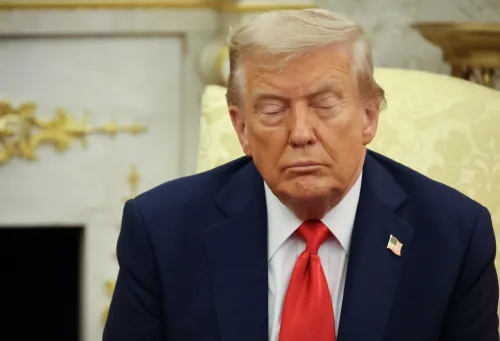
In a recent social media update, Trump indicated that he had directed the Pentagon to initiate nuclear weapons testing after a hiatus of 33 years, stating it would be done "on an equal basis" in light of the nuclear developments of China and Russia. This directive has raised alarms regarding the potential for a new nuclear arms race.
Hours before his meeting with China's President Xi Jinping in South Korea on Thursday, Trump cryptically noted on Truth Social, "Due to the testing programs of other countries, I have instructed the Department of War to commence our Nuclear Weapons testing on an equal basis."
He added that this process would "begin immediately."
Trump also claimed that the US has more nuclear weapons than any other nation due to a "complete update and renovation of existing weapons" accomplished during his first term without any nuclear tests, as scientists argue that computer simulations suffice.
He remarked that despite his reluctance, he felt he had "no choice" but to expand the nuclear arsenal, given that "Russia ranks second, and China is a distant third, but will catch up within five years."
Only North Korea has conducted a nuclear test recently, which occurred in 2017.
The US last performed a nuclear test in 1992, while China and Russia's predecessors executed theirs in 1996 and 1990, respectively. France last tested in 1996, and Britain did so in 1991 at a US facility in Nevada. Both India and Pakistan conducted their last tests in 1998.
Point of View
It's crucial to acknowledge the complexities surrounding nuclear deterrence. While the government emphasizes the need for a credible deterrent, the potential for escalating tensions and sparking an arms race cannot be overlooked. Navigating this balance requires careful consideration and alignment with our allies to ensure peace and stability in the region.
NationPress
29 Sept 2026
Frequently Asked Questions
Why did Trump decide to resume nuclear testing?
Trump argues that resuming nuclear testing is necessary to maintain a credible nuclear deterrent in light of China and Russia's advancements in their nuclear programs.
How long has the US suspended nuclear testing?
The US has not conducted a nuclear test since 1992, marking over three decades of suspension.
What could be the implications of restarting nuclear testing?
Restarting nuclear testing could lead to heightened tensions and the potential for a new arms race, impacting global security dynamics.
What is the stance of NATO allies on nuclear testing?
NATO allies have historically been cautious about nuclear testing, advocating for disarmament and stability in international relations.
Has any other country conducted nuclear tests recently?
North Korea conducted a nuclear test in 2017, while other nations like China and Russia have not tested since the 1990s.