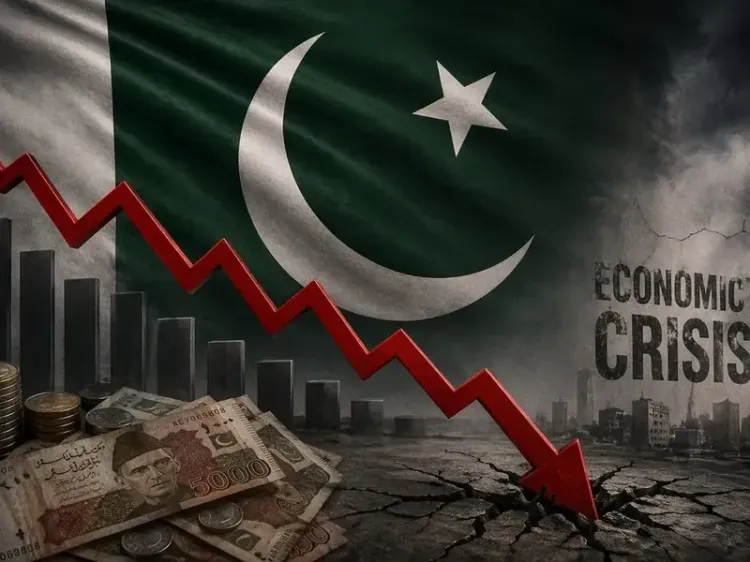
UAE Pulls $3.5bn: Pakistan's Economic Crisis Deepens
Synopsis
The UAE's shock withdrawal of $3.5 billion from Pakistan's reserves, breaking a pledge made to the IMF, has exposed the hollow foundations of Islamabad's economy. Saudi Arabia's emergency $3 billion rescue has only deepened Pakistan's dependency, pushing its liabilities to Riyadh to a record $8 billion.
Key Takeaways
The UAE withdrew $3.5 billion in deposits from Pakistan , breaking a commitment made to the IMF to maintain exposure until 2027 .
Saudi Arabia intervened with a $3 billion emergency deposit to stabilise reserves, but simultaneously ended the rollover of its earlier $5 billion deposit on previous terms.
Pakistan's total liabilities to Saudi Arabia have now reached $8 billion , deepening financial dependence on Riyadh .
Of the State Bank of Pakistan's $16.3 billion in reserves, a large portion comprises deposits from friendly nations vulnerable to sudden recall.
Pakistan's public debt has crossed 70 percent of GDP , above the statutory limit, with interest payments consuming the majority of government revenues.
Despite three IMF programmes since 2019 , structural economic reforms remain unimplemented, with fiscal gains achieved largely through heavy taxation and elevated energy tariffs.
New Delhi, April 26: Pakistan's economic vulnerability has been thrust into the global spotlight after the United Arab Emirates abruptly withdrew $3.5 billion in deposits, triggering an acute liquidity crisis and forcing Saudi Arabia to intervene with an emergency $3 billion injection to prevent a financial meltdown. The development, reported by Dawn, lays bare Islamabad's dangerous dependence on Gulf allies to keep its economy afloat.
UAE's Sudden Withdrawal Shocks Pakistan's Finances
The UAE's decision to pull its $3.5 billion deposit was particularly alarming because Abu Dhabi had previously pledged to the International Monetary Fund (IMF) that it would maintain its financial exposure to Pakistan until at least 2027. The abrupt reversal exposed just how conditional and fragile these bilateral financial commitments truly are.
Compounding the pressure, Pakistan simultaneously faced a looming $1.3 billion Eurobond repayment, intensifying fears over the country's short-term liquidity position and its ability to service external obligations without external bailouts.
Saudi Arabia Steps In But at a Steep Price
Riyadh moved swiftly to contain the fallout, depositing $3 billion to stabilise Pakistan's foreign exchange reserves and protect its IMF-backed Extended Fund Facility (EFF) programme from derailment. However, Saudi Arabia also signalled that its earlier $5 billion deposit would no longer be rolled over under previous terms.
This effectively raises Pakistan's total financial liabilities to Saudi Arabia to a staggering $8 billion, deepening an already lopsided financial interdependence that critics argue compromises Islamabad's foreign policy autonomy. The episode illustrates a recurring pattern: Pakistan avoids default not through structural reform but through last-minute Gulf rescues.
Structural Weaknesses Persist Despite Three IMF Programmes
Despite entering three IMF programmes since 2019, Pakistan's underlying economic architecture remains deeply flawed. While the government has recorded a primary surplus of 1.3 percent of GDP in FY25, analysts warn this has been achieved through aggressive taxation and soaring energy tariffs, burdens disproportionately borne by ordinary citizens rather than by an expanding state apparatus.
Inflation has eased somewhat, but IMF-mandated high interest rates continue to suppress investment and erode export competitiveness, locking the economy in a persistent low-growth cycle. A recent current account surplus, the first in over a decade, has been widely attributed to severe import restrictions and a contraction in foreign business activity, not genuine export-led growth.
Foreign Reserves Built on Borrowed Foundations
A closer look at Pakistan's reserve position reveals a troubling structural reality. Of the State Bank of Pakistan's $16.3 billion in foreign exchange reserves, a substantial share consists of deposits from friendly nations, funds that can be recalled at any time as the UAE episode demonstrates. This makes the reserve figure a misleading indicator of true financial stability.
Public debt has now surpassed 70 percent of GDP, well above the country's own statutory ceiling, while interest payments consume the overwhelming majority of government revenues, leaving little fiscal space for development, defence, or social spending.
Geopolitical Posturing Masks Economic Dependence
There is a sharp irony in Pakistan's current global positioning. Even as Islamabad projects itself as a responsible diplomatic actor and a voice for peace during regional tensions, its economic sovereignty is effectively mortgaged to Gulf capitals. Every financial crisis reveals the same pattern: diplomatic overtures abroad, emergency calls to Riyadh and Abu Dhabi behind the scenes.
Notably, this crisis unfolds as Pakistan's military establishment continues to command a disproportionate share of state resources, a structural imbalance that successive IMF programmes have consistently flagged but failed to correct.
With the IMF's Extended Fund Facility review ongoing and external debt repayments mounting through 2025-26, the pressure on Islamabad to implement deeper structural reforms including energy sector rationalisation, privatisation of state-owned enterprises, and broadening the tax base will only intensify in the months ahead.
Point of View
Resists structural reform, and survives on diplomatic goodwill from Gulf monarchies rather than productive economic output. The UAE's broken promise to the IMF is a warning shot: conditional deposits are not reserves, they are geopolitical leverage. What this episode truly exposes is that Pakistan's much-publicised economic stabilisation narrative is a facade maintained by borrowed time and borrowed money. Until Islamabad confronts the civil-military spending imbalance and builds a genuine export economy, every IMF programme will be a temporary patch on a structural wound.
NationPress
19 Sept 2026
Frequently Asked Questions
Why did the UAE withdraw $3.5 billion from Pakistan?
The UAE withdrew $3.5 billion in deposits from Pakistan amid shifting geopolitical and financial dynamics, reversing an earlier commitment made to the IMF to maintain financial exposure to Pakistan until 2027. The exact reasons behind the reversal have not been officially stated but it coincided with regional tensions and concerns over Pakistan's economic trajectory.
How did Saudi Arabia respond to Pakistan's financial crisis?
Saudi Arabia deposited $3 billion to stabilise Pakistan's foreign exchange reserves and protect its IMF-backed Extended Fund Facility programme. However, Riyadh also indicated its earlier $5 billion deposit would not be rolled over on previous terms, raising Pakistan's total liabilities to Saudi Arabia to $8 billion.
What is Pakistan's current foreign exchange reserve position?
The State Bank of Pakistan holds approximately $16.3 billion in foreign exchange reserves, but a significant portion consists of deposits from friendly nations that can be withdrawn at short notice. This makes Pakistan's reserve position structurally fragile and dependent on continued Gulf goodwill.
Has Pakistan's IMF programme helped fix its economy?
Pakistan has entered three IMF programmes since 2019, but structural weaknesses remain largely unresolved. While a primary surplus of 1.3 percent of GDP was recorded in FY25, this was achieved through heavy taxation and rising energy costs rather than sustainable economic reform.
What is Pakistan's total public debt as of 2025?
Pakistan's public debt has exceeded 70 percent of GDP, surpassing the country's own statutory limit. Interest payments now consume the bulk of government revenues, severely limiting fiscal space for development and social spending.