What Does the US's Approval of a Massive Arms Sale to Taiwan Mean Amid China Tensions?
Synopsis
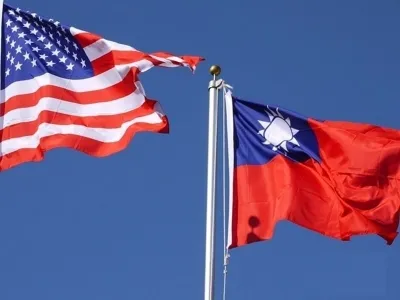
On December 18, the US approved a significant arms package for Taiwan, exceeding $10 billion, amidst intensifying military pressure from China. This move raises critical concerns about regional stability and the implications for US allies like Japan and The Philippines.
Key Takeaways
The US has approved an arms package for Taiwan exceeding $10 billion .
This decision comes amidst heightened military pressure from China.
Japan and The Philippines are drawn into the escalating tensions.
The arms sale signifies US commitment to its regional allies.
China's military expansion poses significant challenges to US interests in the Pacific.
New Delhi, Dec 18 (NationPress) The recent endorsement by the United States for a colossal arms deal exceeding $10 billion for Taiwan has emerged amid China's escalating military assertiveness and a diplomatic campaign aimed at weakening Washington's allies, particularly Japan and The Philippines.
In response, Beijing urged the US to “immediately halt its perilous actions of arming Taiwan,” with China's Foreign Ministry Spokesperson Guo Jiakun asserting that this decision “significantly undermines China’s sovereignty, security, and territorial integrity.”
Earlier this month, the White House indicated in a security strategy document that “deterring a conflict over Taiwan, ideally by maintaining military superiority,” is a priority.
The White House document titled “National Security Strategy of the United States of America November 2025” emphasized that “Taiwan's significance is heightened not only due to its leadership in semiconductor production but also because it provides direct access to the Second Island Chain, delineating Northeast and Southeast Asia into two distinct theatres.”
The ‘First Island Chain’ comprises a series of Pacific islands stretching from the Kamchatka Peninsula to Japan, including the Ryukyu Islands, Taiwan, the northern Philippines, and down to Borneo and the Malay Peninsula. This chain acts as both a natural defense and a platform for military power projection, reinforcing Washington's alliances and curbing Beijing's influence in the Western Pacific.
The ‘Second Island Chain’ consists of a strategic maritime defense line involving Japan, Guam, and Micronesia, providing a secondary defense perimeter for the United States, particularly in light of China's expanding military capabilities.
“We will establish a military capable of denying aggression anywhere within the First Island Chain. However, the American military cannot and should not undertake this alone,” the strategy document posited, encouraging allied nations to increase their contributions towards collective defense.
In the meantime, China has amplified its diplomatic rhetoric against Tokyo and Manila. Japan's Prime Minister Sanae Takaichi remarked that any aggression towards Taiwan could provoke a military response from Japan.
Beijing has also reacted strongly to a reported land lease agreement between Japan's Defense Ministry and a mobile surveillance radar unit stationed on Okinawa, ostensibly to monitor Chinese military activities.
Moreover, China has accused The Philippines of “violating its sovereign airspace and waters.”
Under President Xi Jinping, China has embarked on an extensive military build-up focusing on amphibious, naval, and precision strike capabilities, with the objective of asserting its claim over Taiwan, which it regards as a breakaway province.
In contrast, Taiwan, which operates as a democratic entity, has bolstered its military readiness through large-scale annual drills. It has extended mandatory military service, invested in innovative defense technologies such as drones and missile systems, and reinforced its special forces.
The White House strategy aligns with the security document advocating for robust measures alongside deterrence to ensure that sea lanes remain open, toll-free, and not subjected to arbitrary closures by any single nation.
It also stated that the United States must not only enhance its military capabilities but also foster strong collaboration with every nation, including India and Japan, that risks suffering if this issue remains unresolved.
As the two leading economic and military powers escalate their posturing, the situation remains precarious with rising tensions across the region.
Point of View
I believe this significant arms sale to Taiwan is not just a strategic move but a critical assertion of US support for its allies in the face of China's growing military ambitions. It underscores the necessity for collective defense in a rapidly changing geopolitical landscape. We stand firmly committed to monitoring these developments, ensuring that our reporting remains accurate and insightful.
NationPress
22 Sept 2026
Frequently Asked Questions
What is the significance of the US arms sale to Taiwan?
The arms sale is a critical move to bolster Taiwan's defense capabilities amidst increasing Chinese military pressure, reaffirming US commitment to its allies in the region.
How has China reacted to the arms deal?
China has condemned the arms sale, stating it undermines its sovereignty and security, and has warned the US to cease its actions regarding Taiwan.
What does the First and Second Island Chain refer to?
The First Island Chain includes Pacific archipelagos that serve as a barrier to Chinese influence, while the Second Island Chain provides a secondary defense perimeter for the US.
What military enhancements has Taiwan undertaken?
Taiwan has extended its mandatory military service, invested in new technologies, and increased its military readiness through extensive drills.
What are the implications for US allies in the region?
The arms deal signals a commitment from the US to support its allies like Japan and The Philippines against potential aggression from China, fostering greater regional security cooperation.