White House Backs AG Todd Blanche Against Democrat Oversight Push
Synopsis
The White House amplified AG Todd Blanche's Sunday show appearances on November 9, 2026, framing them as a direct dismantling of Democratic oversight demands — escalating a public war of words between the executive branch and congressional Democrats.
Key Takeaways
The White House posted an 'ICYMI' alert on November 9, 2026 backing AG Todd Blanche's Sunday show appearances.
The administration characterised Democratic congressional oversight efforts as a 'charade', contesting the legitimacy of the scrutiny rather than merely its scope.
Blanche appeared on multiple Sunday political programmes to rebut Democratic oversight claims on behalf of the executive branch.
The move follows a classic pattern of parties out of power using committee authority to scrutinise administration actions.
Subsequent congressional hearings, potential subpoenas, and further media responses from both sides are likely flashpoints to watch.
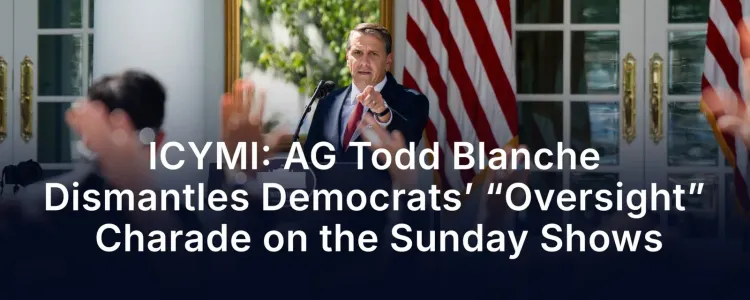
The White House fired back at Democratic lawmakers on Monday, November 9, 2026, amplifying what it called a dismantling of the opposition's 'oversight charade' — pointing to Attorney General Todd Blanche's appearances on Sunday political programmes as the evidence.
Blanche on the Sunday Circuit
The White House post, framed as an 'ICYMI' ('In Case You Missed It') alert, highlighted AG Todd Blanche's media rounds over the weekend, characterising his appearances as a rebuttal to what the administration termed a politically motivated use of congressional oversight powers by Democrats. The post signals the executive branch's intent to push back publicly — not just inside committee rooms.
The Oversight Standoff Taking Shape
Congressional oversight is a constitutionally grounded tool that the party out of power routinely deploys to scrutinise executive branch actions. The current friction follows a familiar Washington pattern: the minority sharpens its investigative authority while the administration contests the premise and the process. What makes this moment notable is the White House's decision to frame the counter-offensive around its own Attorney General — the nation's top law-enforcement officer — taking the argument directly to Sunday television audiences.
The combative 'charade' framing in the post leaves little room for diplomatic ambiguity: the administration is not signalling a willingness to negotiate the terms of scrutiny. It is contesting the legitimacy of the scrutiny itself.
What Comes Next on Capitol Hill
With the White House publicly casting the AG as the face of its resistance to Democratic oversight demands, the stage is set for an escalating exchange — in committee hearings, in court filings if subpoenas follow, and on the airwaves. The Sunday shows are rarely the end of such battles; they are, more often, the opening bell.
Point of View
Designed to delegitimise Democratic oversight before it gains traction with the broader public. It reflects a broader executive-branch playbook: contest the framing early, loudly, and through the most credible spokesperson available. If Democrats press ahead with hearings or subpoenas, this post will serve as the opening salvo of a media and legal battle that could define the administration's second-half political narrative.
NationPress
9 Nov 2026
Frequently Asked Questions
Who is Todd Blanche and what is his role?
Todd Blanche is the Attorney General of the United States, the country's top law-enforcement officer and head of the Department of Justice.
What did Todd Blanche say on the Sunday shows?
The White House characterised his appearances as dismantling Democratic arguments about congressional oversight of the executive branch, though the specific statements have not been independently detailed in this post.
What is congressional oversight and why is it relevant?
Congressional oversight is the constitutional authority of lawmakers to investigate and scrutinise executive branch actions. It is a tool frequently used by the party not in the White House to hold the administration accountable.
Why is the White House calling Democratic oversight a 'charade'?
The administration's framing suggests it views current Democratic oversight efforts as politically motivated rather than genuinely investigative, a characterisation it is pushing publicly through the AG's media appearances.
What could happen next in this oversight dispute?
The standoff could escalate through congressional hearings, potential subpoenas issued to executive branch officials, and continued media exchanges between Democratic lawmakers and administration representatives.