White House Launches America.Gov as One-Stop Federal Services Portal

Synopsis
The White House launched America.Gov on October 2, 2026, a unified federal digital portal designed to give US citizens a single, frictionless gateway to government services — framing Washington as a servant, not a gatekeeper.
Key Takeaways
The White House announced the launch of America.Gov on October 2, 2026 as a unified federal services portal.
The portal is billed as 'Easy.
Convenient.' — a citizen-first, single-window interface for federal government services.
The announcement explicitly states the government 'no longer stands in your way' — framing the launch as a structural shift in how Washington delivers services.
The branding strategy mirrors private-sector product launches, signalling a deliberate departure from traditional government communication.
The move puts the US on a convergent path with India's own unified digital governance platforms like UMANG and DigiLocker .
The United States federal government just rebranded its relationship with citizens in three words: easy, fast, convenient. The White House announced on Friday, October 2, 2026, the launch of America.Gov — a new unified digital portal pitched as the single front door to federal government services — declaring that Washington now stands 'at your service', not 'in your way'.
What America.Gov Is Promising
The White House's announcement is blunt in its framing: the federal government has historically been synonymous with bureaucratic friction — long queues, confusing agency silos, redundant paperwork. The portal's stated mission is to flatten that complexity into one accessible, citizen-first interface. The tagline 'Easy. Fast. Convenient.' signals a deliberate pivot toward a service-delivery philosophy borrowed from the private-sector tech world.
The launch of a single, branded domain — America.Gov — is symbolically significant. The US government currently operates hundreds of separate agency websites, each with its own login systems, navigation logic, and service workflows. A unified portal would, in theory, allow a citizen to access tax filings, passport applications, veterans' benefits, social security queries, and small-business permits from a single authenticated session.
The Political Pitch Inside the Policy Move
The choice of language in the White House post is anything but accidental. 'The federal government no longer stands in your way' is a direct echo of long-standing conservative and libertarian critiques of federal overreach and bureaucratic inefficiency. By framing the launch as government finally stepping aside, the White House is simultaneously announcing a product and making a political argument — that this administration has achieved what previous ones only promised.
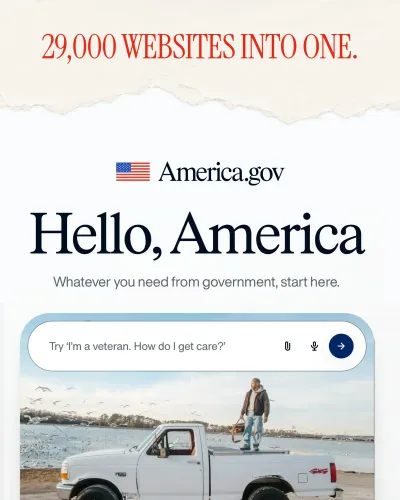
The 'Hello, America' opener, flanked by twin US flag emojis, lends the announcement the register of a product reveal rather than a government press release — a deliberate aesthetic choice that signals how the administration wants this moment to land culturally.
What Indians Watching Washington Should Note
For India, which has spent the last decade building its own unified digital governance stack — from DigiLocker to UMANG to the India Stack — the US pivot toward a single-portal federal model is a notable convergence. The world's two largest democracies are now, in principle, moving toward the same architecture: one citizen identity, one front end, many back-end services. How America.Gov performs at scale will be watched closely by digital governance planners globally.
The portal is live. Whether it delivers on the promise of friction-free government — or becomes the next cautionary tale in federal IT launches — will be written in the months ahead.
Point of View
Tech-forward service provider rather than a regulatory apparatus. The 'stands at your service' framing is politically loaded — it weaponises the language of government-skepticism while simultaneously expanding the state's digital touchpoints with citizens. For global observers, this mirrors a broader democratic trend: India, Estonia, Singapore, and the UK have all built unified citizen portals, and the US is now joining that club late but loudly. The real test will be execution — federal IT projects have a long history of promised revolutions and messy rollouts.
NationPress
2 Oct 2026
Frequently Asked Questions
What is America.Gov and what services does it offer?
America.Gov is a new unified digital portal launched by the US federal government on October 2, 2026, designed to give citizens a single, streamlined gateway to federal services. Specific services available were not detailed in the announcement, but the portal is billed as a one-stop platform replacing the fragmented multi-agency website system.
Who launched America.Gov?
The White House, representing the Executive Office of the President of the United States, announced the launch of America.Gov on October 2, 2026.
Is America.Gov similar to India's UMANG or DigiLocker?
Conceptually, yes. America.Gov follows the same unified digital governance model as India's UMANG and DigiLocker — a single authenticated platform aggregating multiple government services. The US launch marks a convergence with a model India adopted several years earlier.
What does 'the federal government no longer stands in your way' mean?
This phrase, used in the White House's announcement, signals a policy and branding shift — positioning the federal government as a facilitator of services rather than a source of bureaucratic friction. It reflects the administration's pitch that America.Gov removes red tape for ordinary citizens.
Why does America.Gov matter for people outside the US?
The launch is significant for global digital governance watchers, including in India, because it signals the world's largest economy formally adopting a single-portal federal services model — a trend already well established in India, Estonia, and Singapore. Its success or failure will inform how democracies approach citizen-state digital interfaces.