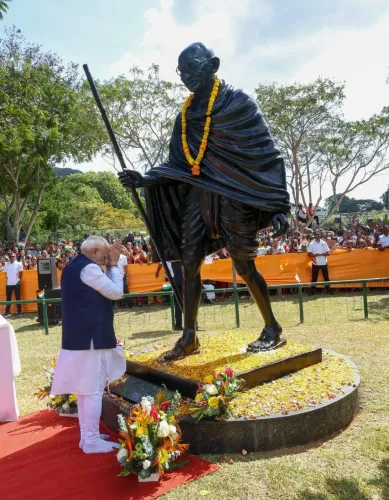
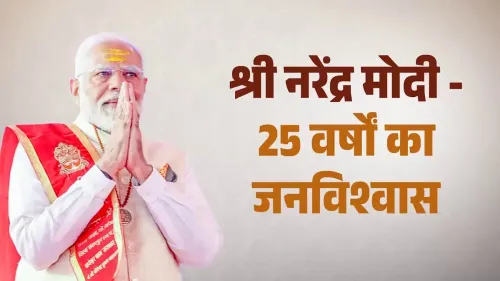
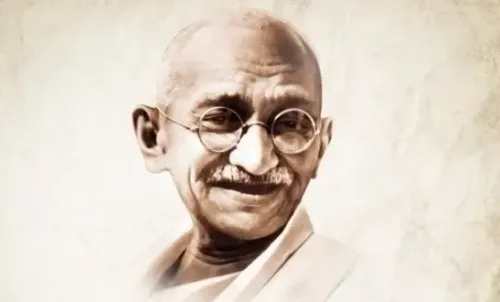
PM Modi pays tribute to Mahatma Gandhi on his birth anniversary

Synopsis
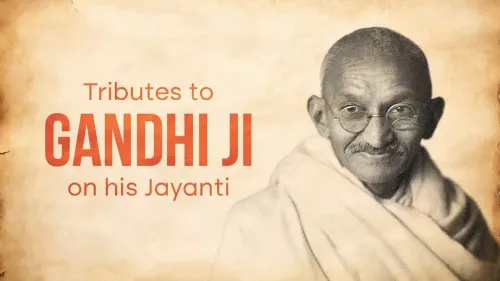
On Gandhi Jayanti 2026, PM Narendra Modi honoured Mahatma Gandhi by calling his life a lighthouse of truth and non-violence, and paired the tribute with a Bhagavad Gita verse describing the ideal of compassion, humility, and forgiveness.
Key Takeaways
PM Modi posted his Gandhi Jayanti tribute on 2 October 2026 , the 158th birth anniversary of Mahatma Gandhi.
He described Gandhi's life as a lighthouse of truth, non-violence, compassion, and service relevant to every era.
He quoted Bhagavad Gita Chapter 12, Verse 13 , describing the ideal of one who is friendly, compassionate, ego-free, and forgiving.
Gandhi Jayanti is a national holiday in India and is observed globally as the International Day of Non-Violence , designated by the UN in 2007 .
Gandhi famously called the Bhagavad Gita his 'eternal mother' and regarded Chapter 12:13 as central to his personal philosophy.
On the 158th birth anniversary of Mahatma Gandhi, Prime Minister Narendra Modi honoured the Father of the Nation with a tribute rooted in timeless ideals — invoking both a Sanskrit verse from the Bhagavad Gita and a personal reflection on Gandhi's enduring relevance to all of humanity.
Posting on the morning of Gandhi Jayanti, 2 October 2026, PM Modi wrote in Hindi: 'Pujya Bapu ka sampurna jeevan satya, ahinsa, karuna aur seva ka aisa prakashstambh hai, jo har yug mein manavta ka marg prashast karta rahega' — 'The entire life of revered Bapu is such a lighthouse of truth, non-violence, compassion and service that it will continue to illuminate the path of humanity in every era.'
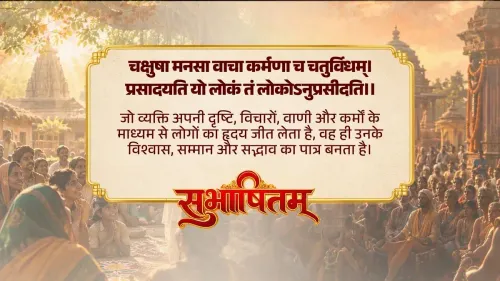
He then quoted a Sanskrit shloka from the Bhagavad Gita, Chapter 12, Verse 13: 'Adveshtaa sarvabhootaanaam maitrah karuna eva cha, nirmamo nirahankaarah samadukhsukhah kshamee' — 'One who harbours no ill-will towards any being, who is friendly and compassionate, free from possessiveness and ego, equal in joy and sorrow, and ever-forgiving.' The pairing of this verse with Gandhi's memory is deliberate and resonant — it is widely regarded as a distillation of the Gita's ideal human being, a description many scholars and Gandhi himself applied to his own philosophy of life.
Gandhi Jayanti and its national significance
Gandhi Jayanti is observed as a national holiday across India every year on 2 October. The day is also recognised by the United Nations as the International Day of Non-Violence, a designation adopted in 2007 to honour Gandhi's global legacy. Prayers, floral tributes at Rajghat in New Delhi — the samadhi of Mahatma Gandhi — and community service programmes mark the occasion nationwide.
The Bhagavad Gita verse PM Modi cited is among those Gandhi described as central to his own spiritual practice. Gandhi famously called the Gita his 'eternal mother' and returned to it through decades of struggle, seeing in verses like Chapter 12:13 a practical guide to conduct rather than mere philosophy. By pairing the shloka with his tribute, PM Modi anchored Gandhi's life not only in political history but in a deeper ethical and spiritual tradition.
On a day when India pauses to remember the architect of its independence movement, the Prime Minister's message frames Gandhi's legacy as universally instructive — a lighthouse, in his words, that 'will continue to illuminate the path of humanity in every era.' That is the challenge Gandhi Jayanti quietly places before each generation: not just to remember the man, but to reckon with what he asked of us.
Point of View
Appealing to a wide base that reveres both. The framing of Gandhi as a universal 'lighthouse' rather than a specifically political figure also subtly universalises the tribute beyond partisan boundaries. On a day of national consensus, it is a message calibrated for breadth rather than controversy.
NationPress
2 Oct 2026
Frequently Asked Questions
Why did PM Modi quote the Bhagavad Gita in his Gandhi Jayanti message?
PM Modi quoted Bhagavad Gita Chapter 12, Verse 13 — which describes a person free from ill-will, ego, and sorrow — because Gandhi himself considered this verse central to his spiritual philosophy and famously called the Gita his 'eternal mother.'
What does 'Adveshtaa sarvabhootaanaam' mean in English?
'Adveshtaa sarvabhootaanaam maitrah karuna eva cha' translates as: 'One who harbours no ill-will towards any being, who is friendly and compassionate.' It is verse 13 of Chapter 12 of the Bhagavad Gita.
When is Gandhi Jayanti celebrated and why is it significant?
Gandhi Jayanti is celebrated on 2 October every year to mark the birth anniversary of Mahatma Gandhi. It is a national holiday in India and is also recognised by the United Nations as the International Day of Non-Violence since 2007.
What did PM Modi say about Mahatma Gandhi on Gandhi Jayanti 2026?
PM Modi said Gandhi's entire life is a lighthouse of truth, non-violence, compassion, and service that will continue to illuminate the path of humanity in every era.
What is the International Day of Non-Violence?
The International Day of Non-Violence is observed on 2 October every year — Mahatma Gandhi's birthday. The United Nations adopted the designation in 2007 to spread the message of non-violence and its relevance to global peace.