Karnataka CM's Office Touts FDI, Aerospace, EV and Green Energy Gains
Synopsis
The Chief Minister's Office of Karnataka declared on 16 November 2026 that the state is setting new milestones in FDI attraction, aerospace, electric vehicles, semiconductors and green energy, asserting that Karnataka's reputation is shining on a global stage in the age of technology.
Key Takeaways
The Chief Minister's Office of Karnataka posted a declaration of industrial ambition on 16 November 2026 , spotlighting four high-growth sectors.
The four named sectors are foreign direct investment, aerospace, electric vehicles, and semiconductors and green energy .
Karnataka frames its global industrial rise as 'New Karnataka on the path of development' — a deliberate brand positioning.
Bengaluru anchors the state's existing aerospace and IT base, which successive state industrial policies have expanded since 1991 liberalisation .
Green energy investment is positioned as infrastructure support for power-hungry semiconductor fabs and EV manufacturing plants.
State-level investor summits and policy updates on semiconductor and EV incentives are expected in the coming fiscal cycle.
From pulling in foreign direct investment to building out aerospace corridors, electric vehicle ecosystems and semiconductor foundries, Karnataka is staking a claim to be India's most diversified high-technology state — and its government wants the world to know it. The Chief Minister's Office of Karnataka posted a sweeping declaration of industrial ambition on Monday, 16 November 2026, asserting that the state is setting new milestones across four of the most consequential sectors of the global economy.
The post, written in Kannada, reads: 'ಅಭಿವೃದ್ಧಿಯ ಪಥದಲ್ಲಿ ನವ ಕರ್ನಾಟಕ' — 'New Karnataka on the path of development' — and goes on to describe how the state's reputation is 'shining on a global stage in the age of technology, and that is our pride.'Four sectors, one ambition: Karnataka's high-stakes industrial bet
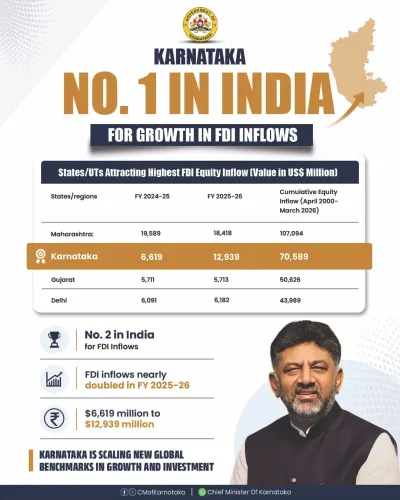
The post names four specific growth engines: foreign direct investment (FDI) attraction, aerospace, electric vehicles (EV), and semiconductors and green energy. That is not an accidental list. Each represents a strategic frontier where national industrial policy — from the Production-Linked Incentive scheme to the semiconductor mission — is directing billions of rupees in public support, and where global capital is hunting for stable, skilled jurisdictions to anchor supply chains.
Karnataka's claim on this territory has deep roots. Since India's 1991 economic liberalisation, the state's successive industrial policies have methodically layered incentives for high-value manufacturing and technology sectors on top of its existing IT base in Bengaluru. The result is a state that now argues it is not merely a software services hub but a full-spectrum industrial economy in the making.
Why aerospace and semiconductors land differently than IT
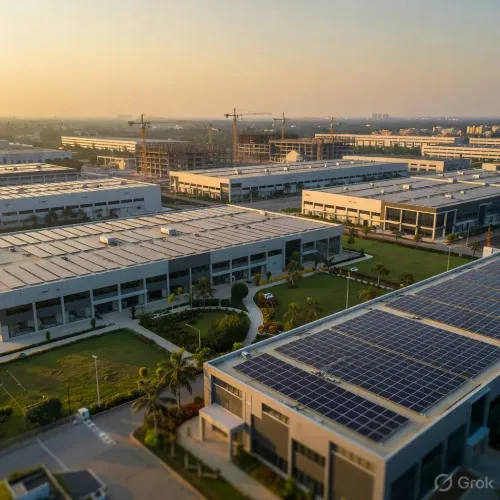
IT services scaled on talent and low barriers to entry. Aerospace and semiconductors are different animals entirely — they require sustained government facilitation, long investment cycles and deep supply-chain ecosystems. Karnataka already hosts major aerospace manufacturing facilities around Bengaluru, and the semiconductor push aligns directly with India's national ambition to reduce import dependence on chips, an urgency sharpened by the global supply-chain disruptions of the early 2020s.
The EV angle is equally pointed. As global automakers accelerate electrification timelines, states that move early to offer land, power, and skilled workers lock in anchor investments that reshape local economies for decades. Karnataka is signalling it intends to be that state.
Green energy: the infrastructure bet underpinning everything else
Semiconductor fabs and EV battery plants are electricity-hungry. Karnataka's concurrent emphasis on green energy is therefore not incidental — it is load-bearing. A reliable, renewable power supply is increasingly a prerequisite for the kind of globally-conscious manufacturers who face ESG scrutiny from their own investors. By framing green energy as part of the same developmental arc as FDI and advanced manufacturing, Karnataka is pitching an integrated offer to international capital: come here, go green, and do it at scale.
Investor summits and state-level policy updates on semiconductor and EV incentives are expected in the coming fiscal cycle — the moments when declarations like today's will face a harder test: concrete commitments, signed MoUs and ground-breaking ceremonies.
Karnataka has long been the state others benchmark themselves against. The question now is whether its ambitions in aerospace, chips and clean energy will produce the same transformative results its IT bet did a generation ago.
Point of View
Aerospace, EVs, semiconductors and green energy into a single developmental narrative signals a deliberate pivot beyond its IT-services identity — an identity that, while lucrative, is increasingly commoditised globally. The timing matters: national industrial policy is redirecting massive incentives into exactly these sectors, and states that build visible political narratives around them gain an edge in attracting attention from both central government and international investors. The risk is that the declaration outpaces delivery; Karnataka's real credibility test will come at the next major investor summit, where signed commitments will speak louder than any post. If the pipeline materialises, however, this positions the state as the template for India's next-generation industrial state model.
NationPress
16 Nov 2026
Frequently Asked Questions
What sectors is Karnataka focusing on for industrial growth in 2026?
Karnataka is focusing on four key sectors: foreign direct investment attraction, aerospace manufacturing, electric vehicles, and semiconductors and green energy, as stated by the Chief Minister's Office on 16 November 2026.
Why is Karnataka important for semiconductor manufacturing in India?
Karnataka, anchored by Bengaluru's established technology ecosystem and existing aerospace manufacturing base, is positioning itself as a natural hub for semiconductor investment, backed by state industrial policies aligned with India's national semiconductor mission.
What is Karnataka's EV policy and investment push?
Karnataka is actively courting electric vehicle manufacturers by offering industrial infrastructure, skilled labour and policy incentives, aiming to become a preferred destination for EV supply-chain investment as automakers accelerate electrification timelines.
How does Karnataka attract foreign direct investment?
Karnataka has used successive industrial policies since India's 1991 liberalisation to offer incentives across high-value manufacturing and technology sectors, with Bengaluru serving as the state's primary investment anchor for global capital.
What role does green energy play in Karnataka's industrial development?
Green energy is a core pillar of Karnataka's industrial strategy because power-intensive sectors like semiconductor fabs and EV battery manufacturing require reliable, renewable electricity — a selling point for ESG-conscious global manufacturers.