CM Bhajan Lal Backs Modi's Tribal Push, Vows End to Naxalism
Synopsis
The Rajasthan Chief Minister's Office invoked PM Modi's 'Sabka Saath, Sabka Vikas, Sabka Vishwas aur Sabka Prayas' framework on 16 November 2026, announcing comprehensive efforts to accelerate development and end Naxalism in the state's tribal districts under CM Bhajan Lal Sharma.
Key Takeaways
The Chief Minister's Office of Rajasthan posted on 16 November 2026 signalling intensified focus on tribal development and Naxalism eradication.
CM Bhajan Lal Sharma's government frames its tribal policy explicitly under PM Modi's 'Sabka Saath, Sabka Vikas, Sabka Vishwas aur Sabka Prayas' mantra.
Rajasthan's southern and eastern tribal districts sit at the edge of India's Left Wing Extremism geography, where security and welfare goals intersect.
The Union government's integrated LWE strategy — combining operations with schemes like Vanbandhu Kalyan Yojana — has been in force since 2014 .
No specific schemes, timelines or operational details were disclosed in the post; concrete delivery metrics remain the benchmark to watch.
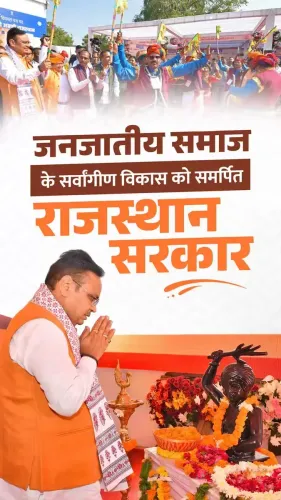
Tribal welfare and security have collided at the top of Rajasthan's political agenda. The Chief Minister's Office of Rajasthan posted on Monday, 16 November 2026, invoking Prime Minister Narendra Modi's signature governance mantra to signal an intensified drive in the state's tribal belts — one that pairs accelerated development with a firm push to eradicate Naxalism.
The post, attributed to Chief Minister Bhajan Lal Sharma via the official Rajasthan CMO handle, quotes Modi's four-part pledge — 'Sabka Saath, Sabka Vikas, Sabka Vishwas aur Sabka Prayas' (Together with all, development for all, trust of all, effort of all) — as the guiding framework for what it describes as 'comprehensive efforts' in tribal areas. The hashtag #आपणो_अग्रणी_राजस्थान ('Our Leading Rajasthan') underscores the BJP government's brand of competitive state-building.
Rajasthan's tribal districts: where development and insurgency intersect
Rajasthan's southern and eastern districts — home to substantial Scheduled Tribe populations — have long sat at the edge of India's Left Wing Extremism geography. While the state has historically been less Naxal-affected than Chhattisgarh or Jharkhand, pockets of tribal unrest linked to land rights and development deficits have drawn consistent attention from both state police and central paramilitary forces.
The reference to eliminating Naxalism is pointed. It signals that the Bhajan Lal Sharma government views security and welfare not as competing priorities but as a single integrated mission — a playbook the Union government has refined since 2014 under its Left Wing Extremism policy, combining infrastructure push with schemes such as the Vanbandhu Kalyan Yojana to draw tribal communities into the mainstream economy.
Modi's mantra as the operational framework
By anchoring the announcement in Modi's four-pillar slogan, the Rajasthan CMO does something deliberate: it places state action inside a larger national narrative, lending both political legitimacy and policy direction to what could otherwise read as a routine administrative update. The phrase 'Sabka Prayas' — 'effort of all' — added to the original trinity ahead of the 2022 UP elections, is particularly resonant here: it asks tribal communities themselves to be partners, not merely beneficiaries, of the development drive.
The broader national pattern backs the framing. Since 2014, districts covered under the Union government's integrated LWE strategy have reported measurable reductions in violence, with road connectivity, mobile coverage, and banking access cited as the key variables that erode the conditions extremist groups exploit.
What the state's next moves will reveal
The CMO post stops short of naming specific schemes, timelines, or security operations — the detail that would let independent observers measure progress. What to watch: whether the Rajasthan government follows up with area-specific development packages for tribal districts, and how central paramilitary deployments are calibrated alongside welfare delivery in the months ahead. Concrete numbers — beneficiaries reached, roads built, camps cleared — will be the real scorecard for a pledge this large.
Rajasthan has signalled its tribal districts are a priority. The harder test is whether the state's pace of delivery matches the ambition of the slogan.
Point of View
The Rajasthan BJP government is doing double political work: aligning with New Delhi's national narrative while claiming ownership of outcomes in its own tribal belt. The move is consistent with a post-2023 election pattern in which the Bhajan Lal Sharma administration has sought to position Rajasthan as a model BJP state, mirroring the Centre's LWE playbook. The critical variable is execution — previous administrations in multiple states have invoked similar frameworks without matching delivery, and tribal communities in Rajasthan's south and east have long memories of unfulfilled promises. How the state translates this signalling into measurable outcomes will determine whether the hashtag 'Aapno Agrani Rajasthan' becomes a credible policy brand or remains campaign rhetoric.
NationPress
16 Nov 2026
Frequently Asked Questions
What did the Rajasthan CMO post on 16 November 2026?
The Chief Minister's Office of Rajasthan posted that comprehensive efforts are being made in tribal areas to accelerate development and end Naxalism, framing the initiative under PM Modi's 'Sabka Saath, Sabka Vikas, Sabka Vishwas aur Sabka Prayas' mantra.
Which tribal areas of Rajasthan are affected by Naxalism?
Rajasthan's southern and eastern districts with significant Scheduled Tribe populations have historically been on the periphery of India's Left Wing Extremism-affected geography, though the state is less severely impacted than Chhattisgarh or Jharkhand.
What is the Vanbandhu Kalyan Yojana and how does it relate to tribal development in Rajasthan?
The Vanbandhu Kalyan Yojana is a central government scheme launched in 2014 to deliver welfare and infrastructure to tribal communities, and it forms part of the integrated LWE strategy that Rajasthan's efforts appear to reference.
What does 'Sabka Saath, Sabka Vikas, Sabka Vishwas aur Sabka Prayas' mean?
The phrase is PM Modi's governance motto meaning 'Together with all, development for all, trust of all, and effort of all' — with 'Sabka Prayas' added later to emphasise collective citizen participation.
Who is Bhajan Lal Sharma and what is his role in Rajasthan?
Bhajan Lal Sharma is the Chief Minister of Rajasthan from the BJP, in office since December 2023, and the official whose government is referenced in the CMO's tribal development announcement.