CM Rekha Gupta Pays Tribute on Gandhi's 157th Birth Anniversary

Synopsis
Delhi Chief Minister Rekha Gupta marked Mahatma Gandhi's 157th birth anniversary on 2 October 2026, honouring his ideals of truth, non-violence, Swadeshi, and self-reliance as enduring inspirations for a developed India.
Key Takeaways
Delhi CM Rekha Gupta posted a Hindi tribute to Mahatma Gandhi on his 157th birth anniversary on 2 October 2026 .
She described Gandhi's life as a 'vast sadhana of dedication to nation and society.' The tribute highlighted Gandhi's core ideals: Satya (truth), Ahimsa (non-violence), Swadeshi , Swavalamban , and Swaraj .
CM Gupta linked Gandhi's philosophy to India's ongoing journey toward becoming a 'self-reliant, capable, and developed nation.' 2 October is both a national holiday in India and the UN-designated International Day of Non-Violence .
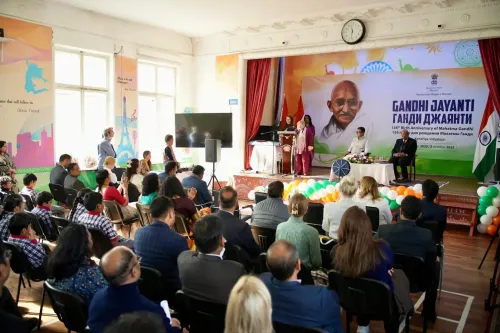
On the 157th birth anniversary of Mahatma Gandhi, Delhi Chief Minister Rekha Gupta offered a reverent tribute to the Father of the Nation on Friday, 2 October 2026, calling his life's journey a 'vast sadhana of dedication to nation and society.'
Posting in Hindi on the occasion of Gandhi Jayanti, CM Gupta wrote that Gandhi's ideals of truth and non-violence — satya aur ahimsa — 'showed the world the path of humanity and peace.' She further noted that his vision of Swadeshi (self-reliance in goods), Swavalamban (self-dependence), and Swaraj (self-rule) 'remains alive in India's consciousness even today.'
Gandhi's Three Pillars and the Aatmanirbhar Echo
The Delhi CM drew a direct line from Gandhi's foundational philosophy to contemporary national ambition, writing that his thinking continues to 'inspire our journey of building a self-reliant, capable, and developed nation.' The framing echoes the Aatmanirbhar Bharat (Self-Reliant India) programme, which drew rhetorical lineage from Gandhian economic thought when it was articulated at the national level in recent years.
Gandhi Jayanti is a national holiday in India and is also observed internationally as the International Day of Non-Violence, designated by the United Nations — a recognition of the global reach of Gandhi's philosophy that CM Gupta's tribute implicitly acknowledges by noting his ideas 'showed the world' a direction.
A Day of Tributes Across the Political Spectrum
2 October invariably draws homage from leaders across India's political landscape, with figures from every party invoking Gandhi's legacy. For the BJP, of which CM Gupta is a prominent leader, the emphasis on Swadeshi and self-reliance serves as a consistent bridge between classical Gandhian thought and the ruling dispensation's economic and governance agenda. The tribute, posted in the early morning hours, reflects the solemn, reflective register that the occasion commands.
Point of View
Lending historical legitimacy to the Aatmanirbhar Bharat framework. The choice to invoke all three pillars of Gandhi's economic thought is politically deliberate: it positions the party not as a departure from India's founding ideals but as their contemporary custodian. On a day when every major political force in India posts a tribute, the specific language chosen reveals the ideological framing each chooses to foreground. For CM Gupta, anchoring a developmental agenda to a universally revered figure reinforces her administration's messaging with a moral authority that transcends party lines.
NationPress
2 Oct 2026
Frequently Asked Questions
Why is 2 October celebrated as Gandhi Jayanti in India?
2 October is the birth anniversary of Mahatma Gandhi , born on this date in 1869 in Porbandar, Gujarat. It is a national holiday in India and is also observed globally as the International Day of Non-Violence , as designated by the United Nations.
What did Delhi CM Rekha Gupta say on Gandhi Jayanti 2026?
CM Rekha Gupta paid tribute to Gandhi on his 157th birth anniversary , calling his life a 'vast sadhana of dedication to nation and society' and highlighting his ideals of truth, non-violence, Swadeshi, Swavalamban, and Swaraj as continuing inspirations for a developed India.
What is the significance of Swadeshi, Swavalamban, and Swaraj in Gandhi's philosophy?
Swadeshi refers to the use of locally made goods, Swavalamban means self-dependence, and Swaraj means self-rule or independence. These three principles formed the economic and political backbone of Gandhi's vision for a free, self-sufficient India.
How does Gandhi's philosophy connect to Aatmanirbhar Bharat?
The Aatmanirbhar Bharat (Self-Reliant India) initiative draws rhetorical and philosophical lineage from Gandhi's emphasis on Swadeshi and economic self-sufficiency, a connection that political leaders including CM Rekha Gupta have explicitly invoked in their tributes.