White House Marks July 4 Reaffirming American Ideals

Synopsis
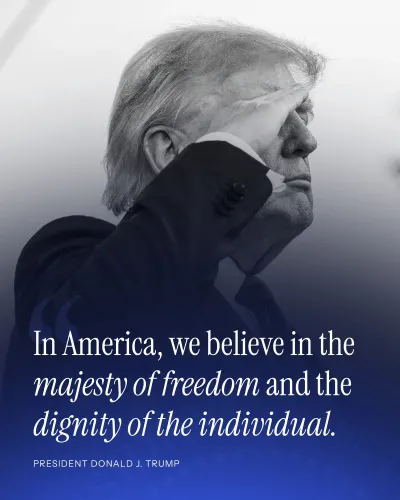
The White House marked Independence Day on 4 July 2026 with a declaration that 'True American ideals will always be worth protecting' and 'Freedom is our foundation,' reaffirming the founding principles of the 1776 Declaration of Independence on the nation's 250th anniversary year.
Key Takeaways
The White House posted an Independence Day message on 4 July 2026 stating 'True American ideals will always be worth protecting.' The post identified freedom as the foundation of the United States, echoing the language of the Declaration of Independence adopted in 1776 .
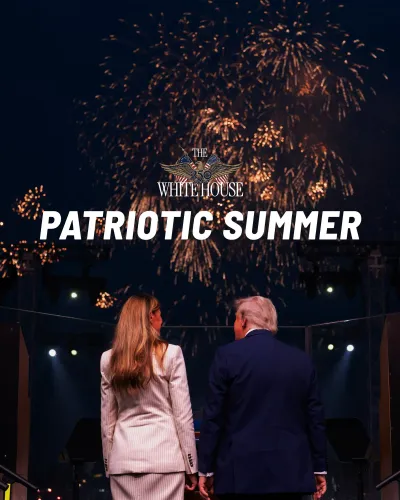
The message was accompanied by 1 image and carried no specific policy announcement.
White House July 4 communications have historically served both domestic cohesion and international projection of democratic values.
The use of the word 'protecting' rather than 'celebrating' signals an active rather than purely ceremonial framing of American ideals.
Analysts will watch for follow-on executive or legislative actions in 2026 that operationalise the stated commitment to freedom.
The White House, the official communications account of the Executive Office of the President of the United States, marked Independence Day on 4 July 2026 with a pointed message reaffirming the core values on which the nation was founded, declaring that 'True American ideals will always be worth protecting' and that 'Freedom is our foundation.'
Context
Independence Day commemorates the adoption of the Declaration of Independence on 4 July 1776, when the thirteen American colonies formally severed ties with Great Britain and asserted the right of a people to self-governance. The declaration's central argument — that governments derive legitimacy from the consent of the governed and exist to protect unalienable rights — remains the philosophical anchor of American civic identity. Every year, the occasion prompts official statements that reconnect contemporary governance to those founding principles.
The White House post, brief in length but deliberate in tone, chose the language of permanence: 'will always be worth protecting.' That framing positions American ideals not as historically contingent but as enduring obligations, a rhetorical choice consistent with how the executive branch has addressed the holiday across successive administrations.
Policy Backdrop
White House communications on July 4 have historically served a dual purpose: reinforcing domestic cohesion by invoking shared national identity, and projecting democratic values outward to an international audience. The Declaration of Independence, drafted primarily by Thomas Jefferson and adopted by the Second Continental Congress, established that liberty and self-determination are not privileges granted by governments but rights that precede government itself.
In recent years, the annual Independence Day message from the executive has taken on added weight amid domestic debates over civil liberties, institutional trust, and the meaning of democratic participation. A statement that leads with 'freedom is our foundation' implicitly addresses those conversations without naming them directly — a common feature of ceremonial but politically aware official communication.
Stakeholders and Impact
U.S. citizens and veterans are the primary audience for such messaging, the former as the constituency whose civic identity is being affirmed, the latter as those who have borne the direct cost of defending the values the post invokes. For the Indian readership, the statement carries relevance as well: India and the United States share a foundational alignment around democratic governance, and American assertions of liberty as a non-negotiable ideal have historically shaped the bilateral relationship's ideological framing.
Globally, a White House statement on the sanctity of freedom lands differently depending on the geopolitical moment. In 2026, with democratic institutions under varying degrees of pressure across multiple continents, the choice of the word 'protecting' — rather than merely 'celebrating' — signals an awareness that these ideals are seen as contested, not settled.
What's Next
Observers will watch for follow-on executive statements, legislative messaging, or diplomatic communications in the weeks after 4 July 2026 that translate this ceremonial affirmation into specific policy positions. Historically, Independence Day rhetoric has served as a rhetorical foundation for subsequent announcements on civil rights, foreign policy, or national security. Whether this year's message presages any such concrete initiative remains to be seen, but the language of active protection — rather than passive commemoration — suggests the White House intends the statement to do more than mark a calendar date.
Point of View
The statement is a reminder that the US-India democratic alignment is partly ideological, and that Washington's self-presentation as a guardian of liberty has direct implications for how bilateral ties are framed. The real test will be whether this July 4 affirmation is followed by concrete actions that give 'protection' a specific meaning.
NationPress
4 Jul 2026
Frequently Asked Questions
Why did the White House post a message on July 4 2026?
The White House posted on 4 July 2026 to mark Independence Day , the annual US national holiday commemorating the adoption of the Declaration of Independence on 4 July 1776 , reaffirming the founding values of liberty and self-governance.
What did the White House say on Independence Day 2026?
The White House stated: 'True American ideals will always be worth protecting. Freedom is our foundation,' a message emphasising the enduring nature of American democratic values.
What is the significance of Independence Day in the United States?
Independence Day on 4 July commemorates the formal adoption of the Declaration of Independence in 1776 , which established the principle that governments derive legitimacy from the consent of the governed and must protect citizens' unalienable rights.
How does the White House's July 4 message relate to India?
India and the United States share a foundational alignment around democratic governance; White House affirmations of liberty as a core American ideal have historically shaped the ideological framing of the US-India bilateral relationship .
What should we watch for after the White House Independence Day 2026 statement?
Observers will monitor whether follow-on executive actions, legislative messaging, or diplomatic initiatives in 2026 translate the ceremonial affirmation of freedom into specific policy commitments.