White House Marks Liberty as US Independence Day Nears
Synopsis
The White House marked the approach of the 250th US Independence Day on July 2, 2026, with a short patriotic post declaring 'A nation built on liberty,' echoing the Continental Congress vote of July 2, 1776 that set the nation's founding in motion.
Key Takeaways
The White House posted 'A nation built on liberty' on July 2, 2026 , ahead of Independence Day .
July 2, 1776 was the date the Continental Congress voted to approve independence from Britain .
The Declaration of Independence was formally adopted two days later on July 4, 1776 .
2026 marks the 250th anniversary — the semiquincentennial — of American independence.
White House accounts across administrations routinely issue patriotic social media posts ahead of major national holidays.
Larger Independence Day ceremonies and a presidential address are expected on July 4, 2026 .
The White House, the official communications account of the Executive Office of the President of the United States, posted a brief patriotic message on Thursday, July 2, 2026, declaring 'A nation built on liberty' alongside the American flag emoji ahead of Independence Day.
Context
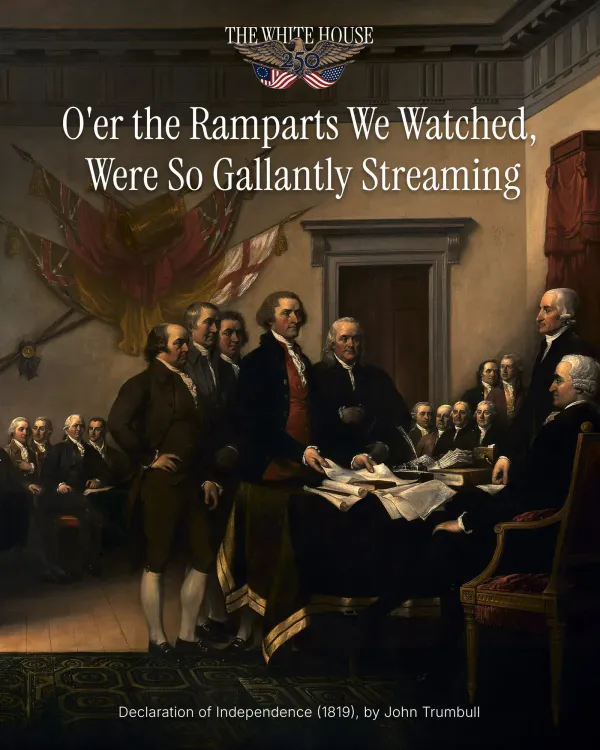
The post, carrying the words 'A nation built on liberty,' arrives on July 2 — a date that holds its own place in American founding history. It was on July 2, 1776 that the Continental Congress voted to approve independence from Britain, two days before the formal adoption of the Declaration of Independence on July 4, 1776. John Adams, one of the founding fathers, famously believed July 2 would be celebrated as the true day of independence.
Policy Backdrop
White House accounts across administrations have consistently issued patriotic social media messages in the days leading up to Independence Day, reinforcing the founding ideals of liberty, equality, and self-governance. The Declaration of Independence, adopted 250 years ago this cycle, proclaimed the separation of the thirteen colonies from British rule and enshrined rights including life, liberty, and the pursuit of happiness. The 2026 observance carries added weight as it falls near the semiquincentennial — the 250th anniversary of American independence, a milestone being marked with ceremonies and commemorations across the country.
Stakeholders and Impact
American citizens across the country are the primary audience for such messaging, which serves to reinforce national identity and shared founding values ahead of the July 4 holiday. For the Indian diaspora and observers abroad, the White House's emphasis on liberty as the nation's cornerstone reflects the ideological framing that successive US administrations project both domestically and in foreign policy. The post's brevity — a single line paired with the national flag — is characteristic of high-visibility social media communication designed for wide reach and symbolic resonance.
What's Next
The White House is expected to follow the July 2 post with more extensive Independence Day messaging and ceremonies on July 4, 2026, including a presidential address and public celebrations. Fireworks displays, parades, and official gatherings across the United States will mark the occasion. The 250th anniversary of American independence is anticipated to draw particularly large commemorative events at historic sites including Philadelphia and Washington DC.
Point of View
A detail that resonates with founding-era purists. With 2026 marking the 250th anniversary of independence, even a brief social media post carries outsized symbolic weight as the administration sets the tone for a milestone national celebration. The single-line format — stripped of policy or partisan framing — signals an attempt at broad, unifying patriotism ahead of what is expected to be an elaborate semiquincentennial commemoration. For global audiences, including India's large diaspora community with ties to the United States, such messaging underscores how American institutions continue to anchor national identity in the language of liberty.
NationPress
2 Jul 2026
Frequently Asked Questions
Why did the White House post about liberty on July 2 and not July 4?
July 2, 1776 is the date the Continental Congress actually voted to approve independence from Britain , making it historically significant. The White House post on July 2, 2026 aligns with this founding moment, two days before the formal adoption of the Declaration of Independence on July 4 .
What is the significance of Independence Day 2026 for the United States?
Independence Day 2026 marks the 250th anniversary — the semiquincentennial — of American independence, first declared on July 4, 1776 . It is one of the most significant milestone anniversaries in US history and is expected to be marked by major national celebrations.
What does 'A nation built on liberty' mean in the White House post?
The phrase references the foundational principle of the United States as established by the Declaration of Independence in 1776 , which proclaimed liberty as a core right of all people. It is a standard patriotic framing used by White House communications ahead of Independence Day .
When is US Independence Day celebrated?
US Independence Day is celebrated every year on July 4 , commemorating the adoption of the Declaration of Independence on July 4, 1776 . In 2026 , it falls on a Saturday and marks the nation's 250th anniversary .
How does the White House typically mark Independence Day on social media?
White House accounts across multiple administrations have issued short patriotic posts on social media in the days leading up to July 4 , emphasising founding values such as liberty, equality, and democracy. These posts are designed for wide reach and symbolic resonance with American citizens .