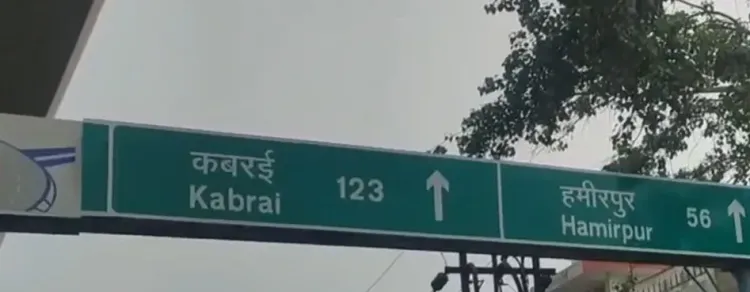
Kanpur–Kabrai greenfield highway: 117.7 km corridor to boost Bundelkhand trade
Synopsis
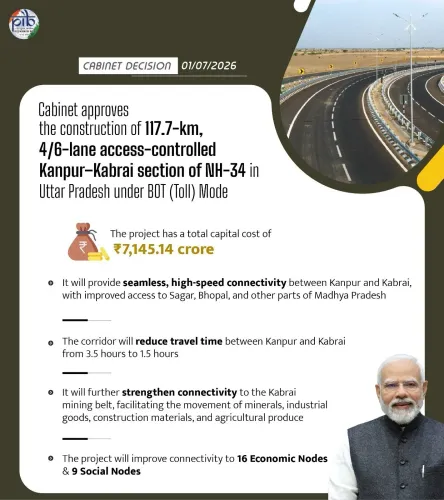
The CCEA's approval of the 117.7 km Kanpur–Kabrai greenfield highway fills a connectivity gap that traders say has cost lives and business for years. Designed for future six-laning and anchored in the Bhopal–Kanpur Economic Corridor, the project could reshape Bundelkhand's logistics landscape — if construction begins without the delays that dogged the approval itself.
Key Takeaways
The CCEA , chaired by PM Narendra Modi , approved the 117.7 km Kanpur–Kabrai greenfield highway on 2 July .
The four-lane, access-controlled corridor is designed for future expansion to six lanes .
It forms a key segment of the Bhopal–Kanpur Economic Corridor under the National Highways Programme.
Traders cited a recent seven-hour traffic jam and called the existing route one of the most accident-prone roads in the country.
Industry leaders say the highway will link Kanpur to Bundelkhand, Madhya Pradesh, Maharashtra , and other western states, spurring industrial hub creation and employment.
Stakeholders are urging the Centre to begin construction at the earliest; no formal timeline has been announced.
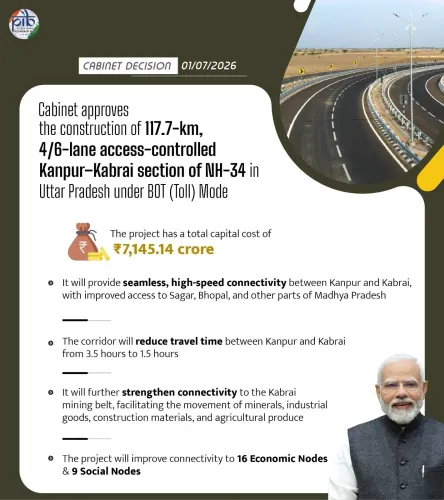
The Cabinet Committee on Economic Affairs (CCEA), chaired by Prime Minister Narendra Modi, on Wednesday, 2 July approved the construction of a 117.7 km access-controlled greenfield highway connecting Kanpur and Kabrai in Uttar Pradesh. Senior traders and industry leaders have welcomed the move, saying the four-lane corridor — designed for future six-laning — will cut travel time, ease chronic traffic congestion, and unlock industrial growth across the Bundelkhand region.
Project Overview
The approved corridor is a key segment of the Bhopal–Kanpur Economic Corridor under the National Highways Programme. Built as an access-controlled greenfield route, the highway's structures have been engineered to accommodate future expansion to six lanes. The project is intended to provide a direct, high-speed link between Kanpur and the Bundelkhand belt, a stretch that currently lacks adequate road infrastructure connecting it to major commercial centres.
What Traders and Industry Leaders Said
Gyanesh Mishra, Uttar Pradesh President of Bharatiya Udyog Vyapar Mandal, said the highway addresses a long-standing bottleneck. 'Recently, there was a seven-hour traffic jam,' he said, adding that the project 'will connect Kanpur and Kabrai with Bundelkhand' and 'facilitate better transportation of goods for traders. There will be economic gains for the cities.' Mishra called the project 'a great achievement' for Kanpur.
Ravi Shankar Mishra, President of the Kanpur Transport Association, said vehicles carrying crushed stone and coarse river sand primarily operate through Bundelkhand and would directly benefit. However, he noted the approval was delayed: 'We faced a lot of losses using the current infrastructure as it is one of the most accident-prone roads in the country. Many lives have been lost so far.' He urged the government to begin construction without further delay.
Vijay Kapoor, Chairman of Kanpur Industrial Development Co-operative Estate Ltd., said the highway will cut travel time to neighbouring Madhya Pradesh and 'lead to the creation of industrial hubs in the region, generate employment and subsequently lead to the country's development.' He also called for the earliest possible completion.
Wider Connectivity and Industrial Impact
Sunil Vaish, former President of the Indian Industries Association (IIA), pointed to a structural gap the highway addresses. 'Kanpur is connected to almost all major cities except Bundelkhand and Madhya Pradesh, due to which there used to be extreme traffic congestion and transportation was difficult,' he said. 'Now, with the construction of the highway, Kanpur will be connected not only to Madhya Pradesh but also to Maharashtra and other western states. This road will play a major role in the movement of industrial output.'
What Comes Next
Industry stakeholders are pressing the Centre to fast-track land acquisition and tender processes so that ground-level work begins at the earliest. The corridor's approval under the National Highways Programme signals central funding commitment, though a formal construction timeline has not yet been announced. Once operational, the highway is expected to reduce logistics costs for raw material-intensive industries — particularly stone and sand transport — that form the backbone of Kanpur's supply chains into the Bundelkhand belt.
Point of View
But the trader community's frustration is telling — this corridor has been in planning long enough for 'many lives' to be lost on the existing road, by their own account. The real measure of this announcement is not the greenfield design or the six-laning provision, but how quickly land acquisition moves in a region where infrastructure projects routinely stall between sanction and shovel. Bundelkhand's economic lag is not simply a connectivity problem; it is also a governance execution problem. A highway approval that took this long to materialise should come with a publicly committed construction milestone, not just a press release.
NationPress
2 Jul 2026
Frequently Asked Questions
What is the Kanpur–Kabrai greenfield highway project?
It is a 117.7 km, four-lane access-controlled greenfield corridor approved by the CCEA on 2 July, connecting Kanpur in Uttar Pradesh to Kabrai. The highway is designed for future six-laning and forms part of the Bhopal–Kanpur Economic Corridor under the National Highways Programme.
Why is this highway significant for Bundelkhand?
Kanpur currently lacks direct, high-quality road connectivity to the Bundelkhand region and Madhya Pradesh, resulting in severe congestion and high accident rates on existing routes. The new highway is expected to ease goods movement, reduce logistics costs, and support industrial hub development across the region.
Who approved the Kanpur–Kabrai highway and when?
The Cabinet Committee on Economic Affairs (CCEA), chaired by Prime Minister Narendra Modi, approved the project on Wednesday, 2 July. It is funded under the National Highways Programme.
When will construction on the highway begin?
No formal construction timeline has been announced as of the approval date. Industry leaders and traders have urged the Centre to begin work at the earliest, citing long delays in the approval process and ongoing losses from the existing road's poor condition.
Which industries will benefit most from the new highway?
Traders dealing in crushed stone and coarse river sand — key raw materials sourced from Bundelkhand — stand to benefit most immediately. Broader industrial sectors in Kanpur are also expected to gain from improved connectivity to Madhya Pradesh, Maharashtra, and other western states.