Gadkari: Cabinet clears ₹7,145 cr Kanpur–Kabrai highway
Synopsis
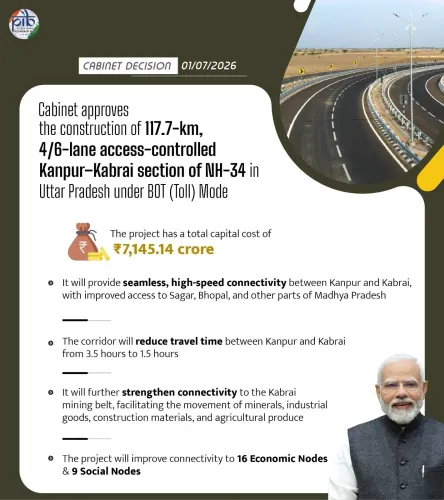
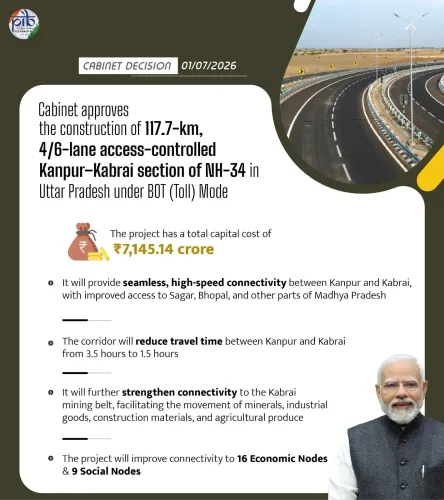
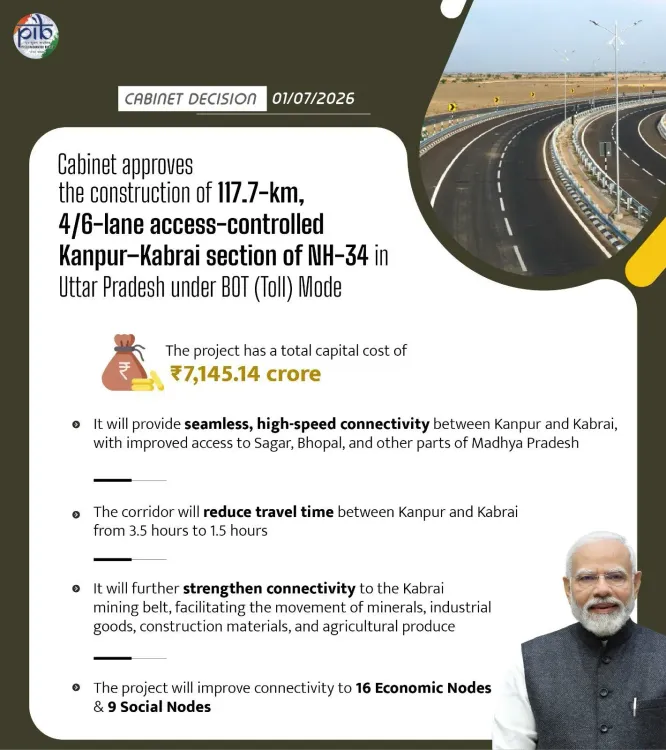
The Union Cabinet has approved a ₹7,145.14 crore, 4/6-lane access-controlled highway on the Kanpur–Kabrai section of NH-34 in Uttar Pradesh, bundling 117.70 km of greenfield construction with 123.86 km of brownfield maintenance under BOT, cutting travel time from 3.5 hours to 1.5 hours.
Key Takeaways
The Union Cabinet approved the Kanpur–Kabrai section of NH-34 at a total capital cost of ₹7,145.14 crore on 1 July 2026 .
The project bundles 117.70 km of greenfield development with 123.86 km of brownfield operation and maintenance under the Build-Operate-Transfer (BOT) mode.
Infrastructure includes 16 major bridges , one Railway Over Bridge , and 12.002 km of service roads on each side.
Travel time between Kanpur and Kabrai is projected to fall from 3.5 hours to 1.5 hours , with speeds rising from 30–50 kmph to 80–100 kmph .
The corridor will connect 16 PM GatiShakti Economic Nodes , 9 Social Nodes , and 10 Logistics Nodes including 7 railway stations and 3 airports .
Next steps include NHAI tender finalisation, land acquisition, and multimodal integration works.
Union Road Transport and Highways Minister Nitin Gadkari announced on Wednesday, 1 July 2026 that the Union Cabinet, chaired by Prime Minister Narendra Modi, has approved a ₹7,145.14 crore highway project covering the Kanpur–Kabrai section of NH-34 in Uttar Pradesh, combining 117.70 km of greenfield development with 123.86 km of brownfield operation and maintenance under the Build-Operate-Transfer (BOT) mode.
Context
The approved corridor is a 4/6-lane access-controlled highway that will physically connect Kanpur to Kabrai in Uttar Pradesh. The project bundle includes 16 major bridges, one Railway Over Bridge (ROB), and 12.002 km of service roads on each side of the carriageway. Once operational, the corridor is projected to cut travel time between the two cities from 3.5 hours to just 1.5 hours, while lifting average travel speeds from the current 30–50 kmph to 80–100 kmph.
Gadkari described the decision as 'a major boost to high-speed connectivity and economic growth in Uttar Pradesh,' flagging its potential to strengthen regional supply chains and reduce logistics costs for businesses along the corridor.
Policy Backdrop
The project sits within two overlapping policy frameworks. Bharatmala Pariyojana, approved in 2015, set out to develop approximately 34,800 km of optimal highway corridors including greenfield alignments across India, with a particular emphasis on economic corridors and ring roads. The Kanpur–Kabrai section reflects that mandate for access-controlled, high-speed greenfield routes in densely populated northern India.
The PM GatiShakti National Master Plan, launched in October 2021, added a node-based planning layer, requiring new infrastructure to be mapped against economic, social and logistics clusters. The Cabinet note cited connectivity to 16 PM GatiShakti Economic Nodes, 9 Social Nodes, and 10 Logistics Nodes — including 7 railway stations and 3 airports — as a core justification for the project's approval. The Build-Operate-Transfer (BOT) financing model, which has been the backbone of national highway private participation since the early 2000s, is being used here to mobilise private capital while transferring operational risk to a concessionaire.
Stakeholders and Impact
For commuters and freight operators in Uttar Pradesh, the most immediate benefit is the projected halving of travel time on a corridor that currently suffers from congestion-related speed drops. Logistics companies serving the Kanpur industrial belt — one of India's significant leather and textile manufacturing hubs — stand to gain from reduced transit times and lower per-kilometre operating costs at higher average speeds.
The connectivity to 3 airports and 7 railway stations through the GatiShakti node framework signals an intent to create seamless multimodal freight and passenger links rather than a standalone road project. Businesses located at the 10 Logistics Nodes along the alignment are expected to see improved last-mile access, which planners argue will attract fresh investment to the region.
What's Next
The Cabinet approval triggers the next phase of project preparation at the National Highways Authority of India (NHAI), which will need to finalise the tender documents and invite bids from BOT concessionaires. Land acquisition — a historically sensitive and time-consuming step for greenfield alignments — will be a critical variable determining the project's construction timeline.
Integration works connecting the new corridor to the 7 railway stations and 3 airports cited in the Cabinet note will require coordinated planning across multiple ministries. Progress on these milestones will determine how quickly the projected economic and connectivity benefits materialise for Uttar Pradesh.
Point of View
A technique NHAI has refined over successive highway generations. For Uttar Pradesh, which has seen significant expressway investment under both state and central programmes, this project deepens the network effect rather than opening an entirely new corridor. The real test will be whether land acquisition and tender timelines hold, since delays on both counts have historically been the gap between Cabinet approval and actual ground-breaking on greenfield alignments.
NationPress
30 Sept 2026
Frequently Asked Questions
What is the Kanpur–Kabrai NH-34 highway project approved by the Cabinet?
It is a 4/6-lane access-controlled highway project on the Kanpur–Kabrai section of National Highway 34 in Uttar Pradesh, approved by the Union Cabinet on 1 July 2026 at a total capital cost of ₹7,145.14 crore. The project combines 117.70 km of new greenfield construction with 123.86 km of brownfield operation and maintenance under the Build-Operate-Transfer (BOT) model.
How much will travel time reduce on the Kanpur–Kabrai highway?
Once the corridor is operational, travel time between Kanpur and Kabrai is expected to drop from 3.5 hours to 1.5 hours, with average speeds rising from 30–50 kmph to 80–100 kmph.
What is the BOT mode used for this highway project?
Build-Operate-Transfer (BOT) is a public-private partnership model in which a private concessionaire finances, builds and operates the highway for a defined period — recovering costs through toll collection — before transferring the asset back to the government. India has used BOT for national highway development since the early 2000s.
How does this project connect to PM GatiShakti?
The Kanpur–Kabrai corridor is aligned with the PM GatiShakti National Master Plan, which maps infrastructure to economic, social and logistics clusters. The project is cited as connecting 16 PM GatiShakti Economic Nodes, 9 Social Nodes, and 10 Logistics Nodes, including 7 railway stations and 3 airports, enabling multimodal connectivity.
What are the key infrastructure features of the Kanpur–Kabrai NH-34 project?
The project includes 16 major bridges, one Railway Over Bridge (ROB), and 12.002 km of service roads on each side of the carriageway, in addition to the 117.70 km greenfield highway alignment itself.