Cabinet Clears ₹7,145 Cr Kanpur–Kabrai Greenfield Highway
Synopsis
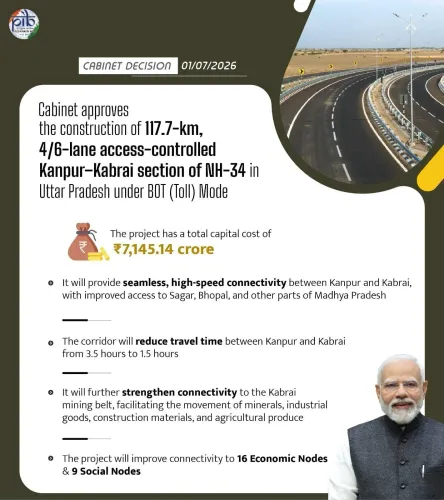
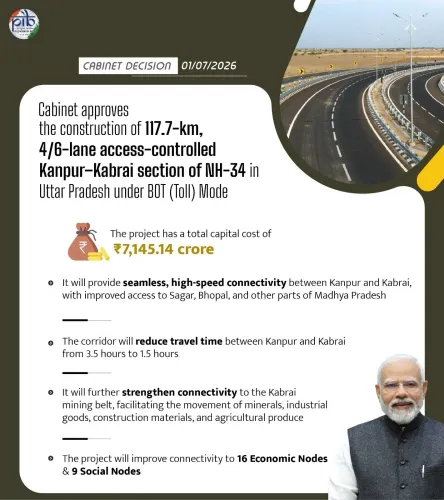
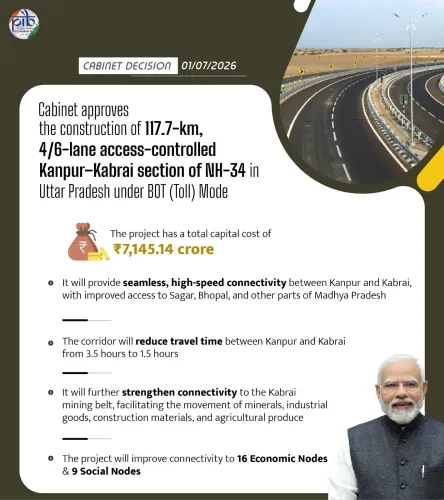
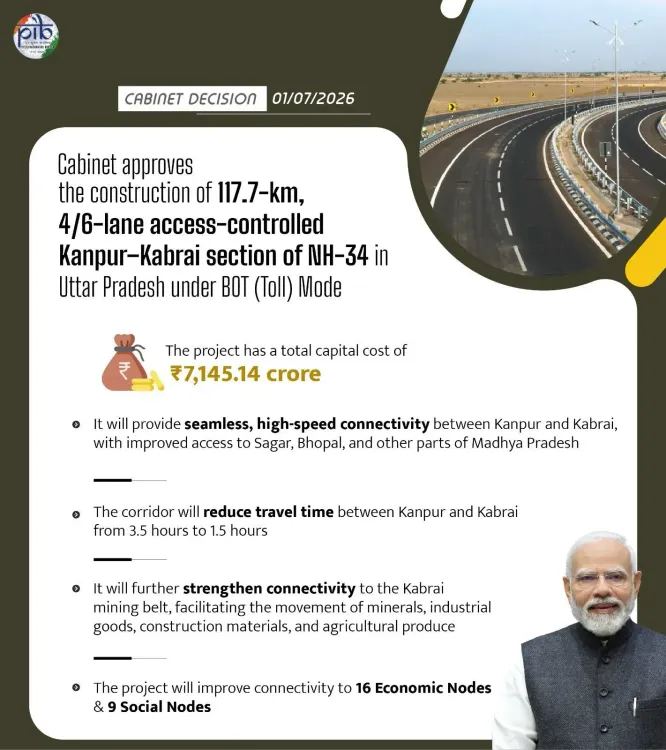
The Union Cabinet has approved a ₹7,145.14 crore, 117.7-km access-controlled greenfield highway between Kanpur and Kabrai on NH-34, cutting travel time from 3.5 to 1.5 hours and boosting connectivity across the Bhopal–Kanpur economic corridor through Bundelkhand.
Key Takeaways
The Union Cabinet approved the Kanpur–Kabrai greenfield highway (NH-34) on 1 July 2026 .
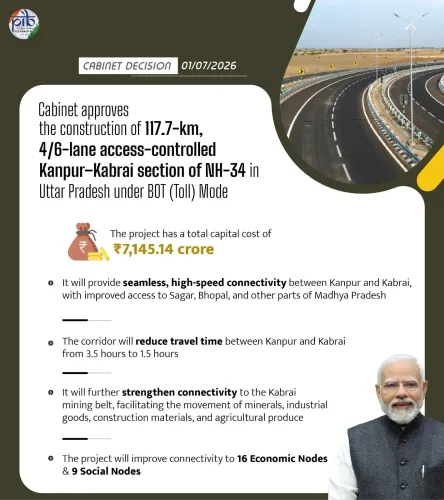
The project spans 117.7 km and will be built as a 4/6-lane access-controlled highway at a cost of ₹7,145.14 crore .
Travel time between Kanpur and Kabrai will fall from approximately 3.5 hours to 1.5 hours .
The highway is a key segment of the Bhopal–Kanpur Economic Corridor , linking UP's industrial centres with MP's agriculture, manufacturing, and mineral zones.
The project is expected to improve logistics efficiency, lower transport costs, and generate industrial growth and employment in Bundelkhand .
Next steps include NHAI tendering and land acquisition across the greenfield alignment.
Union Agriculture Minister Shivraj Singh Chouhan on Wednesday, 1 July 2026 announced that the Union Cabinet, under the leadership of Prime Minister Narendra Modi, has approved construction of a 117.7-kilometre, 4/6-lane access-controlled greenfield highway between Kanpur and Kabrai on NH-34 in Uttar Pradesh, at a total cost of ₹7,145.14 crore.
Chouhan, posting on X in Hindi, described the project as 'भोपाल–कानपुर आर्थिक कॉरिडोर का महत्वपूर्ण हिस्सा' — 'an important segment of the Bhopal–Kanpur economic corridor' — that will provide modern, seamless connectivity between Uttar Pradesh's industrial and commercial centres and Madhya Pradesh's agriculture, manufacturing, and mineral-rich zones. The corridor will also improve access to Sagar, Bhopal, and other parts of Madhya Pradesh.
Context
The approved stretch forms a critical link in the broader Bhopal–Kanpur Economic Corridor, a multi-state connectivity initiative designed to integrate resource-rich hinterlands with industrial nodes across two of India's most populous states. The highway will be access-controlled, meaning vehicles enter and exit only at designated interchanges, enabling higher average speeds and improved road safety.
According to the Cabinet decision, travel time between Kanpur and Kabrai is expected to drop from approximately 3.5 hours to 1.5 hours — a reduction of nearly two hours — once the highway is operational.
Policy Backdrop
The project fits within the framework of Bharatmala Pariyojana Phase-I, approved in 2017, which identified a network of greenfield economic corridors connecting major industrial and agricultural regions across India, including segments linking Uttar Pradesh and Madhya Pradesh. Successive cabinets have prioritised access-controlled highways that reduce logistics costs and integrate agricultural hinterlands with manufacturing clusters.
Bundelkhand — the region straddling southern Uttar Pradesh and northern Madhya Pradesh — has historically lagged in road infrastructure relative to other parts of the Hindi heartland. The new highway directly addresses this gap by threading through the corridor that connects Kanpur with Kabrai, a town in Mahoba district at the edge of Bundelkhand.
Stakeholders and Impact
The Cabinet approval is expected to benefit a wide range of stakeholders. Logistics operators stand to gain from lower per-kilometre transport costs on a route that currently traverses slower, non-access-controlled roads. Farmers in Bundelkhand — a zone known for oilseeds, pulses, and stone quarrying — will gain faster market access to the large consumer and processing hub at Kanpur.
Industrial investors in both states are also expected to take note: improved connectivity between Kanpur's leather, textile, and engineering industries and Madhya Pradesh's mineral and manufacturing belt could attract fresh investment along the corridor. The government statement cited gains in logistics efficiency, reduced transportation costs, enhanced road safety, and fresh impetus to industrial growth and employment in the Bundelkhand region.
What's Next
The immediate milestones will be the National Highways Authority of India (NHAI) tendering process and land acquisition for the 117.7-km stretch. Greenfield alignments typically require fresh land acquisition across multiple districts, which can influence project timelines. Observers will also watch for further Cabinet approvals covering remaining packages of the Bhopal–Kanpur Economic Corridor, of which this stretch is one segment.
With the Cabinet green-light secured, the project now moves toward detailed project report finalisation and contractor bidding — steps that will determine when construction begins and how quickly the travel-time savings materialise for commuters and freight operators across Uttar Pradesh and Madhya Pradesh.
Point of View
A region that both parties have long courted with development promises. For Shivraj Singh Chouhan, who spent four terms as Madhya Pradesh Chief Minister championing connectivity projects in the state, amplifying this announcement reinforces his continued relevance as a Union minister with cross-state influence. The project also advances the Centre's broader Bharatmala playbook of using access-controlled corridors to compress inter-state logistics costs, a metric that increasingly shapes industrial investment decisions in the Hindi heartland. Whether the project delivers on its employment and growth promises will depend heavily on how swiftly NHAI navigates land acquisition — historically the most contentious bottleneck for greenfield alignments in this region.
NationPress
30 Sept 2026
Frequently Asked Questions
What is the Kanpur–Kabrai greenfield highway project?
It is a 117.7-km, 4/6-lane access-controlled greenfield highway on NH-34 in Uttar Pradesh, approved by the Union Cabinet at a cost of ₹7,145.14 crore . It forms part of the Bhopal–Kanpur Economic Corridor connecting Uttar Pradesh and Madhya Pradesh.
How much will the Kanpur–Kabrai highway cost and who approved it?
The project was approved by the Union Cabinet under Prime Minister Narendra Modi at a total estimated cost of ₹7,145.14 crore , as announced on 1 July 2026 .
How will the new highway reduce travel time between Kanpur and Kabrai?
The access-controlled greenfield alignment will cut travel time from approximately 3.5 hours to 1.5 hours — a saving of nearly two hours — by eliminating at-grade intersections and enabling higher sustained speeds.
What is the Bhopal–Kanpur Economic Corridor?
It is a planned multi-state highway corridor linking Kanpur's industrial and commercial centres in Uttar Pradesh with Madhya Pradesh's agriculture, manufacturing, and mineral-rich regions, including Sagar and Bhopal . The Kanpur–Kabrai stretch is one key segment of this corridor.
How will the Kanpur–Kabrai highway benefit Bundelkhand?
Bundelkhand , which straddles southern UP and northern MP, will gain faster market access, lower logistics costs, and improved road safety. The government expects the project to accelerate industrial investment, economic activity, and employment generation across the region.