Cabinet clears ₹7,145 crore Kanpur-Kabrai greenfield highway, cuts travel time by 2 hours
Synopsis
The Centre has greenlit a ₹7,145 crore, 117.7 km highway linking Kanpur to Kabrai — cutting travel time by two hours and opening a direct freight corridor into Bundelkhand's mining belt. With 16 economic nodes in its catchment and 1.2 crore person-days of projected employment, this is one of the largest single infrastructure bets on the UP-MP border in years.
Key Takeaways
The CCEA , chaired by PM Modi , approved the ₹7,145.14 crore Kanpur–Kabrai highway on 1 July 2025 .
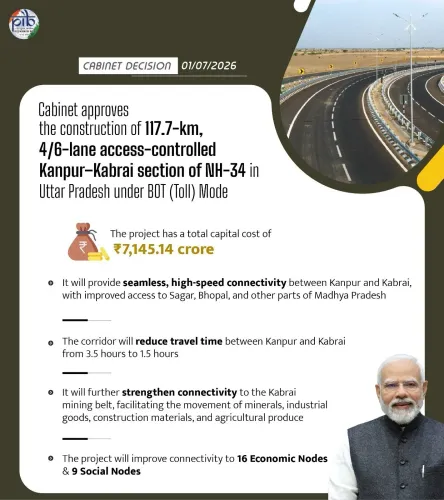
The 117.7 km four-lane greenfield corridor is designed for future six-laning and operating speeds of 80–100 kmph .
Travel time between Kanpur and Kabrai will drop from 3.5 hours to 1.5 hours .
NHAI will implement the project on a BOT (toll) model, including maintenance of the existing NH-34 stretch.
The corridor connects 16 Economic Nodes and the Kabrai mining belt , aligning with the PM GatiShakti National Master Plan .
The project is projected to generate nearly 1.2 crore person-days of direct and indirect employment and carry 18,069 passenger car units daily by FY 2028 .
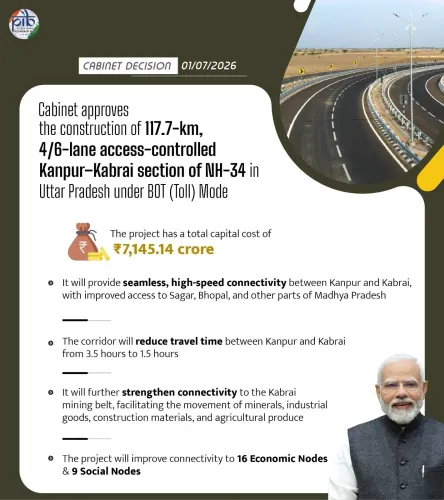
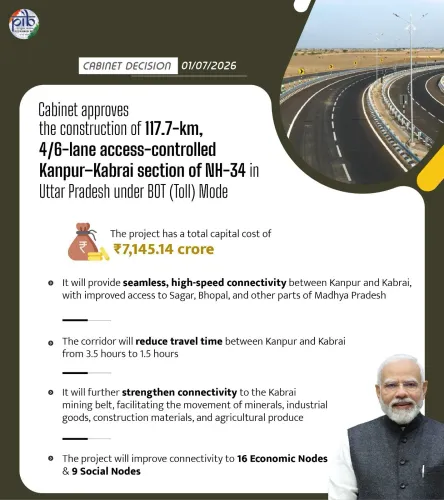
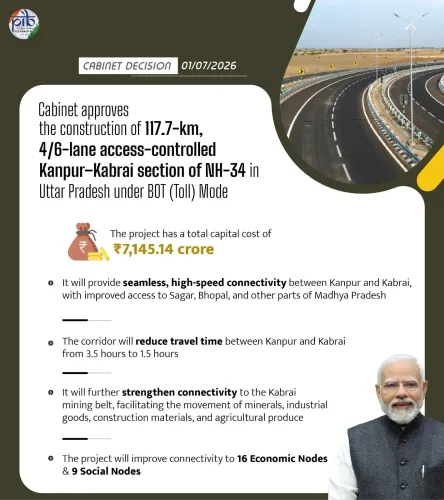
The Cabinet Committee on Economic Affairs (CCEA), chaired by Prime Minister Narendra Modi, on Wednesday, 1 July approved a ₹7,145.14 crore project to construct a 117.7 km greenfield, four-lane access-controlled highway between Kanpur and Kabrai in Uttar Pradesh. The corridor, designed with structures ready for future six-laning, will form a critical segment of the Bhopal–Kanpur Economic Corridor under the National Highways Programme.
Project Structure and Implementing Agency
The National Highways Authority of India (NHAI) will implement the project on a Build-Operate-Transfer (BOT) toll basis, which also covers the operation and maintenance of the existing Kanpur–Kabrai section of NH-34. The BOT model means private investment drives construction while toll revenues fund long-term upkeep — reducing the direct burden on the exchequer.
The corridor is designed for operating speeds of 80–100 kmph, slashing the travel time between Kanpur and Kabrai from 3.5 hours to 1.5 hours, according to an official statement. The project also promises improved road safety, lower vehicle operating costs, and faster movement of both passenger and freight traffic.
Connectivity and Strategic Integration
Beyond the Kanpur–Kabrai stretch, the highway will strengthen onward links to Sagar, Bhopal, and other parts of Madhya Pradesh, effectively stitching together the industrial and commercial heartland of Uttar Pradesh with the mineral-rich, manufacturing, and agricultural belt of Madhya Pradesh. The corridor will intersect with NH-34, NH-35, the Bundelkhand Expressway, the Kanpur Ring Road, and state highways SH-46, SH-91, SH-10B, and SH-42.
Critically, the route passes through the Kabrai mining belt, improving the logistics chain for minerals, industrial goods, construction materials, and agricultural produce — sectors that have long suffered from inadequate road infrastructure in the Bundelkhand region.
PM GatiShakti Alignment and Economic Nodes
The project is aligned with the PM GatiShakti National Master Plan and is expected to improve connectivity to 16 Economic Nodes. These include the Unnao, Banther, Pankhi, Rania, Jainpur, Rooma, Chakeri, Sumerpur, and Bhuragarh Industrial Areas, the Trans Ganga Integrated Township, Growth Centre Jaipur, Kanpur Nagar Node, and Bengal Chemicals and Pharmaceuticals Ltd, among others.
This connectivity push is part of a broader Centre strategy to use highway infrastructure as a lever for industrial clustering — linking production zones to freight corridors to reduce logistics costs, which currently account for a disproportionately high share of India's GDP compared to developed economies.
Employment and Traffic Projections
The project is expected to generate approximately 11,188 direct and 13,985 indirect person-days of employment per lane per km during construction. In aggregate, the corridor is projected to create close to 1.2 crore person-days of direct and indirect employment. Annual average daily traffic is projected to reach approximately 18,069 passenger car units by FY 2028, underlining the corridor's long-term transport and economic significance.
With the Bundelkhand region historically lagging on infrastructure and industrial investment, the approved highway represents one of the more consequential connectivity interventions in the area in recent years. Implementation timelines and land acquisition progress will be closely watched as the project moves to execution.
Point of View
And the FY 2028 projection of 18,069 PCUs per day will be the real test. The alignment with 16 economic nodes looks compelling on paper, but several of those nodes — including the industrial areas around Banther and Pankhi — remain underutilised. The highway alone will not unlock them; it needs parallel investment in power, water, and industrial policy to convert corridor into cluster.
NationPress
30 Sept 2026
Frequently Asked Questions
What is the Kanpur–Kabrai greenfield highway project approved by the Cabinet?
It is a 117.7 km , four-lane access-controlled greenfield highway approved by the CCEA on 1 July at a cost of ₹7,145.14 crore . The corridor forms part of the Bhopal–Kanpur Economic Corridor and will be built with structures ready for future six-laning.
Who will build and operate the Kanpur–Kabrai highway?
The National Highways Authority of India (NHAI) will implement the project on a Build-Operate-Transfer (BOT) toll basis. This model also covers the operation and maintenance of the existing Kanpur–Kabrai section of NH-34 .
How much will the new highway reduce travel time between Kanpur and Kabrai?
Travel time between Kanpur and Kabrai is expected to fall from 3.5 hours to 1.5 hours — a reduction of two hours — owing to the corridor's design speed of 80–100 kmph .
How many jobs will the Kanpur–Kabrai highway project create?
The project is projected to generate approximately 11,188 direct and 13,985 indirect person-days of employment per lane per km during construction, totalling close to 1.2 crore person-days of direct and indirect employment overall.
Which regions and economic zones will benefit from the new highway?
The corridor will benefit 16 Economic Nodes including industrial areas in Unnao , Banther , Chakeri , and Kanpur Nagar , and will improve freight movement from the Kabrai mining belt across Bundelkhand and into Madhya Pradesh toward Sagar and Bhopal .