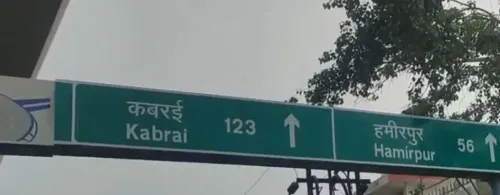
Cabinet Clears 117.7 km Kanpur-Kabrai Greenfield Highway
Synopsis
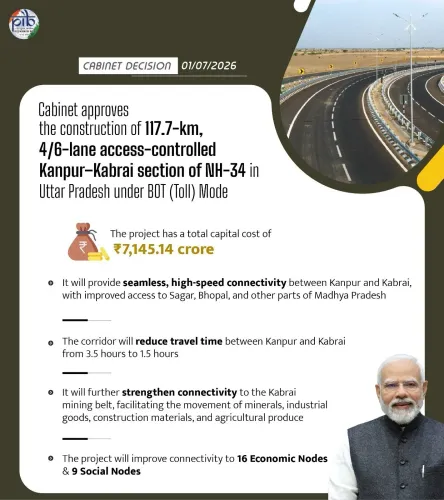
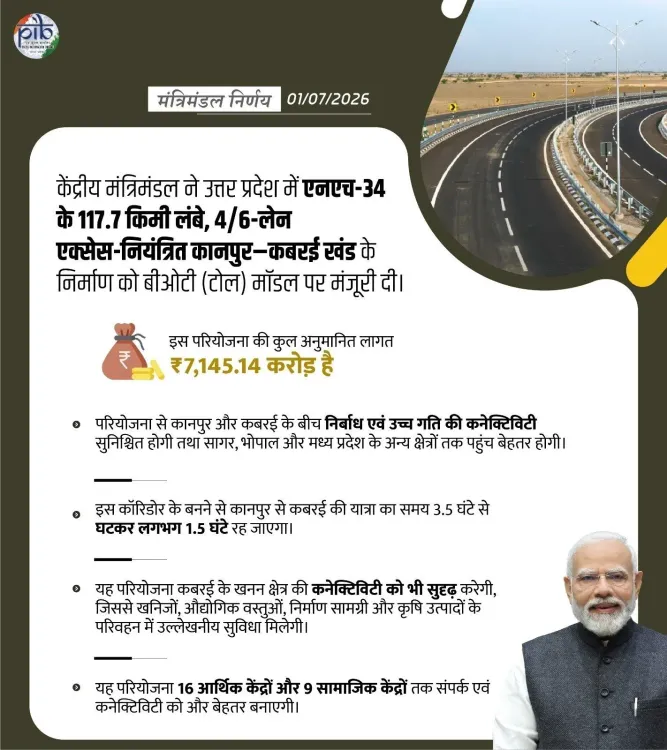
The Union Cabinet has approved a 117.7 km access-controlled greenfield highway between Kanpur and Kabrai at ₹7,145.14 crore. The project, part of the Bhopal-Kanpur Economic Corridor under the National Highways (O) programme, aims to boost connectivity, trade, and employment across Uttar Pradesh and Madhya Pradesh.
Key Takeaways
The Union Cabinet approved the 117.7 km Kanpur-Kabrai access-controlled greenfield highway on 1 July 2026 .
Estimated project cost is ₹7,145.14 crore .
The highway is a key segment of the Bhopal-Kanpur Economic Corridor under the National Highways (O) programme .
The corridor will improve connectivity to Sagar , Bhopal , and other parts of Madhya Pradesh .
The project is expected to accelerate growth in mineral, manufacturing, and agricultural sectors across Uttar Pradesh and Madhya Pradesh .
Land acquisition and tendering are the critical next steps before construction can begin.
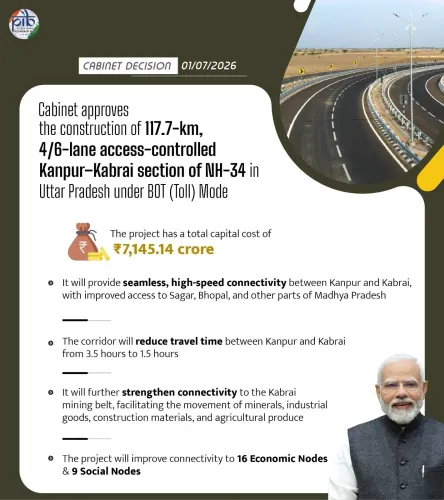
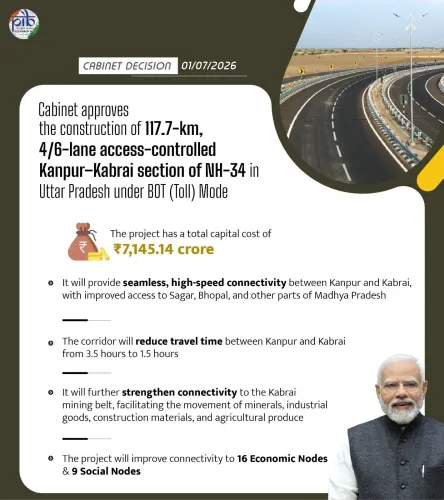
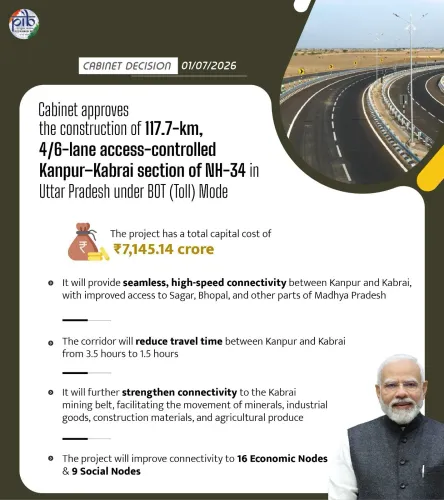
Union Health Minister J. P. Nadda on Wednesday, 1 July 2026, announced that the Union Cabinet, under the leadership of Prime Minister Narendra Modi, has approved the construction of a 117.7-kilometre access-controlled greenfield highway between Kanpur and Kabrai, at an estimated cost of ₹7,145.14 crore. The project forms a key segment of the Bhopal-Kanpur Economic Corridor under the National Highways (O) programme.
Context
Nadda shared the cabinet decision on X, stating — translated from Hindi — that the new highway will ensure 'tez, surakshit aur nirbadh aavagaman' (fast, safe and uninterrupted movement) between Kanpur and Kabrai. He credited Prime Minister Modi's 'visionary leadership' for the approval and used the hashtag #CabinetDecisions. The minister noted that the corridor will simultaneously improve connectivity to Sagar, Bhopal, and other parts of Madhya Pradesh.
The greenfield alignment is designed as an access-controlled highway, meaning entry and exit points are limited and controlled, which significantly reduces travel time and improves road safety compared with conventional national highways.
Policy Backdrop
The approval sits within the broader Bharatmala Pariyojana, launched in 2015, which has prioritised economic corridors and greenfield expressways to integrate state economies and reduce logistics costs. The National Highways (O) programme is a component of this framework specifically targeting access-controlled inter-state links.
Successive cabinets have sanctioned similar corridor segments to connect northern and central India, with a focus on regions whose mineral, manufacturing, and agricultural output has historically been constrained by poor road infrastructure. The Kanpur-Kabrai stretch fits this pattern, linking Uttar Pradesh's industrial heartland with Madhya Pradesh's mineral-rich Bundelkhand belt.
Stakeholders and Impact
The highway is expected to benefit traders, farmers, and manufacturing units across Uttar Pradesh and Madhya Pradesh, two of India's largest states by population and economic output. Faster road access is projected to reduce freight costs for minerals extracted in the Bundelkhand region and improve cold-chain connectivity for agricultural produce moving toward Kanpur and beyond.
Nadda specifically highlighted the project's potential to 'create new investment opportunities and employment for youth' — a framing consistent with the government's stated goal of using infrastructure spending as a lever for job creation. Local youth in districts along the corridor corridor, including those in Mahoba and Hamirpur in UP, are among the intended beneficiaries of construction-phase and post-completion economic activity.
What's Next
Following cabinet approval, the project will move to the tendering and land acquisition stages, which are typically the most time-sensitive phases for greenfield highway projects in India. Land acquisition across state boundaries — spanning both Uttar Pradesh and Madhya Pradesh — will require coordination between two state governments and the National Highways Authority of India (NHAI).
Construction milestones and tender awards over the next two years will be closely watched as indicators of whether the ₹7,145.14 crore project stays on schedule. Completion of this stretch is expected to substantially reduce travel time between Kanpur and Bhopal, with cascading benefits for regional trade and investment flows across central India.
Point of View
The BJP leadership — with Nadda as the messenger — reinforces the party's infrastructure-delivery credentials in two electorally significant states. The ₹7,145.14 crore price tag and the specific focus on mineral and agricultural connectivity signal an attempt to address long-standing grievances in the Bundelkhand belt, a region that has historically lagged in development indices. Whether the project translates into tangible on-ground progress will depend on how swiftly land acquisition and tendering are completed — the perennial chokepoints for India's greenfield highway ambitions.
NationPress
30 Sept 2026
Frequently Asked Questions
What is the Kanpur-Kabrai greenfield highway project?
It is a 117.7 km access-controlled greenfield highway approved by the Union Cabinet on 1 July 2026 , connecting Kanpur in Uttar Pradesh to Kabrai in Madhya Pradesh at an estimated cost of ₹7,145.14 crore . It forms part of the Bhopal-Kanpur Economic Corridor .
What is the cost of the Kanpur-Kabrai highway?
The estimated cost of the project is ₹7,145.14 crore , as approved by the Union Cabinet under the National Highways (O) programme.
Which states will benefit from the Bhopal-Kanpur Economic Corridor?
Uttar Pradesh and Madhya Pradesh are the primary beneficiaries. The highway will improve connectivity to Sagar , Bhopal , and other MP regions while boosting UP's mineral, manufacturing, and agricultural sectors.
What is the National Highways O programme?
The National Highways (O) programme is a component of India's Bharatmala Pariyojana , launched in 2015 , that focuses on developing access-controlled economic corridors and greenfield expressways to reduce logistics costs and integrate state economies.
Who announced the Kanpur-Kabrai highway cabinet approval?
Union Health Minister and BJP national president J. P. Nadda announced the cabinet decision on 1 July 2026 via a post on X, attributing the approval to Prime Minister Narendra Modi's leadership.