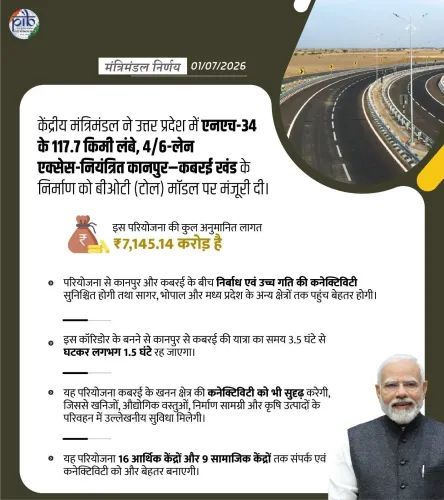
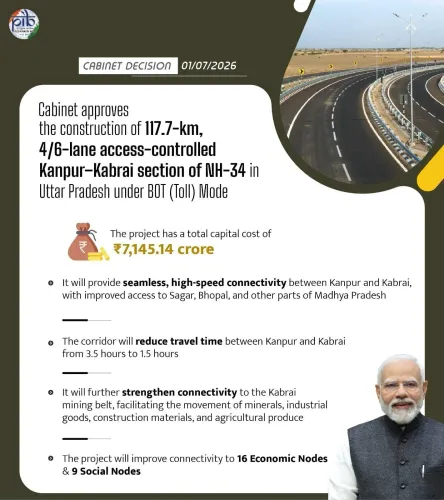
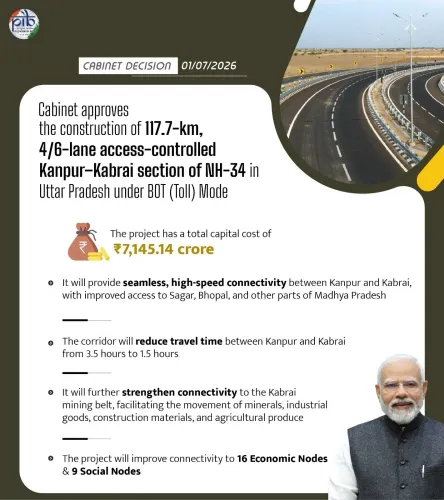
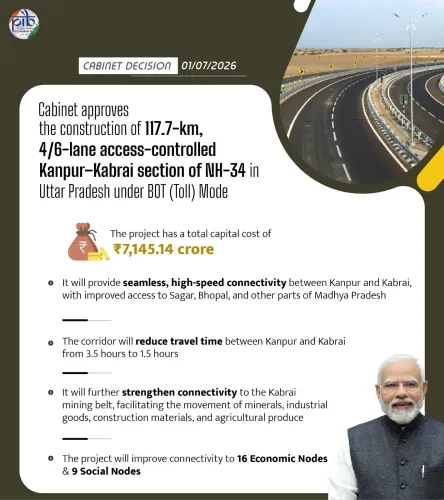
Khattar: Cabinet Clears 117.7 km Kanpur–Kabrai Highway
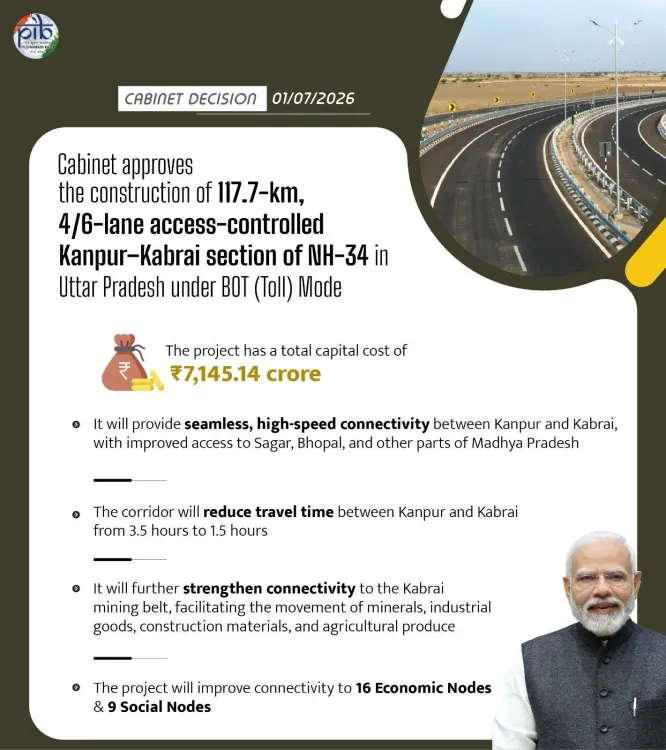
Synopsis
The Union Cabinet has approved a 117.7-km, 4/6-lane access-controlled greenfield highway between Kanpur and Kabrai, targeting improved logistics, industrial growth, and employment in the historically underserved Bundelkhand region spanning Uttar Pradesh and Madhya Pradesh.
Key Takeaways
The Union Cabinet , chaired by PM Narendra Modi , approved the 117.7 km Kanpur–Kabrai Access-Controlled Greenfield Highway on 1 July 2026 .
The highway will be built as a 4/6-lane access-controlled corridor on a new alignment, designed to reduce travel time and improve logistics efficiency.
The project targets the Bundelkhand region, spanning parts of Uttar Pradesh and Madhya Pradesh , which has historically suffered from weak infrastructure connectivity.
The corridor aligns with both Bharatmala Pariyojana (approved 2017 ) and the PM Gati Shakti National Master Plan (launched 2021 ) for multimodal logistics integration.
Expected benefits include reduced freight costs, industrial and agricultural growth, and employment generation in Bundelkhand and adjoining regions.
Land acquisition timelines and the detailed project report from the Ministry of Road Transport and Highways are the immediate next steps to watch.
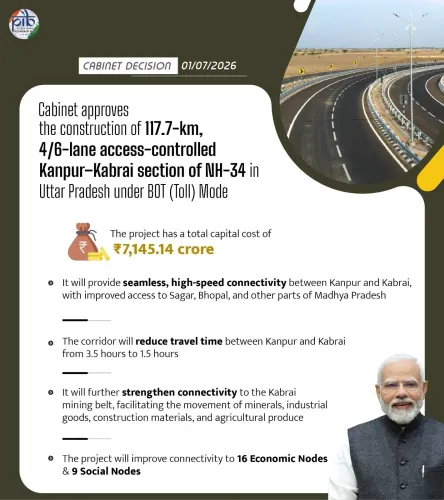
Union Power Minister Manohar Lal Khattar on Wednesday, 1 July 2026, announced that the Union Cabinet, chaired by Prime Minister Narendra Modi, has approved the construction of a 117.7-kilometre, 4/6-lane access-controlled greenfield highway connecting Kanpur and Kabrai — a corridor expected to unlock economic growth across Uttar Pradesh and Madhya Pradesh.
Context
Khattar described the project as 'a major step towards strengthening connectivity and unlocking new avenues of growth' in both states. The approved highway is designed as an access-controlled greenfield corridor — meaning it will be built on a new alignment with controlled entry and exit points — aimed at reducing travel time and improving logistics efficiency between the two states.
The announcement was made under the #CabinetDecisions series, with a formal press release issued by the Press Information Bureau. The project directly targets the Bundelkhand region, a historically underserved area straddling southern Uttar Pradesh and northern Madhya Pradesh, long marked by weak industrial and agricultural connectivity.
Policy Backdrop
The Kanpur–Kabrai corridor sits within the broader framework of Bharatmala Pariyojana, the national highway development programme approved in 2017 that prioritises greenfield, access-controlled expressways across economic corridors. Phase-I of Bharatmala identified over 34,000 km of roads for development, with a specific focus on linking underdeveloped regions to production and logistics clusters.
The project also aligns with the PM Gati Shakti National Master Plan, launched in 2021, which coordinates road development with rail, ports, and logistics parks to cut overall freight costs. Bundelkhand has been a recurring target of central infrastructure outlays under the National Infrastructure Pipeline unveiled in 2019, which earmarked substantial funds for highway projects in both Uttar Pradesh and Madhya Pradesh.
The new corridor is expected to complement existing national highway alignments in the region while supporting multimodal freight movement, including integration with proposed logistics parks near Kanpur and Kabrai.
Stakeholders and Impact
The highway is projected to benefit a wide range of stakeholders: residents of the Bundelkhand region who currently face long travel times on congested routes; logistics and transport operators seeking faster freight corridors between UP and MP; and farmers and agro-industries dependent on timely market access. Industrial investors eyeing land parcels near the corridor are also expected to benefit from improved connectivity.
Khattar specifically cited that the project will 'boost industrial and agricultural growth, generate employment opportunities, and accelerate the economic development of Bundelkhand and adjoining regions.' The 4/6-lane specification allows the corridor to scale capacity as traffic demand grows, a design choice consistent with other Bharatmala greenfield expressways.
What's Next
Attention will now shift to the Ministry of Road Transport and Highways for notifications on land acquisition timelines and the release of the detailed project report. The pace of land acquisition — often the most complex phase of greenfield highway projects in densely populated regions — will determine when construction can begin in earnest.
Integration with multimodal logistics infrastructure near Kanpur and Kabrai will be a key marker of whether the corridor delivers on its promise of end-to-end logistics efficiency. With Bundelkhand emerging as a repeated focus of central infrastructure policy, the Kanpur–Kabrai highway adds another data point to the government's sustained push to reduce India's logistics cost as a share of GDP.
Point of View
Which spans two electorally significant states, has now received successive infrastructure commitments under Bharatmala and Gati Shakti. The 4/6-lane access-controlled design mirrors the template used for other economic corridor highways, suggesting the government is betting on scalable capacity rather than incremental upgrades to existing roads. For the project to move beyond announcement, the speed of land acquisition and integration with logistics parks near Kanpur will be the real tests. Khattar's prominent role in amplifying Cabinet decisions — despite holding the Power and Housing portfolios — also signals the BJP's broader communication strategy of deploying senior leaders to project infrastructure momentum ahead of state electoral cycles.
NationPress
30 Sept 2026
Frequently Asked Questions
What is the Kanpur–Kabrai Greenfield Highway?
The Kanpur–Kabrai Greenfield Highway is a 117.7-km, 4/6-lane access-controlled corridor approved by the Union Cabinet on 1 July 2026 to improve connectivity between Uttar Pradesh and Madhya Pradesh , with a focus on the Bundelkhand region.
Which states will benefit from the Kanpur–Kabrai Highway?
The highway primarily benefits Uttar Pradesh and Madhya Pradesh , with the Bundelkhand region — which straddles both states — being the key focus area for improved logistics, industrial, and agricultural connectivity.
What is Bharatmala Pariyojana and how does this highway fit in?
Bharatmala Pariyojana is India's national highway development programme approved in 2017 , covering over 34,000 km of roads including greenfield expressways. The Kanpur–Kabrai corridor aligns with its mandate to build access-controlled highways linking underdeveloped economic regions.
What is the PM Gati Shakti connection to this project?
PM Gati Shakti , launched in 2021 , is a national master plan coordinating road, rail, ports, and logistics parks. The Kanpur–Kabrai highway is designed to integrate with this multimodal framework, potentially linking with logistics parks near Kanpur and Kabrai .
When will construction on the Kanpur–Kabrai Highway begin?
A construction start date has not been announced. The immediate next steps are the release of the detailed project report and land acquisition notifications by the Ministry of Road Transport and Highways , which will determine the construction timeline.