Nvidia Maps AI Supply Chain Across 43 US States

Synopsis
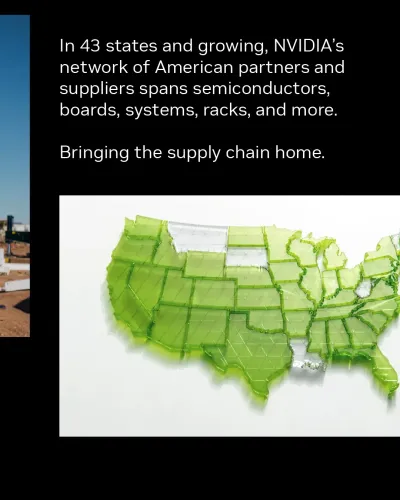
Nvidia on 2 July 2026 said its American partner and supplier network spans 43 states and covers the full hardware stack from semiconductors to rack systems, citing goals of better healthcare, scientific discovery, and global technology leadership — a move tightly aligned with the US CHIPS Act industrial-policy push.
Key Takeaways
Nvidia says its US partner and supplier network now covers 43 states and is still expanding.
The network spans the full hardware stack: semiconductors, boards, systems, and racks .
Nvidia cited applications in healthcare, scientific discovery, and industrial productivity as key outcomes.
The disclosure aligns with the CHIPS and Science Act of 2022 , which authorised approximately $52 billion to onshore US semiconductor supply chains.
US policy since 2021 has pushed to reduce reliance on overseas chip fabrication amid tensions with China and concerns over Taiwan -concentrated production.
The 43-state footprint suggests economically distributed impact beyond traditional tech hubs, with implications for allied markets including India .
Chip giant Nvidia Corporation on 2 July 2026 publicly acknowledged its growing domestic supply-chain network, stating that partners and suppliers now span 43 US states and cover the full hardware stack — from semiconductors and boards to systems and racks.
Context
In its post on X, Nvidia wrote: 'Thank you to the partners across America helping bring the supply chain home. In 43 states and growing, NVIDIA's network of American partners and suppliers spans semiconductors, boards, systems, racks, and more.' The company framed the network as enabling 'better healthcare, breakthrough scientific discovery, stronger industrial productivity, and global technology leadership.'
The statement arrives as Nvidia sits at the centre of global demand for AI accelerators and GPUs, hardware that underpins everything from large language models to scientific simulation. Its domestic supplier map signals a deliberate effort to reduce dependence on overseas fabrication and assembly.
Policy Backdrop
The announcement maps closely onto the objectives of the CHIPS and Science Act of 2022, the landmark US legislation that authorised approximately $52 billion in grants, loans, and tax credits to expand domestic semiconductor manufacturing and research capacity.
US industrial policy since 2021 has explicitly targeted the reduction of reliance on overseas chip fabrication, driven by export-control tensions with China and strategic concerns over concentrated production in Taiwan. Major AI and semiconductor firms have responded with domestic investment pledges aligned to federal funding streams, and Nvidia's partner-network disclosure fits squarely within that pattern.
The CHIPS Act created financial incentives for precisely the kind of multi-tier domestic ecosystem — spanning design, fabrication, packaging, and systems integration — that Nvidia now describes as operational across a majority of US states.
Stakeholders and Impact
The beneficiaries of this network include US semiconductor suppliers, printed-circuit-board manufacturers, rack and systems integrators, and the broader technology manufacturing workforce. A 43-state footprint suggests the economic impact is geographically distributed rather than concentrated in traditional tech hubs alone.
For India, the development carries strategic significance. Indian technology firms, data-centre operators, and government AI initiatives are heavy consumers of Nvidia hardware. A more resilient and domestically anchored US supply chain could affect lead times, pricing, and export-licence conditions for shipments to allied markets including India.
The healthcare and scientific-discovery applications cited by Nvidia also resonate with India's own ambitions in AI-driven drug discovery, genomics, and climate modelling, sectors that rely on Nvidia compute infrastructure.
What's Next
Attention will now turn to the disbursement of remaining CHIPS Act awards and any state-level matching incentives that could push Nvidia's supplier footprint beyond its current count. The company's phrase 'and growing' signals that the 43-state figure is a milestone, not a ceiling.
Analysts will also watch whether Nvidia translates this supply-chain consolidation into formal commitments — factory announcements, long-term supplier contracts, or co-investment with federal partners — that lock in the domestic network ahead of future geopolitical disruptions.
Point of View
Science, and industrial productivity as outputs, Nvidia broadens its political constituency well beyond defence and tech circles. For India, the subtext is consequential: a more self-sufficient US AI-hardware ecosystem reshapes the terms on which allied nations access cutting-edge compute. The announcement also intensifies pressure on other major chip firms to produce comparable domestic-footprint disclosures or risk appearing laggard in the onshoring race.
NationPress
2 Jul 2026
Frequently Asked Questions
What is Nvidia's US supply chain network?
Nvidia says it has a partner and supplier network spanning 43 US states that covers semiconductors, boards, systems, and racks — the full hardware stack needed to build AI infrastructure.
How does the CHIPS Act relate to Nvidia's supply chain push?
The CHIPS and Science Act of 2022 authorised approximately $52 billion in federal incentives to onshore semiconductor manufacturing. Nvidia's domestic supplier network aligns with the goals that legislation was designed to achieve.
Why does Nvidia's US supply chain matter for India?
India is a significant consumer of Nvidia AI hardware for data centres, government AI programmes, and research. A more domestically anchored US supply chain could affect availability, pricing, and export-licence conditions for shipments to India.
What products does Nvidia's American partner network cover?
According to Nvidia, the network spans semiconductors, boards, systems, racks, and more — meaning partners are involved at every layer of the AI-hardware stack, not just chip fabrication.
Is Nvidia's 43-state supplier count still growing?
Yes. Nvidia described the network as '43 states and growing,' indicating the company expects to add more domestic partners and suppliers beyond the current count.