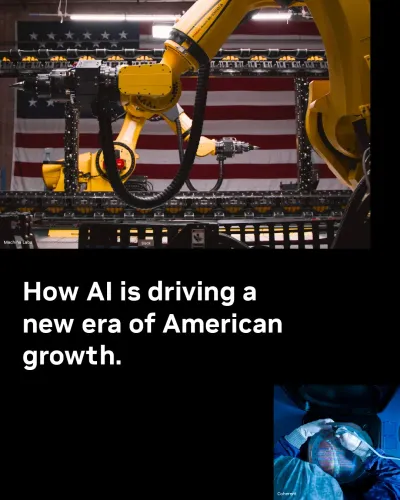
Nvidia Says US Chip Buildout Is About Enabling AI Science

Synopsis
Nvidia on 1 July 2026 reframed the US domestic chip and systems buildout as a platform for AI-driven scientific progress — including medicine discovery and weather forecasting — going beyond the conventional supply-chain and economic rationale for semiconductor onshoring.
Key Takeaways
Nvidia posted on 1 July 2026 that the US chip buildout's purpose extends 'far beyond the chips and systems being produced.' The company highlighted three AI applications: discovering medicines, forecasting weather, and solving previously intractable problems.
The post was framed as a reply, suggesting Nvidia was responding to a narrower characterisation of the buildout's goals.
The CHIPS and Science Act of 2022 authorised approximately $52 billion in US semiconductor manufacturing subsidies and research incentives.
Nvidia's GPUs power the majority of large-scale AI workloads globally, giving the company a direct stake in how the buildout's purpose is publicly defined.
Congressional follow-through on CHIPS Act funding and new executive AI infrastructure actions remain key variables to watch.
Chip giant Nvidia on Wednesday, 1 July 2026 pushed back on a narrow reading of America's semiconductor manufacturing expansion, arguing that the real purpose of the domestic buildout goes well beyond hardware production — and into the transformative scientific applications that AI infrastructure makes possible.
In a reply posted on X, Nvidia stated: 'But the purpose of this buildout extends far beyond the chips and systems being produced in the U.S. It's to accelerate what those chips and systems make possible. AI can help scientists discover medicines, forecast weather, and solve problems once beyond reach.'
Context
Nvidia's post arrives as the United States continues to ramp up domestic semiconductor capacity, driven in large part by the CHIPS and Science Act of 2022, which authorised approximately $52 billion in federal subsidies and incentives for onshore chip manufacturing and related research. The legislation was designed to reduce American dependence on overseas supply chains, particularly for advanced semiconductors.
Nvidia, as the dominant designer of GPUs and AI infrastructure systems, occupies a central position in this ecosystem. Its hardware underpins the majority of large-scale machine-learning workloads globally, making its framing of the buildout's purpose especially significant.
Policy Backdrop
The CHIPS and Science Act marked a decisive pivot in US industrial policy toward semiconductor self-sufficiency. Congressional appropriations under the act have been directed at both manufacturing facilities and the scientific research ecosystem that depends on advanced compute.
Parallel executive-branch efforts have promoted AI deployment across scientific domains — including drug discovery, climate modelling, and materials science — aligning closely with the vision Nvidia articulated in its post. Corporate statements from hardware leaders have increasingly framed manufacturing expansions not merely as economic or security imperatives, but as enablers of downstream scientific breakthroughs.
Stakeholders and Impact
US semiconductor firms, AI researchers, and pharmaceutical companies are among the primary stakeholders watching this buildout. For drug developers, greater domestic AI compute capacity could compress timelines for identifying and validating new medicines. For climate scientists, expanded GPU infrastructure supports higher-resolution weather forecasting models.
Nvidia's framing is also significant for the broader policy debate: by tying chip manufacturing to scientific outcomes, the company makes a case for sustained public investment that resonates across party lines — from defence hawks focused on supply-chain security to progressives interested in healthcare and climate applications.
What's Next
Attention will now turn to whether Congressional appropriations keep pace with the ambitions of the CHIPS Act, and whether any new executive actions on AI infrastructure reinforce or redirect the current trajectory. The degree to which the scientific applications Nvidia describes — medicines, weather forecasting, previously unsolvable problems — materialise will serve as the long-term measure of the buildout's success.
If domestic AI infrastructure scales as proponents envision, the United States could establish a durable lead in AI-driven scientific research, with implications that extend well beyond the semiconductor industry itself.
Point of View
Predicting storms — the company shifts the conversation from geopolitical supply-chain anxiety to human-progress optimism, a far more durable political coalition. This matters because CHIPS Act funding faces ongoing Congressional scrutiny, and hardware companies benefit from broadening the perceived constituency for continued public investment. The post also signals that Nvidia sees its role not merely as a chip supplier but as the infrastructure layer beneath a coming wave of AI-driven scientific discovery — a positioning that carries significant commercial implications as governments worldwide decide where to direct AI research spending.
NationPress
30 Sept 2026
Frequently Asked Questions
What did Nvidia say about the US chip buildout on 1 July 2026?
Nvidia stated that the purpose of the US chip and systems buildout 'extends far beyond' hardware production, arguing it is meant to accelerate AI applications such as discovering medicines, forecasting weather, and solving problems once considered beyond reach.
What is the CHIPS and Science Act?
The CHIPS and Science Act is a 2022 US law that authorised approximately $52 billion in federal subsidies and incentives to boost domestic semiconductor manufacturing and scientific research, aiming to reduce American dependence on overseas chip supply chains.
How does Nvidia's hardware relate to AI scientific research?
Nvidia designs the GPUs that power the vast majority of large-scale AI and machine-learning workloads globally. Expanding domestic production of these chips directly increases the compute capacity available for AI-driven scientific applications like drug discovery and climate modelling.
Which industries benefit from the US AI chip buildout Nvidia described?
Pharmaceutical companies, climate and weather scientists, and AI researchers are among the primary beneficiaries. Greater domestic GPU capacity can compress drug development timelines and enable higher-resolution weather forecasting models.
What should India watch regarding the US semiconductor and AI push?
India, which is developing its own semiconductor and AI infrastructure ambitions, should monitor US CHIPS Act funding follow-through and any new executive actions on AI infrastructure, as they will shape global compute availability, pricing, and the competitive landscape for AI-driven scientific research.